
Nepal's UNESCO World Heritage Sites: Entry Fees, Best Times & Travel Guide 2026
Hidden Hymn
Author
Hidden Hymn writes for Hidden Hymn — long-form stories from the world's quietest corners.
July 31, 2026 · 23 min read
What does "UNESCO World Heritage" status actually mean?
UNESCO reserves the designation for places of Outstanding Universal Value: cultural or natural significance so exceptional that it is judged to belong not to a single nation, but to all of humanity. A listing brings global recognition, formal monitoring, and access to conservation support. It is less a trophy than a covenant - a promise that a place will be safeguarded for generations not yet born to walk it.
Every inscribed place falls into one of three categories. Cultural sites honor human achievement - temples, cities, monuments. Natural sites protect the planet's own work - reefs, forests, mountains. Mixed sites, the rarest of all, carry both at once. In the Global context, the World Heritage List holds 1,248 properties across 170 countries - 972 cultural, 235 natural, 41 mixed (as of July 2025).
Nepal at a glance:
Landlocked between China (Tibet) to the north and India to the south, east and west, Nepal covers just 147,516 km² - smaller than the US state of Florida - yet holds extraordinary diversity. Its 2021 census recorded 142 caste and ethnic groups and 124 languages, with Nepali the mother tongue of about 45% of people. The country runs on its own official calendar, Bikram Sambat, roughly 56–57 years ahead of the Gregorian, and its communities celebrate several new years - Nepali, Newar, Tibetan and Tharu among them.
List of Nepal's 10 UNESCO World Heritage Sites
Nepal's heritage is famously counted as ten sites, though UNESCO formally lists only four inscriptions. The reason is the Kathmandu Valley: it is one cultural inscription made up of seven monument zones. Add Lumbini, Chitwan and Sagarmatha, and you reach the familiar ten.
Site | Location | Built / Founded | Listed | Altitude | Signature Highlight & Major Festival |
Kathmandu Durbar Square | Kathmandu (Basantapur) | Malla era, 12th–18th c. | 1979 | ~1,400 m | Kumari Ghar & Hanuman Dhoka palace Indra Jatra |
Patan Durbar Square | Lalitpur (Patan) | Malla era, 16th–17th c. | 1979 | ~1,350 m | Krishna Mandir stone shikhara Rato Machhindranath Jatra |
Bhaktapur Durbar Square | Bhaktapur | Malla era, from 15th c. | 1979 | ~1,400 m | 55-Window Palace & Nyatapola Temple Bisket Jatra |
Swayambhunath | Kathmandu (west hill) | Stupa c. 5th c. | 1979 | ~1,400 m | Self-arisen stupa, Buddha eyes, monkeys Buddha Jayanti |
Bouddhanath | Kathmandu (northeast) | c. 5th–6th c. | 1979 | ~1,400 m | Largest stupa, kora & monasteries Losar |
Pashupatinath | Kathmandu (Bagmati bank) | Pagoda 15th–17th c.; origins c. 5th c. | 1979 | ~1,400 m | Holiest Shiva shrine, ghats & evening aarti Maha Shivaratri |
Changu Narayan | Bhaktapur district (hilltop) | c. 4th–5th c. (464 CE inscription) | 1979 | ~1,540 m | Oldest temple, 5th-century stone art Changu Narayan Jatra |
Lumbini | Rupandehi (Terai) | Buddha's birth 623 BCE; Ashoka Pillar 249 BCE | 1997 | ~150 m | Mayadevi Temple, Ashoka Pillar, Sacred Garden Buddha Jayanti |
Chitwan National Park | Chitwan (Inner Terai) | Established 1973 | 1984 | ~110–815 m | One-horned rhino, Bengal tiger, jungle safari Chath Festival |
Sagarmatha National Park | Solukhumbu | Established 1976 | 1979 | 2,845–8,849 m | Everest, Tengboche, Sherpa culture Mani Rimdu Festival |
1. Kathmandu / Basantapur Durbar Square
Also called Hanuman Dhoka or Basantapur, this was the royal seat of the Malla and Shah kings, built and expanded between the 12th and 18th centuries on Licchavi-era foundations. It remains a living plaza where coronations once took place and daily worship still does.
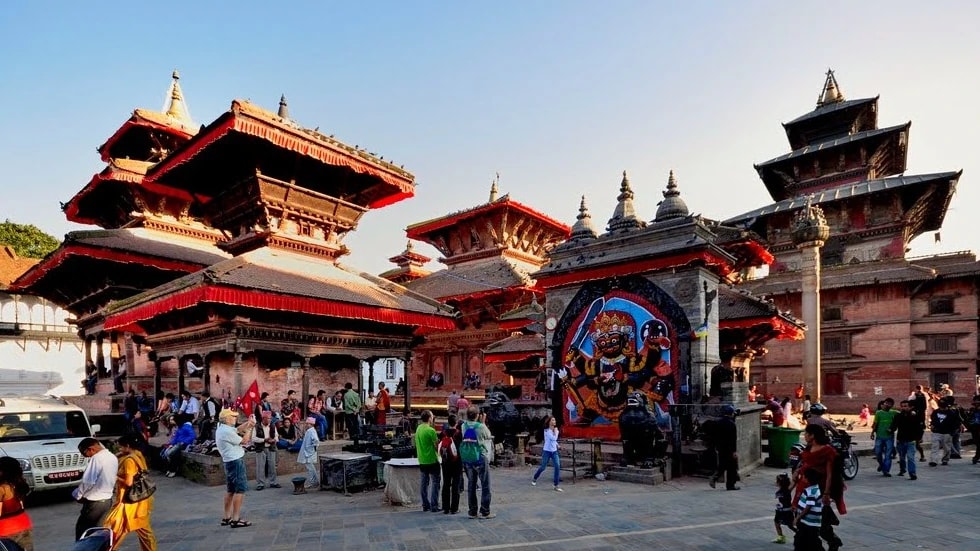
Must-see highlights:
Landmark | What it is |
Hanuman Dhoka Palace | The old royal palace complex. Named after the Hanuman statue installed by King Pratap Malla in 1672 to guard the gate; its courtyards hosted coronations and remain the square's ceremonial core. |
Kumari Ghar | A 1757 Newar residence of the Living Goddess, a young girl revered as an incarnation of Taleju/Durga. Its carved wooden windows are masterworks. |
Kasthamandap | A pavilion said to date to the 12th century, carved from a single sal tree - the structure that gave Kathmandu its name (rebuilt after 2015). |
Taleju Temple | The tallest temple here, raised by King Mahendra Malla in 1564 for the royal goddess Taleju Bhawani. Opens to the public just once a year at Dashain. |
Kal Bhairav | A large 17th-century stone image of Shiva in fierce form, once used for oath-taking - lying before it was believed to bring instant death. |
Freak Street (Jhochhen) | The legendary 1960s–70s hippie-trail hangout just south of the square - cheap cafés and lodges, still atmospheric today. |
Palace museums | The Tribhuvan and King Mahendra Memorial museums inside Hanuman Dhoka, tracing Nepal's monarchy. |
Things to do:
• Visit the palace museums - the Tribhuvan and King Mahendra Memorial museums.
• See the Kumari at her carved window (photographing her is not allowed).
• Roam the old bazaars - busy Asan and Indra Chowk, Kathmandu's trading heart.
• Time it for Indra Jatra (Sept) - masked dances and the Kumari's chariot procession.
How to get there:
A ~20-minute walk south from Thamel, or a short taxi ride; local buses from Ratna Park stop nearby.
Planning Your Visit
Best time & hours:
Open daily; arrive 7–9 am for quiet lanes and soft light. Autumn/spring ideal. Allow 2–3 hours.
Entry ticket:
Visitor | Fee (NPR) |
Foreign nationals | 1,000–1,500 |
SAARC nationals | 500–750 |
Nepali citizens | Free / nominal (50) |
*The ticket is the only permit needed. Fee revised recently and varies by source (2026); includes the palace museums.
*
Stay & Eat:
Thamel (5–10 min) for all budgets; rooftop cafés overlooking Basantapur; Newari eateries in the old town.
Things to Make Sure:
• Dress modestly and remove shoes before entering temples.
• No photos of the Kumari.
• Buy tickets only at official booths - touts outside are not official.
• Ask for the free multi-day extension at the site office (bring your passport).
2. Patan Durbar Square
Patan, or Lalitpur - “City of Arts”, is the valley's center of arts and crafts, about 5 km south of Kathmandu across the Bagmati. Its Durbar Square - shaped by the Malla kings in the 16th–17th centuries on far older foundations - is the densest showcase of Newar stone, wood and metalwork around the old royal palace.
Must-see highlights:
Landmark | What it is |
Krishna Mandir | A stone shikhara-style temple built in 1637 by King Siddhi Narsingh Malla, crowned with 21 gilded pinnacles. Its carved friezes narrate the Mahabharata and Ramayana - the square's masterpiece and a rare all-stone temple. |
Hiranya Varna Mahavihar (Golden Temple) | A 12th-century Buddhist monastery faced in gilded copper, still an active vihara. Its shimmering courtyard and daily worship make it Patan's spiritual heart. |
Patan Museum | Set in the restored Keshav Narayan Chowk palace wing (opened 1997), rated among South Asia's finest museums, displaying sacred bronze and gilt-copper art. |
Sundari Chowk & Tusha Hiti | A palace courtyard built around the ornate 17th-century royal sunken bath, ringed by stone and metal deities - Malla craftsmanship at its peak. |
Mahabuddha & Kumbeshwar | The terracotta “Temple of a Thousand Buddhas” and the five-storey Kumbeshwar (1392), one of only two five-tier temples in the valley. |
**
Things to do:**
• Tour the Patan Museum - allow an hour for its bronze and gilt-copper collection.
• Watch the craftsmen - Patan is Nepal's capital of metal- and stone-work.
• See morning worship at the Golden Temple.
• Shop for singing bowls, statues and jewellery around the square.
• Time it for Rato Machhindranath Jatra (Apr–May), the valley's longest chariot festival.
How to get there:
~5 km / 20–30 min by taxi from Thamel; microbuses from Ratna Park or Lagankhel.
Planning Your Visit
Best time & hours:
Open daily; mornings calm and best-lit. Autumn/spring ideal. Allow 2–3 hours.
Entry ticket:
Visitor | Fee (NPR) |
Foreign nationals | 1,000 (some sources 1,500) |
SAARC nationals | 250–500 |
Nepali citizens | Free |
*Includes the Patan Museum. Confirm the current price at the booth (2026).
*
Stay & Eat:
Boutique heritage hotels in Patan; rooftop cafés on the square; Newari restaurants in the backstreets.
Things to Make Sure:
• Remove shoes at temples.
• The Golden Temple has a small separate fee.
• Hire a licensed guide at the square to decode the temples.
3. Bhaktapur Durbar Square
Bhaktapur, or Khwopa - “city of devotees”, is the valley's best-preserved medieval city, 13 km east of Kathmandu. Its Durbar Square - heart of a Malla kingdom until the 18th century - is a largely traffic-free open-air museum of palaces, pagodas and pottery.
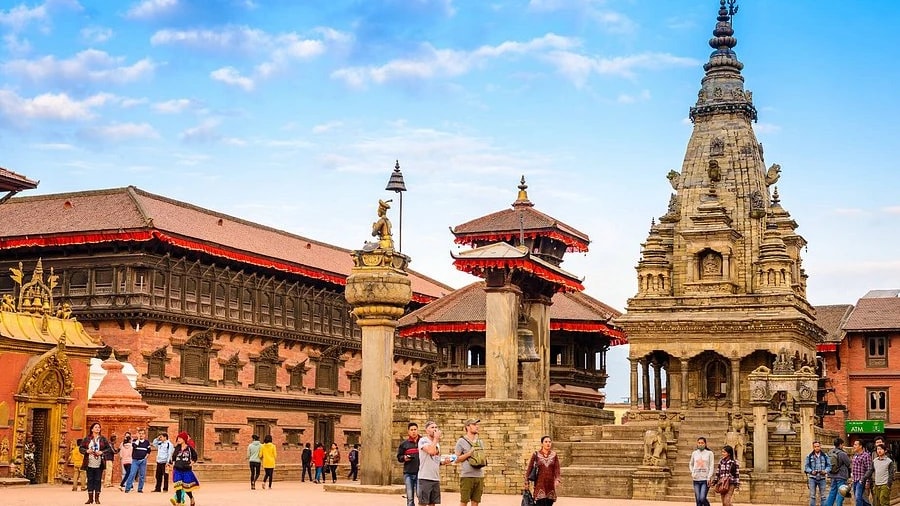
Must-see highlights:
Landmark | What it is |
55-Window Palace | The royal palace, its brick façade set with 55 carved wooden windows, was completed under King Bhupatindra Malla in the early 18th century. A pinnacle of Newar woodcarving. |
Golden Gate (Sun Dhoka) | A gilded copper gateway of 1754 opened into the palace's Taleju courtyard. Densely embossed with deities, regarded as the finest gate of its kind in the country. |
Nyatapola Temple | Nepal's tallest pagoda (~33 m), built in 1702 by King Bhupatindra Malla for the goddess Siddhi Lakshmi. Five plinths guarded by paired figures, each said to be ten times stronger than the last. |
Bhairavnath Temple | A three-storey pagoda in Taumadhi Square dedicated to Bhairava, Shiva's fierce form; raised to its present height in 1718 and central to Bisket Jatra. |
Dattatreya Temple & Peacock Window | A 1427 temple said to be built from a single tree, in the oldest square; nearby hangs the exquisitely carved 15th-century Peacock Window. |
Pottery Square | An open working yard where potters still shape and sun-dry clay by hand - a living craft tradition centuries old. |
Things to do:
• Climb Nyatapola's steps for the best view over the square.
• Watch potters at work in Pottery Square and buy a handmade piece.
• Taste Juju Dhau, Bhaktapur's famous “king of yoghurts.”
• Find the Peacock Window and wander the Dattatreya woodcarving lanes.
• Time it for Bisket Jatra (Nepali New Year, mid-April) - chariot pulls and pole-raising.
How to get there:
~13 km / 45–60 min from Kathmandu by taxi; buses from Ratna Park or Bhaktapur Bus Park.
Planning Your Visit
Best time & hours:
Open daily; mornings best. The ticket lets you re-enter for up to 7 days. Allow half a day.
Entry ticket:
Visitor | Fee (NPR) |
Foreign nationals | 1,800 |
SAARC nationals | 500 |
Nepali citizens | Free |
*Covers the whole old city (Durbar, Taumadhi, Pottery, Dattatreya squares).
*
Stay & Eat:
Heritage guesthouses inside the old city (ideal for quiet early mornings); rooftop cafés; try Juju Dhau and Newari bara and chhoyla.
Things to Make Sure:
• Keep your ticket - inspections are common.
• The square is traffic-free - explore on foot.
• Guides are available at the gates.
4. Swayambhunath Stupa
Swayambhunath, the hilltop Stupa - west of Kathmandu, is among Nepal's oldest and holiest Buddhist shrines. Its great stupa dates to around the 5th century; legend says the valley was once a lake and the hill rose “self-arisen” (swayambhu). Sacred to Buddhists and Hindus alike, it crowns the city with the Buddha's watching eyes.
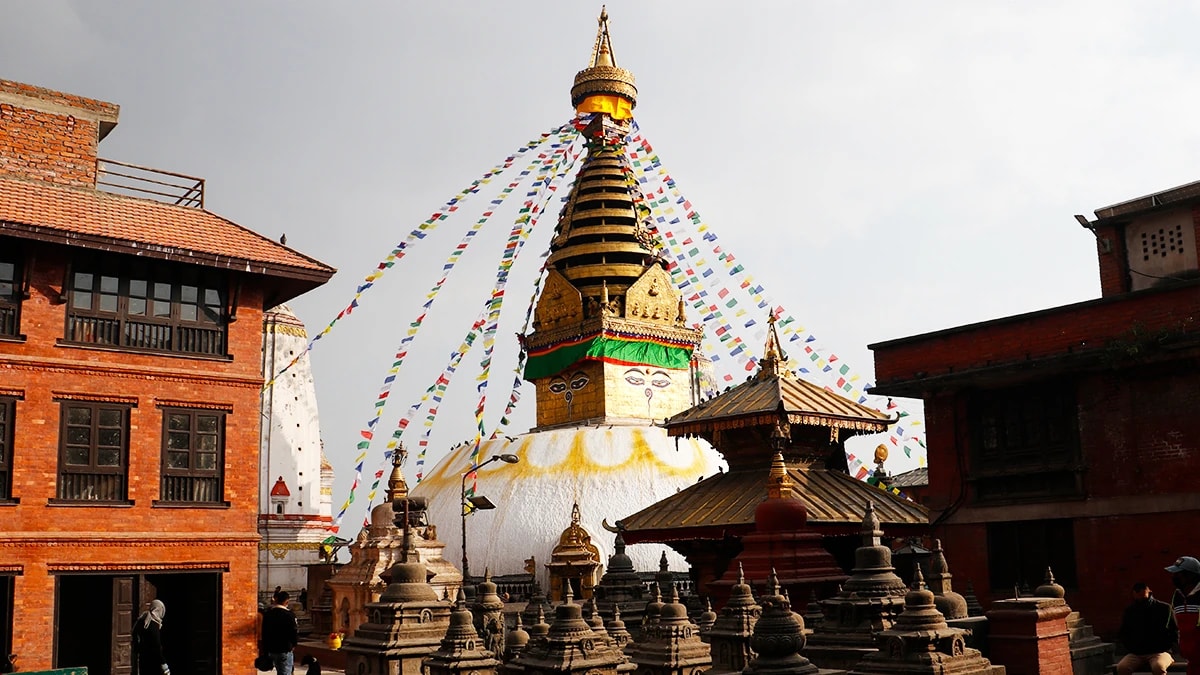
Must-see highlights:
Landmark | What it is |
The Great Stupa | A whitewashed dome topped by a gilded spire, dated to c. 5th century. Its 13 tiers mark the stages to enlightenment; the painted eyes gaze in all four directions. |
Buddha Eyes | Between the eyes sits the Nepali numeral ek (one), symbolising unity and the single path to enlightenment - the stupa's most recognisable feature. |
The 365 Steps | A steep stone stairway climbs the east face, lined with chaityas and statues, ending at a giant golden vajra (thunderbolt) at the summit. |
Harati (Ajima) Temple | A shrine to the goddess of protection from disease, showing the site's blend of Buddhist and older folk worship - still busy with local devotees. |
Shrines & monasteries | A Saraswati/Manjushri shrine to learn, the large images of the Buddha Park at the base, and active monasteries ringing the hill. |
**
Things to do:**
• Climb the 365 steps - or drive to the rear car park for an easier approach.
• Spin the prayer wheels and walk clockwise (kora) around the stupa.
• Come at sunrise or sunset for the valley panorama and soft light.
• Visit the Buddha Park statues at the hill's base.
How to get there:
~3 km / 15 min by taxi west of Thamel; climb the 365 steps from the east, or drive to the southwest car park.
Planning Your Visit
Best time & hours:
Open daily; sunrise and sunset are magical. Allow 1–2 hours.
Entry ticket:
Visitor | Fee (NPR) |
Foreign nationals | 200 |
SAARC nationals | 50 |
Nepali citizens | Free |
Confirm on site - a few operators quote higher.
Stay & Eat:
Stay in Thamel nearby; small cafés at the base and on the hilltop with valley views.
Things to Make Sure:
• Secure bags and food from the monkeys.
• Steps are steep - wear good shoes.
• Walk clockwise around the stupa.
5. Bouddhanath Stupa
Bouddhanath, northeast of Kathmandu, is one of the largest stupas in the world and the centre of Tibetan Buddhism in Nepal. Dating to around the 5th–6th century and long a landmark on the old Tibet trade route, its great white dome and golden spire - ringed by monasteries and prayer flags.
Must-see highlights:
Landmark | What it is |
The Great Stupa | One of the world's largest stupas (~36 m), raised c. 5th–6th century on the Tibet–Kathmandu trade route. Its mandala plan - dome on three terraces beneath 13 gilded tiers - maps the path to enlightenment. |
Buddha Eyes & 108 niches | The all-seeing eyes gaze from the golden tower; 108 small niches of Amitabha Buddha ring the base - 108 being a sacred number in Buddhism. |
The Kora | The wide pilgrim circuit walked clockwise around the stupa while spinning prayer wheels - the living daily ritual, busiest at dawn and dusk. |
Surrounding monasteries | Some 50 Tibetan gompas ring the stupa, many open to visitors, their prayers carried on horns, drums and chanting. |
“Little Tibet” | The quarter was settled by Tibetan refugees after 1959 - full of thangka studios, craft shops and rooftop cafés overlooking the dome. |
**
Things to do:**
• Walk the kora clockwise with the pilgrims, spinning prayer wheels.
• Sit in on monastery prayers (horns, drums, chanting) morning or evening.
• Watch sunset from a rooftop café over the stupa.
• Shop for thangkas, singing bowls and Tibetan crafts.
• Time it for Losar (Feb–Mar), Tibetan New Year, for masked dances.
How to get there:
~6 km / 20–30 min by taxi northeast of Thamel.
Planning Your Visit
Best time & hours:
Open daily; dawn and dusk best for the kora. Allow 1–2 hours.
Entry ticket:
Visitor | Fee (NPR) |
Foreign nationals | 400 |
SAARC nationals | 100 |
Nepali citizens | Free |
**
Stay & Eat:**
Guesthouses and boutique hotels in the Boudha quarter (great for early kora); rooftop cafés round the stupa.
Things to Make Sure:
• Walk clockwise around the stupa.
• Dress modestly and remove shoes inside gompas.
6. Pashupatinath Temple
Pashupatinath, on the banks of the Bagmati in eastern Kathmandu, is Nepal's holiest Hindu temple and one of Asia's most important Shiva shrines. Its gold-roofed pagoda - origins around the 5th century, rebuilt in present form by the 17th - presides over cremation ghats where the rituals of life and death unfold daily.
Must-see highlights:
Landmark | What it is |
The Main Temple | A gilded, silver-doored pagoda enshrining the four-faced Pashupati lingam (Shiva as Lord of Animals). Origins reach the 5th century; the present structure is 15th–17th. Only Hindus may enter the inner sanctum. |
Bagmati Ghats (Arya Ghat) | Riverside stone platforms where open-air Hindu cremations take place - a public expression of the Hindu view of death and rebirth. Viewed respectfully from the far bank. |
Evening Aarti | A nightly fire-and-lamp ritual on the Bagmati's banks, with bells and chanting - one of Kathmandu's most moving spectacles, open to all. |
Nandi & the complex | A large statue of Nandi, Shiva's bull, faces the temple; the wider complex holds some 518 shrines, lingams and ashrams across both riverbanks. |
Sadhus | Ash-smeared, saffron-robed ascetic holy men gather here - especially at Shivaratri - living symbols of Hindu renunciation. |
**
Things to do:**
• View the temple and ghats from the eastern (far) bank - respectfully, no intrusive photos.
• Attend the evening Bagmati aarti around dusk.
• Walk the hilltop shrines and terraces for the wider complex.
• Time it for Maha Shivaratri (Feb–Mar) - hundreds of thousands of pilgrims and sadhus.
How to get there:
~5 km / 15–20 min by taxi east of Thamel, near the airport.
Planning Your Visit
Best time & hours:
Open ~4 am–9 pm; evenings for the aarti, mornings for calm. Allow 1–2 hours.
Entry ticket:
Visitor | Fee (NPR) |
Foreign nationals | 1,000 |
Indian & Nepali citizens | Free |
Non-Hindus may tour the complex but not the inner temple.
Stay & Eat:
Central Kathmandu or nearby Boudha; simple eateries around the complex.
Things to Make Sure:
• Be respectful at cremations - no intrusive photography.
• Non-Hindus view the main temple from across the river.
• Beware unofficial “guides” at the gates.
7. Changu Narayan Temple
Changu Narayan, on a hilltop east of the valley in Bhaktapur district, is considered the oldest temple in Nepal. Dedicated to Vishnu and dated to around the 4th–5th century - with a stone inscription from 464 CE, the country's oldest - it is a treasury of early Nepali stone art in a quiet Newar village.
Must-see highlights:
Landmark | What it is |
The Main Temple | A two-storey pagoda to Vishnu (Narayan) with a gilded roof and finial, rebuilt in 1702 after fire on far older foundations. Its struts and doorways are masterpieces of Newar woodcarving. |
The 464 CE Inscription | A stone pillar bearing Nepal's oldest known inscription, recording a Licchavi king - the basis of the temple's claim to be the country's oldest. |
Ancient Stone Sculptures | 5th–12th-century masterpieces around the courtyard - the ten-headed Vishvarupa, Vishnu Vikranta (Trivikrama) and Narasimha among them - an open-air gallery of early Hindu art. |
Garuda Statue | A kneeling figure of Vishnu's eagle mount, said to date to the 5th century, facing the temple - one of its most photographed images. |
Changu Village & Museum | A traditional Newar hilltop settlement with a small Living Traditions Museum, plus sweeping views over the valley and the Manohara river. |
Things to do:
• Study the ancient stone sculptures - an open-air art-history lesson.
• Wander the Newar village of Changu.
• Visit the Folk/Living Traditions Museum.
• Combine with a hike or drive from Nagarkot for valley views.
How to get there:
~22 km / ~1 hr by taxi east of Kathmandu, or ~6 km from Bhaktapur; also a short downhill hike from Nagarkot.
Planning Your Visit
Best time & hours:
Open daily; mornings quiet. Allow 1–2 hours. Often paired with Bhaktapur or Nagarkot.
Entry ticket:
Visitor | Fee (NPR) |
Foreign nationals | ~300 |
SAARC nationals | 100 |
Nepali citizens | Free |
*Confirm on site (2026).
*
Stay & Eat:
Day trip from Kathmandu/Bhaktapur; small cafés in the village; Nagarkot for hilltop stays.
Things to Make Sure:
• Remove shoes at the temple.
• A guide helps decode the sculptures.
8. Lumbini
Lumbini, in the Terai plains of southwest Nepal, is the birthplace of the Buddha and a UNESCO cultural site of global pilgrimage. At its heart, the Sacred Garden holds the Mayadevi Temple, the Ashoka Pillar and the pond of his birth; around it stand monasteries built by nations worldwide.
Must-see highlights:
Landmark | What it is |
Mayadevi Temple | The shrine marks the exact spot of the Buddha's birth (traditionally 623 BCE), sheltering an ancient marker stone and the Nativity sculpture - the spiritual centre of the site. |
Ashoka Pillar | A sandstone column erected by Emperor Ashoka in 249 BCE, its inscription naming Lumbini as the Buddha's birthplace - the earliest evidence and the basis of its authenticity. |
Puskarini (Sacred Pond) | The pond where Queen Mayadevi is said to have bathed before the birth, and the infant given his first bath - beside the temple and pillar. |
The Monastic Zone | A vast planned precinct (designed by architect Kenzo Tange) where dozens of countries have built monasteries - Thai, Myanmar, Chinese, German and more - each in its own style. |
World Peace Pagoda & Eternal Flame | A gleaming white stupa on the site's edge and a flame lit in 1986 for world peace - the enduring symbols of Lumbini's message. |
**
Things to do:**
• Visit the Sacred Garden - Mayadevi Temple, marker stone and Ashoka Pillar.
• Cycle or take an e-rickshaw around the monastic zone.
• See the World Peace Pagoda and the eternal flame.
• Visit the Lumbini Museum and, with time, Tilaurakot (ancient Kapilvastu) nearby.
• Meditate in the gardens - the whole site is built for reflection.
How to get there:
Fly Kathmandu → Bhairahawa (Gautam Buddha Int'l Airport), then ~30 min by road; or ~8–9 hr overland.
Planning Your Visit
Best time & hours:
Oct–Mar (cooler); the Terai is very hot Apr–Jun. Allow a full day.
Entry ticket:
Visitor | Fee (NPR) |
Foreign nationals | 500 |
SAARC nationals | 100–400 |
Indian & Nepali | Nominal (~80) |
*Fee covers the Sacred Garden / Mayadevi Temple; the wider monastic zone is free to roam. E-tickets via the Lumbini Development Trust site.
*
Stay & Eat:
Monastery guesthouses, mid-range hotels, a few resorts; simple vegetarian eateries.
Things to Make Sure:
• Remove shoes in the Mayadevi Garden.
• Distances are large - hire a bike or e-rickshaw.
• Dress modestly.
9. Chitwan National Park
Chitwan, in the Inner Terai lowlands of south-central Nepal, was the country's first national park (1973) and its first natural UNESCO site (1984). Across ~953 sq km of sal forest, grassland and riverine jungle, it shelters the one-horned rhino and Bengal tiger - the finest wildlife destination in the Himalaya's shadow.
Must-see highlights:
Landmark | What it is |
One-horned Rhinoceros | Chitwan's flagship species - one of the world's best places to see the greater one-horned rhino in the wild, often grazing the floodplain grasslands. |
Royal Bengal Tiger | The park holds a significant tiger population; sightings are rare and thrilling, most often on jeep safaris in the core grasslands. |
Rivers & Gharial | The Rapti and Narayani rivers, home to the fish-eating gharial and mugger crocodiles - best seen on a dugout-canoe trip. |
Sal Forest & Grasslands | A mosaic of sal woodland, tall elephant grass, riverine forest and wetland - habitat for 700+ animal and 540+ bird species. |
Tharu Culture | The indigenous Tharu of the Terai, whose villages, stick dances and cuisine are part of the Chitwan experience. |
**
Things to do:**
• Jeep safari into the core zone for rhino, deer and - if lucky - tiger.
• Dugout-canoe trip on the Rapti for crocodiles and birds.
• Guided jungle walk with a naturalist.
• Visit the Elephant Breeding Centre and go birdwatching at dawn.
• Watch a Tharu stick dance in Sauraha.
**
How to get there:**
~150 km from Kathmandu - ~5–6 hr by road, or ~25 min flight to Bharatpur then ~30 min to Sauraha.
Planning Your Visit
Best time & hours:
Oct–Mar (dry, best viewing); very hot Apr–Jun; monsoon Jul–Sep. Plan 2–3 days.
Entry ticket:
Visitor | Fee (NPR) |
Foreign nationals | 2,000 (+VAT) |
SAARC nationals | 1,000 |
Nepali citizens | 150 |
Per entry; under-10s free. Usually arranged through your lodge; buy at the Sauraha entrance.
**
Stay & Eat:**
Jungle lodges and safari resorts in and around Sauraha, budget to luxury.
Things to Make Sure:
• Wear neutral colours.
• Follow your guide's safety briefing.
• Safaris book out in peak season - reserve ahead.
10. Sagarmatha National Park
Sagarmatha National Park, in the Everest region of Solukhumbu, protects the highest landscape on Earth - established in 1976 and Nepal's first natural UNESCO site (1979). Across 1,148 sq km rising from 2,845 m to the 8,849 m summit of Everest, it fuses the world's tallest peaks with living Sherpa Buddhist culture.
Must-see highlights:
Landmark | What it is |
Mount Everest (Sagarmatha) | The world's highest peak at 8,848.86 m - Sagarmatha in Nepali, Chomolungma in Sherpa/Tibetan. The park's centrepiece and the goal of trekkers and climbers worldwide. |
The High Peaks | Lhotse, Nuptse, Cho Oyu, Ama Dablam and Pumori ring the park - some of the most dramatic mountain scenery on the planet. |
Namche Bazaar | The Sherpa “capital” and main trading and acclimatisation hub (~3,440 m) - a horseshoe of lodges and shops, gateway to the high Khumbu. |
Tengboche Monastery | The region's most important monastery (~3,867 m), set against Ama Dablam; home of the Mani Rimdu masked-dance festival. |
Gokyo Lakes & Khumbu Glacier | Turquoise high-altitude lakes and the vast Khumbu Glacier - quieter alternatives and complements to Everest Base Camp. |
**
Things to do:**
• Trek to Everest Base Camp and climb Kala Patthar (5,644 m) for the classic Everest view.
• Trek the Gokyo Lakes and Gokyo Ri as a quieter alternative.
• Visit Tengboche Monastery; time it for Mani Rimdu (Oct–Nov).
• Explore Namche Bazaar and acclimatise; watch for tahr and monal.
• Take a mountain flight or heli tour if short on time.
How to get there:
Fly Kathmandu (or Ramechhap in peak season) → Lukla, then trek; or the longer Jiri/Salleri road-and-walk approach.
Planning Your Visit
Best time & hours:
Mar–May and Oct–Nov are the trekking windows; avoid monsoon (Jun–Sep) and deep winter. The EBC trek is ~12–14 days.
Entry ticket:
Visitor | Fee (NPR) |
Foreign nationals | 3,000 |
SAARC nationals | 1,500 |
Nepali citizens | 25 |
*Plus the Khumbu Pasang Lhamu Rural Municipality permit (~NPR 2,000–3,000).
*
Stay & Eat:
Sherpa-run teahouses and lodges along the trail; dal bhat, Sherpa stew, bakeries in Namche.
Things to Make Sure:
• Acclimatise carefully to avoid altitude sickness.
• A licensed guide is now required for the trek.
• Carry cash - ATMs are few and none higher up.
Why Visit Nepal's UNESCO Sites?
Few places pack so much into so little ground. In one small country you can stand at the Buddha's birthplace, walk medieval royal cities, witness cremations by a holy river and trek beneath the highest peak on Earth - all UNESCO-listed, and all still living.
-
Living heritage, not ruins. These are working temples, stupas and jungles - daily worship, festivals and wildlife, not roped-off monuments.
-
Two faiths, one space. Hindu and Buddhist traditions share the same courtyards - a coexistence found almost nowhere else.
-
Unmatched variety. From the Terai jungle (110 m) to Everest (8,849 m), and 5th-century stone art to snow leopards - a huge range in a compact area.
-
World-class craftsmanship. Newar woodcarving, metalwork and temple architecture at the very peak of the art.
-
Compact and connected. Seven of the ten sites sit inside the Kathmandu Valley, most within ~20 km - easy to combine.
-
Deeply spiritual. Lumbini (Buddha's birthplace) and Pashupatinath (Nepal's holiest Shiva shrine) draw pilgrims worldwide.
-
Resilient and cared-for. Painstakingly rebuilt after the 2015 earthquake - a matter of national pride.
Nepal's UNESCO Tentative List - Future Sites Worth Visiting
Beyond the ten, Nepal has 15 sites on UNESCO's official Tentative List - properties proposed for future inscription. Many are already rewarding to visit and far quieter than the headline sites.
Site | Location | What it is | |
1 | Tilaurakot (Kapilvastu) | Kapilvastu | Ruins of the Shakya palace where the Buddha spent his first 29 years |
2 | Ramagrama Stupa | Nawalparasi | The only undisturbed original stupa still holding the Buddha's relics |
3 | Panauti | Kavre | Well-preserved medieval Newar town; Indreshwar Mahadev temple; home of yomari |
4 | Khokana | Lalitpur | Vernacular Newar village famed for traditional mustard-oil pressing |
5 | Cave Architecture, Muktinath Valley | Mustang | Thousands of ancient "sky-caves" carved into cliffs |
6 | Lo Manthang (walled city) | Upper Mustang | Walled former capital of the Lo kingdom; Tibetan Buddhist murals |
7 | Gorkha Palace Complex | Gorkha | Hilltop palace, birthplace of Prithvi Narayan Shah, unifier of Nepal |
8 | Nuwakot Palace Complex | Nuwakot | Seven-storey Malla-era palace and fort |
9 | Vajrayogini & Sankhu | Kathmandu | Ancient Newar settlement and hilltop tantric temple |
10 | Kirtipur | Kathmandu | Medieval hilltop Newar town with fine temples and valley views |
11 | Sinja Valley | Jumla | Cradle of the Nepali language; medieval Khasa kingdom capital |
12 | Ram Janaki Temple | Janakpur | Grand Mithila-style temple to Sita; major Hindu pilgrimage |
13 | Medieval Town of Tansen | Palpa | Hill bazaar town; Newar architecture; Ranighat palace nearby |
14 | Ruru Kshetra (Ridi) | Gulmi | Riverside Hindu temple complex on the Kali Gandaki |
15 | Bhurti Temple Complex | Dailekh | Cluster of medieval stone temples in far-western Nepal |
Easiest must-visit picks: Panauti, Kirtipur and Tilaurakot for a day trip; Lo Manthang for the adventurous.