
Pashupatinath: A Travel Guide to Nepal's Holiest Temple
Hidden Hymn
Author
Hidden Hymn writes for Hidden Hymn — long-form stories from the world's quietest corners.
September 15, 2026 · 15 min read
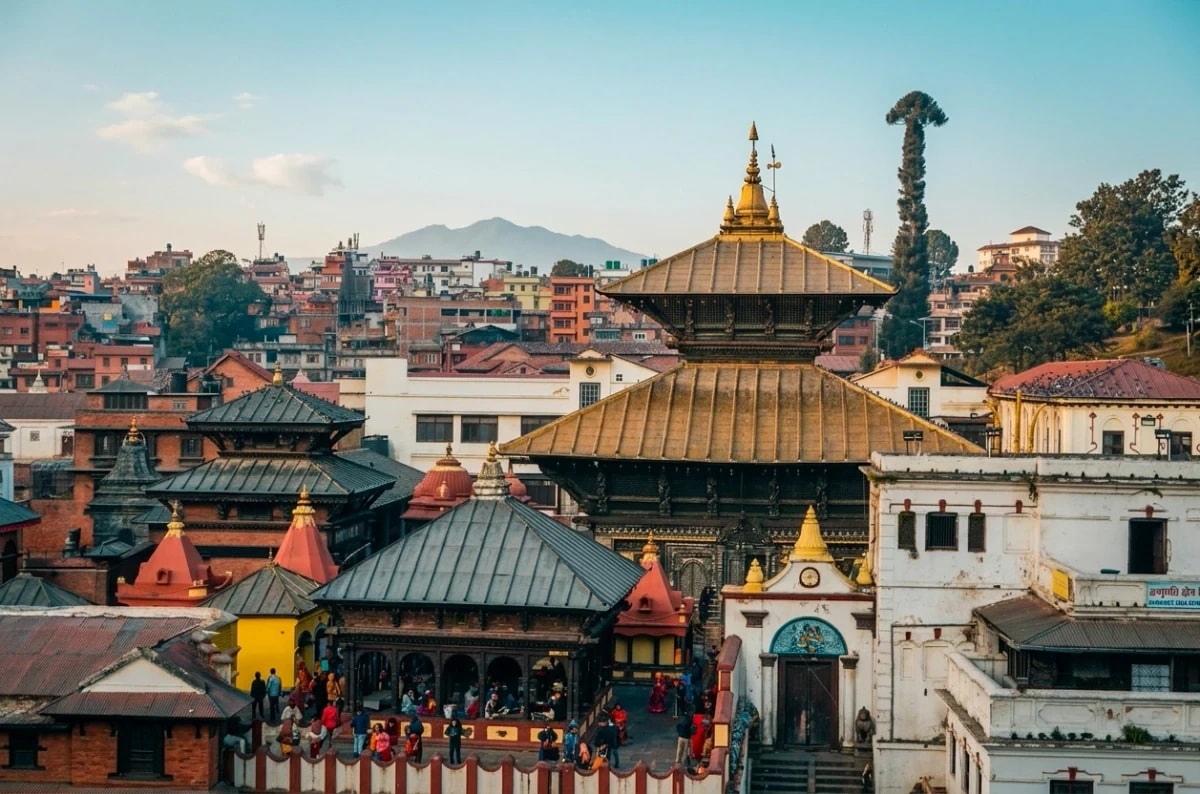
About Pashupatinath
Pashupatinath Temple about five kilometers northeast of central Kathmandu standing beside the sacred Bagmati River. It is the holiest site in Nepal, dedicated to Shiva in his form as Pashupati, the Lord of All Beings, and a UNESCO World Heritage Site since 1979. Rather than a single temple, it is a sprawling precinct of 246 hectares holding 518 subsidiary shrines gathered around the main pagoda at its center.
That central temple, built in the Nepali pagoda style, has a two-tiered roof sheathed in copper and gold, a gold pinnacle, and four silver-plated doors; inside the sanctum stands its most sacred object, a stone lingam (a stone pillar) carved with four faces (Chaturmukha).
Which god is worshipped at Pashupatinath?
The temple is dedicated to Shiva, one of the three principal deities of Hinduism, who forms the Trimurti (Trinity) with Brahma the creator and Vishnu the preserver. Within that trinity Shiva is the destroyer and transformer, the force that dissolves the universe so it can be renewed and he is revered as the supreme being in Shaivism-one of Hinduism's largest traditions.
What does the name "Pashupati" mean?
The name breaks into two Sanskrit words: pashu and pati. Pashu means "animal" and pati means "protector" so Pashupati literally means the Lord who protects animals. In its fuller sense, pashu extends to all living beings, making Pashupati the Lord & Protector of all creatures. In the temple's full name, Pashupatinath, a third element is added “nath” meaning Lord and the honorific Shree is often prefixed as a mark of devotion
Mythology of Pashupatinath
The origins of Pashupatinath are recorded not in dated history but in myth, and several distinct stories explain how the site became sacred to Shiva. The most prominent legend recited in Nepal is about the deer and the broken antler .
The deer and the broken antler
Shiva, wishing to escape his duties, roamed the forests along the Bagmati in the form of a deer. When the other gods found him and tried to bring him back, they seized him by the antler and it broke. In the telling most often attached to Pashupatinath, the antler shattered into pieces that became the faces of the linga, which is why the principal Shiva linga in the sanctum is four-faced (Chaturmukha). The broken fragment, left in the earth, became the self-arisen linga at the heart of the temple — the object still worshipped today.
There are different legends regarding Pasupati’s origin that differ in detail; however, they share a common claim that the linga worshipped here was not made by human hands.
What is the history of Pashupatinath ?
The history of Pashupatinath spans more than 1,500 years, from an indigenous shrine of the valley's earliest rulers to the pagoda standing today.
Early history
● The first temple (around 400 CE)
Chronicles credit the Licchavi king Prachanda Deva with the earliest temple, later expanded by Supuspa Deva into a five-storey shrine.
● The Jayadeva II inscription (732 CE)
A donative inscription in the temple courtyard — the last securely dated royal record of the Licchavi period — shows the site already established under royal patronage.
Medieval history:
● Ananta Malla (13th-14th century)
Added the temple's iconic gold plated pagoda roof.
● The Bengal raid (1349)
The Sultan Shamsuddin invaded the valley and, by tradition, burned the temple, broke the central linga, and looted its gold. It was rebuilt in the years after.
The present temple
After repeated destruction, the temple was given its current form under King Bhupalendra Malla of Kathmandu - a square, two-tiered pagoda about 23.6 meters tall, with gilt and silver-plated doors on all sides. This is the temple that stands today.
Pre-modern and modern history: the Shah dynasty to today
Unification
Prithvi Narayan Shah of Gorkha conquered the Kathmandu Valley and unified Nepal, bringing Pashupatinath under a single crown that would rule for nearly 240 years. During the dynasty's reign Pasupuaptinath was revered as a national & royal deity of the Kingdom of Nepal.
The 2015 earthquake
The 7.8-magnitude Gorkha quake left the main temple intact, though outer structures across the precinct were damaged. (add more)
A Self-Guided Walking Tour
Overview of Pasupatinath complex
Pashupatinath is not a temple. It is a sacred city with some five hundred shrines, ashrams, ghats and votive stones across both banks of the Bagmati and up a wooded hill. The gilded pagoda everyone photographs is the oldest and the most important architecture.
Most tours manage the exterior, twenty minutes at the ghats, and leave inside the hour. Give it three, and walk it as a loop; everything below is arranged the way you meet it.
One thing to know before you start: non-Hindus cannot enter the main courtyard, where the golden temple and the five-faced lingam stand. Everything else on this walk is open to you — and the best view of the temple is from the far bank anyway.
The approach and the western gate
You arrive through a bazaar lane, and the lane is part of the temple. Stalls stacked with marigold garlands, bilva leaves, vermilion, rudraksha strings, coconut, incense, small brass pots of milk of the Shiva worship, sold by the handful. Buy something even if you are only looking; it costs almost nothing and it changes how you walk in. Ahead, the great western gate opens onto the main courtyard.
The main temple of Pasupatinath
Nepali pagoda architecture at its most confident, and the model for a thousand smaller copies across the valley: a square, two-tiered structure rising about 24 metres, its roofs sheeted in gold over copper, its four cardinal doors plated in silver, its pinnacle gold-plated. The wooden struts under the eaves carry carved deities and guardian figures and some of them are engraved with erotic scenes which belong to an old and serious symbolic vocabulary about creation. The current form owes much to a 17th-century rebuilding, but the site has been in worship since at least the 5th century.
The five faces lingam - the main deity
Inside the sanctum stands the entire complex which shelters a metre-high black stone Mukhalinga, bound at its silver base by a silver serpent, dressed in a golden vastram (garment) except during the daily bathing ritual. It has four carved faces, one to each cardinal direction, and a fifth that is formless and faces the sky. Each visible face has two small protruding hands carrying a rudraksha mala in the right, a water vessel in the left.
Face | Direction | Element | What it governs |
Sadyojata (Barun) | West | Earth | Creation, birth, the material world |
Vamadeva(Uma Maheshwar) | North | Water | Preservation, healing, harmony |
Tatpurusha | East | Air | Consciousness, knowledge |
Aghora | South | Fire | Dissolution, destruction |
The Inner ScantrumIshana | Zenith (upward) | Ether | The formless; pure consciousness |
The Inner sanctum
Just inside the western entrance kneels an enormous gilded Nandi, Shiva's bull, facing the door he guards pilgrims pass to his right on the way in. Nearby stands Vasuki Nath, the serpent king: human from the waist up, an intricate knot of snake bodies below.
The courtyard holds a compressed pantheon and array of deities
-
Unmatta Bhairava - Shiva's "intoxicated" form, one of his eight fierce aspects. The ecstatic state in which restraint and ego dissolve.
-
Kirtimukha Bhairava - the Face of Glory: a demon so ravenous it devoured its own body down to the face. Shiva set it above doorways as a guardian.
-
Surya Narayan - the sun, fused with Vishnu. Light, heat, health, and the measure of the day.
-
Hanuman - son of Vayu, the wind god; his speed and his leaps are air made muscular. Strength in the service of devotion.
-
184 votive lingams - the aniconic Shiva, the formless given the least possible form. enshrined one at a time in the courtyard , across centuries.
Down to the river: Bachhareshwari and the ghats
Steps drop from the temple terrace to the Bagmati, and the cremation ghats spread along the western bank in two groups.
Arya Ghat
Immediately below the temple, and the most restricted ground on the riverbank. This is where Nepal's royal family was cremated, and where dignitaries still are. It also serves a function nowhere else can: the lustral water used in the daily bathing of the lingam may be drawn only from here .
Bhasmeshwar Ghat
Downstream, and the working heart of the site the busiest cremation ground in the Kathmandu Valley, open to all castes, in use through the day. A cremation takes roughly three hours from lighting to the ashes being swept into the river. The stone terraces directly opposite are where visitors are meant to sit and watch; do it from there, quietly, and not from the platforms themselves.
Bachhareshwari
Between the two ghat groups sits a small 6th-century temple most people walk straight past carved with tantric figures, skeletons and erotic scenes. It is the oldest visible structure on this stretch of bank and the least visited.
Panch Deval
A little south along the west bank, a five-domed courtyard complex that was built as shrines and now serves as a shelter for the destitute elderly. Many of its residents came to Pashupatinath deliberately, to die within sight of the temple. Walk through quietly, or walk past.
The terraces and the Pandra Shivalaya
Cross and climb the stone terraces on the east bank for the full view of the temple, the ghats and the river. Among them stand the Pandra Shivalaya fifteen identical stone shrines, built 1859–1869, each enshrining a lingam in memory of a named individual. Beyond them, the Ram Mandir, where sadhus gather.
Mrigasthali - the deer forest
The path drops through the Sleshmantak woods, where deer graze on the hillside — protected, fed, and part of the site rather than an attraction beside it. Mriga means deer, sthali means place. This is the forest where Shiva is said to have hidden as a golden antelope, and the herd has been kept here ever since .
Guhyeshwari and the northern edge
Guhyeshwari, a kilometre from Gorakhnath by road. A Shakti Peetha, marking where Sati's yoni fell. The shrine is sunk into the ground rather than raised: no spire, a low silver-roofed enclosure over a water pit. Closed to non-Hindus. Shiva at Pashupatinath, Shakti upstream pilgrims visit both.
Kirateshwar Mahadev - small riverside temple near Guhyeshwari, marking where Shiva appeared as a Kirata, a hill hunter. Classical music is performed here on full-moon nights.
Bankali - behind Mrigasthali. Burial ground for the Kirat, Rai and Limbu, who inter rather than cremate their dead.
Kailash Hill - rocky rise above Surya Ghat, named for Shiva's mountain. Sadhu caves beneath; widest view of the complex from the top.
Gauri Ghat - furthest north, named for Parvati. Women's bathing ghat, upstream of all cremations - purity flows downward, so washing sits above burning.
Visitor Rules & Guidelines
Pashupatinath is a working funeral ground and an active temple before it is a heritage site. Most of these rules exist because someone standing near you is having the worst day of their life.
Guideline | On the ground | Why |
Never photograph a cremation | No cameras or phones pointed at the pyres, the body, or the family — from any distance, including the far bank | This is the single most common offence at the site, and the one families notice |
Leave leather outside | Belts, wallets, bags and shoes are restricted at temple precincts; racks and lockers are provided at the gates | Animal products are ritually impure in a temple to the Lord of Animals |
Dress modestly | Shoulders, chest and knees covered, men and women both | Enforced at gates more strictly here than at most Kathmandu sites |
No photography in the inner temple | Banned inside the sanctum and during rituals; permitted across the outer complex | Non-negotiable, and posted |
Ask before photographing sadhus | Many will pose; most will then expect payment. Agree the amount first or don't raise the camera | The ones who make a living from photographs are not the ones in meditation |
Buy tickets only at official counters | Offical counters at the main gates. Ignore anyone selling "tickets" or "temple passes" near the river | Unofficial desks operate on the approach |
Walk clockwise | Circle shrines and lingams with your right shoulder inward | Standard parikrama; visitors going the wrong way are visible immediately |
Guard your belongings from the monkeys | Food out of sight, sunglasses and phones held, bags zipped | They take from open hands and unzipped bags |
Allow 2–3 hours | The site is roughly 250 hectares across two banks | An hour buys you the temple exterior and nothing else |
Entry Fees, Tickets & Opening Hours
Visitor category | Fee (NPR) | Notes |
Foreign nationals | 1,000 | Includes Chinese and non-Indian SAARC nationals |
Indian nationals | Free | |
Nepali citizens | Free | |
Children under 10 | Free | With an adult |
What is the Best Time to Visit ?
Time of day
Mangala aarti at around 5:00 am is the quietest and most concentrated hour - pilgrims, priests, almost no visitors. The inner gates then close through the afternoon, which makes midday the weakest window. The second peak is the Bagmati aarti from about 6:00 pm, watched from the eastern terraces with lamps, bells and chanting on the water.
Season
October to November is the strongest stretch: clear, dry, post-monsoon. March to May is the close second. Broadly, October through March is reliable.
Festivals at Pashupatinath
Beyond the daily morning worship and the evening Bagmati aarti, the temple keeps a full calendar of sacred time. These are the major festivals observed here.
Festival | When observed | Why it's celebrated | Interesting facts | Philosophy of the festival |
Maha Shivaratri | Feb-Mar; 14th of the waning moon (Krishna Paksha Chaturdashi), month of Phalgun | The "Great Night of Shiva" — the night held most sacred to Shiva across the year | The temple's largest gathering, from several hundred thousand to over a million; thousands of sadhus arrive from Nepal and India; an all-night vigil in four prahars | Wakefulness as devotion; the dissolution of ego in the darkest hour; the meeting of the ascetic and the householder |
Haritalika Teej | Aug-Sep (Bhadra Shukla Tritiya) | Women honor Shiva and Parvati; rooted in Parvati's penance to win Shiva | Thousands of red-clad women fill the precinct; strict fasting, often without water; day-long singing and dancing | Steadfast devotion and the feminine vow embodied in Parvati; faith rewarded through discipline |
Bala Chaturdashi | Nov-Dec; Mangsir Krishna Trayodashi into Chaturdashi | Remembrance and salvation of departed family, especially those lost in the past three years | Night vigil with oil lamps and lamps floated on the Bagmati; at dawn, a ritual walk scattering Satbeej (seven grains) through the Sleshmantak forest | Memory as an offering; the porous boundary between living and dead at a cremation site; salvation extended even to a demon |
Shrawan Mondays (Bol Bam) | The month of Shrawan (mid-Jul to mid-Aug); Mondays especially | The whole month is dedicated to Shiva, with Mondays the most auspicious for his worship | Queues stretch for kilometers; devotees offer water and milk (Jalabhishek) and bilva leaves (Belpatra); many keep strict fasts | The union of Prakriti (the monsoon earth) and Purusha (Shiva); a month that levels caste and class in shared devotion |
Janai Purnima | Full moon of Shrawan (Jul-Aug) | Brahmin and Chhetri men renew the Janai, the sacred thread; a day of purification | Janai-exchange rituals performed on the ghats; special puja at the temple; observed as Raksha Bandhan in the Terai | Renewal of vows and inner discipline; protection through sacred obligation |
Dashain | Sep-Oct; fifteen days, new moon to full moon | The victory of the goddess and of good over evil | Special Mahabhishek pujas and goddess offerings at the Arya Ghat; vast devotional gatherings during the valley's grandest festival | Triumph of dharma over adharma; the Shakti dimension present even at Shiva's own temple |
How to Get There
Pashupatinath sits in Deopatan, about 5 km east of Thamel and only a few kilometres from Tribhuvan International Airport — close enough to slot into an arrival or departure day.
-
Taxi - 15-30 minutes from Thamel depending on traffic. Expect NPR 300-800; meters are often ignored, so agree the fare first.
-
Ride apps - Pathao and InDrive both work and remove the negotiation.
-
Local bus - services from Ratna Park and Chabahil, around NPR 20-30, alight at Gaushala. Slow at peak hours.
-
On foot from Boudhanath - roughly 3 km, 20-30 minutes. The two sites are routinely paired, and this is the better order: Pashupatinath early, Boudhanath after.
Which gate?
Foreign visitors are generally directed to the eastern entrance, where the ticket counter is; the western gate is the devotees' entrance. Arriving at the wrong one costs a walk around the perimeter.
Pashupatinath vs Boudhanath vs Swayambhunath
A side-by-side comparison of the Kathmandu Valley's three great pilgrimage sites.
| Pashupatinath | Boudhanath | Swayambhunath |
Type | Hindu temple complex (Shiva) | Buddhist stupa | Buddhist stupa, shared with Hindu worship |
Location | Deopatan, Bagmati bank, ~5 km east of Thamel | ~6 km northeast of Thamel | Forested hill ~3 km west of Thamel |
Founded | Origins c. 5th century; present pagoda 1697 | c. 5th–6th century | Stupa c. 5th century |
UNESCO | Listed 1979 (Kathmandu Valley) | Listed 1979 | Listed 1979 |
Scale | 246 hectares, ~518 shrines across both banks | One of the world's largest stupas (~36 m), ringed by ~50 gompas | Compact hilltop complex, one great stupa plus a quieter western summit |
Signature sight | Gold pagoda, four-faced lingam, cremation ghats | The great dome, Buddha eyes, 108 Amitabha niches | Buddha eyes, gilded vajra, 365 steps |
Entry fee (foreign) | NPR 1,000 | NPR 400 | NPR 200 |
SAARC / Nepali | Indian & Nepali free; other SAARC pay full | NPR 100 / free | NPR 50 / free |
Access restrictions | Main courtyard and sanctum closed to non-Hindus | Fully open | Fully open |
Time needed | 2–3 hours | 1–2 hours | 1–2 hours |
Best time of day | Mangala aarti ~5 am; Bagmati aarti ~6 pm | Dawn and dusk for the kora | Dawn, or sunset into the blue hour |
Opening hours | ~4 am–9 pm; sanctum closed through the afternoon | Open daily | No gates; practical window first light to ~8 pm |
Signature festival | Maha Shivaratri (Feb–Mar) | Losar (Feb–Mar) | Buddha Jayanti (May) |
Atmosphere | Working funeral ground; confronting, unhurried, deeply ritual | Tibetan, flat, sociable; café-ringed pilgrim circuit | Hilltop, panoramic, monkey-inhabited; Newar–Tibetan–Hindu mix |
Best paired with | Boudhanath (3 km, 20–30 min walk) | Pashupatinath | Kathmandu Durbar Square, 3 km east |
Watch for | No cremation photography, no leather, modest dress | Walk clockwise, shoes off in gompas | Monkeys taking food and phones; walk clockwise |