
Boudhanath Stupa: History, Legends & Travel Guide
Boudhanath Stupa 2026: history, legends, entry fees, opening hours, and everything you need to visit Nepal's largest stupa and the heart of Tibetan Buddhism in the Kathmandu Valley.
Hidden Hymn
Author
Hidden Hymn writes for Hidden Hymn — long-form stories from the world's quietest corners.
September 13, 2026 · 11 min read
About Boudhanath
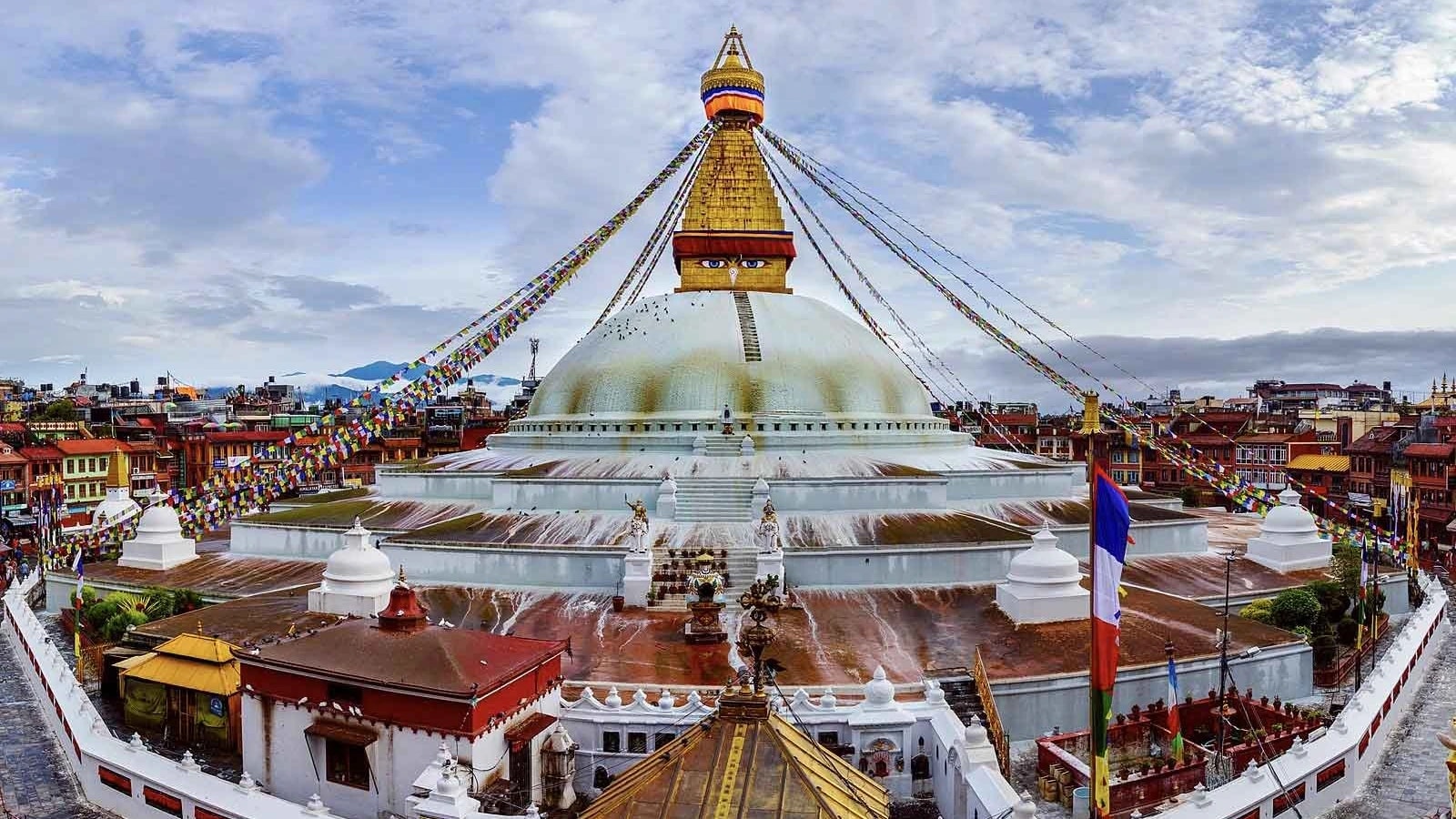
The first sight of Boudhanath stops most visitors mid-step: a vast white dome, wide as a small stadium, prayer flags running taut from its golden spire down to the rooftops below. Butter lamps flicker in the shopfronts even at midday. Walk the base and you're swept into a slow clockwise current of maroon-robed monks, prostrating pilgrims, and spinning prayer wheels — the kora never really stops. This is Boudhanath, the largest stupa in the Kathmandu Valley, and among the largest spherical stupas anywhere in the world.
It carries three names, and each tells you something different about the place. Nepalis call it Boudhanath, "Lord of Awakening." In Newari it's Khāsti Chaitya, the "dewdrop stupa." In Tibetan it's Jarung Kashor, "it can be done."
Sitting in Boudha, in the northeast of the city, it is roughly 6–11 km from central Kathmandu and close enough to the airport that arriving flights often bank directly over the dome. A UNESCO World Heritage Site since 1979, as one of the seven monument zones that make up the Kathmandu Valley listing, it is usually spoken of in the same breath as Swayambhunath — the valley's two great stupas, one on a hill in the west, one flat and immense in the northeast.
Boudhanath is one of Nepal's great centers of Buddhist practice, and one of the most important Tibetan Buddhist sites anywhere outside Tibet — a place where Nepali, Newar and Tibetan communities have worshiped side by side for centuries.
History & Legend
Boudhanath's origins trace back to the Licchavi period, somewhere in the 4th to 6th centuries CE. Historical sources disagree on exactly who built it, with credit given variously to King Manadeva, King Shivadeva, or a ruler named Vrisadeva. The stupa is traditionally said to enshrine the relics of Kassapa Buddha, the buddha believed to have preceded Shakyamuni.
The legend of the poultry-keeper's promise
The story most often told about Boudhanath explains the name Jarung Kashor. A poor widow who kept poultry for a living, known as Jadzima, asked the king of the valley for a piece of land, only as much as a buffalo's hide could cover. He granted it without much thought. She cut the hide into one continuous strip and used it to ring a plot far larger than he'd intended. Advisors urged the king to revoke the grant. He refused, saying it had been done and could not be undone. On that land, the widow built the great stupa, working at it until she died and leaving her four sons to complete it. Before the finished dome, the four brothers made a vow to spread Dharma in Tibet. Tradition holds they were later reborn as Trisong Detsen, the scholar Shantarakshita, the tantric master Padmasambhava, and a royal minister, the very figures who carried Buddhism into Tibet in the 8th century.
The long life of the trade route
For centuries, Boudhanath sat directly on the caravan road connecting Tibet to the valley, via Sankhu and Chabahil, a resting point where merchants made offerings before or after the crossing. That position is a large part of why, after 1959, Tibetan refugees settled in numbers around Boudha; the neighborhood grew into the dense cluster of gompas that surrounds the stupa today.
The 2015 earthquake
The Gorkha quake cracked the dome's stucco and damaged the spire badly enough that everything above the dome had to be dismantled and rebuilt. A new life-tree pole, the ritual axis at the stupa's core, was set in November 2015, and Boudhanath reopened in November 2016, the first major heritage site in the valley to be fully restored. More on the rebuild, and what followed it, is in Challenges & Preservation below.
Major Attractions – A Self-Guided Walking Tour
Everything at Boudhanath sits within a single circular plaza, so there's no real climb or approach the way there is at Swayambhunath , you arrive and the stupa is there. Everything below is arranged in the order you'd meet it walking clockwise around the stupa.
The dome and the mandala plan
The whitewashed dome, around 120 feet across, rests on three descending circular platforms said to represent the earth itself — the whole structure is laid out as a mandala. A saffron-yellow double lotus is painted where the dome meets the base.
The Buddha eyes and the harmika
Above the dome sits the square harmika, and painted on all four of its sides are the same watching eyes found at Swayambhunath, wisdom and compassion gazing in every direction at once. Above that, thirteen gilded rings taper toward the pinnacle, each ring said to mark a stage on the path to enlightenment.
Climbing the dome
Unusually for a stupa this significant, visitors are permitted to walk up onto the white dome itself for a view over the square and the surrounding rooftops. Shoes come off first, and the climb is worth timing for late afternoon, when the light is low and the square below is at its busiest.
The kora
The ground-level circuit is the heart of a Boudhanath visit. Mani wheels are set into the boundary wall at hand height the whole way around; spin them clockwise as you pass, the same direction as everyone walking beside you. Some pilgrims prostrate the full circuit, rising and lowering themselves the length of the plaza — give them space and let them set the pace.
Ajima (Hariti) shrine
Built into the northern wall of the complex is a shrine to Ajima, known in Buddhist texts as Hariti — once a child-devouring yakshini(demon/demigod), tamed by the Buddha and turned into a protector of children instead. Hindus and Buddhists both make offerings here, much as they do at her counterpart shrine on the Swayambhunath hill.
The reliquaries and the deeper Tibetan geography
For those who know where to look, the ground around Boudhanath carries a heavier significance still. The stupa is considered the spiritual center of an ancient charnel ground where the tantric master Padmasambhava, the figure credited with bringing Buddhism to Tibet, is said to have meditated. Centuries later, its eastern courtyard is where the Tibetan visionary Jikmé Lingpa received a major scripture in a dream. Scattered around the complex are also the memorial stupas of several revered 20th-century Tibetan Buddhist teachers, quiet stops for pilgrims that most visitors walk straight past.
Around the Complex
Gompas and monasteries
More than twenty monasteries ring the square and can be visited respectfully outside of prayer times. Tamang Gompa is best known, largely for its giant prayer wheel and a balcony that looks straight across at the stupa; the smaller ones are quieter and equally worth a look inside.
Taragaon Museum
A short walk northeast, away from the traffic around the main square, this small private museum holds a well-regarded collection of art and photography documenting the valley's built heritage, a good quiet hour away from the crowds.
Rooftop cafés
Restaurants overlooking the stupa are a fixture of the square, serving Tibetan, Nepali, and international menus. A rooftop table at dusk, as the lamps come on below, is one of the classic Kathmandu experiences.
Shopping
The shops circling the plaza sell singing bowls, thangka paintings, prayer wheels, incense, and jewelry, largely aimed at pilgrims rather than tourists specifically. Bargaining is expected.
What Most Visitors Miss
Most people walk one lap, photograph the dome, buy a singing bowl, and leave within the hour. A few things reward staying longer.
Come back after dark. Hundreds of butter lamps are lit around the stupa in the evening, and the floodlit dome against a dark sky is a different experience entirely from the midday version — many say the best version of Boudhanath only shows up after sunset.
Kora is also said to be most effective spiritually at dawn and dusk, and especially on the 10th, 15th, and last day of the lunar month, when the plaza fills.
Step into one of the smaller gompas rather than only the well-known ones. None of them are built as tourist attractions, and the quieter monasteries — away from Tamang Gompa's giant prayer wheel — are where you're most likely to sit in on ordinary, unstaged chanting.
Walk out to Chabahil. A short walk northeast sits a much smaller, much older stupa, sometimes called "Little Boudha," said locally to have been built from material left over from the main stupa's construction. Almost no tourists make it there, which is rather the point.
Entry Fees, Tickets & Opening Hours
Visitor Category | Entry Fee (NPR) | Notes |
Foreign nationals | ~400 | Standard non-SAARC rate |
SAARC nationals | ~100 | Passport required as proof |
Nepali citizens | Free | |
Children under 10 | Usually free | Accompanied by an adult |
Guesthouse guests staying within the Boudha complex generally pay the entry fee once, for their arrival.
Opening hours
The plaza is open roughly 5:00 am to 9:00 pm daily, with ticket booths closing in the evening.
Visitor Rules & Guidelines
Boudhanath is an active place of worship, not a backdrop, and the plaza is small enough that visitors and pilgrims share the same few meters of ground all day.
Guideline | What it means on the ground |
Dress modestly | Shoulders and knees covered. |
Remove your shoes | Before stepping onto the dome or into any shrine interior. |
Walk clockwise | Around the stupa and every mani wheel, always. |
Photograph respectfully | The courtyard and stupa are fine; ask first inside gompas and shrines, and never during active prayer. |
No vehicles on the kora path | Two- and four-wheelers are kept off the circular walkway |
Keep it quiet | Especially near monasteries during chanting. |
Best Time to Visit Boudhanath
-
Time of day: Early morning or after dark are best — the kora is calmer, the light is softer at dawn, and the butter lamps make dusk into evening the more atmospheric window.
-
Season: October–November is the clearest, most comfortable stretch of the year, with spring (March–April) a close second.
-
Festivals: Losar (Tibetan New Year) and Buddha Jayanti bring the plaza fully alive, but also its biggest crowds — decide in advance which you're after.
Read more: [Best Time to Visit Kathmandu, Nepal 2026]
Boudhanath's Festival Calendar
Losar (Tibetan New Year, Feb–Mar)
The single biggest event of the year at Boudhanath - lamps, prayers, and processions fill the plaza, and the surrounding gompas hold their own ceremonies simultaneously.
Buddha Jayanti (Apr–May)
Marking the Buddha's birth, enlightenment, and death together, this is the other major date on the calendar, observed with lamps and processions much like Losar.
Beyond these two, smaller local jatras occur through the year, and any festival night is worth planning around — the illuminated, lamp-lit stupa after dark is, by most accounts, the best version of Boudhanath there is.
How to Get There
-
Taxi - The most common option roughly 20 minutes from the airport and 15–45 minutes from central Kathmandu depending on traffic, at around NPR 400. Ask for the Boudha main gate specifically.
-
Bus and ride apps - Minivans and public buses run from Ring Road, Jamal, and Machhapokhari for about NPR 25; Pathao and InDrive both work here and remove the need to negotiate.
-
On foot from Pashupatinath - About thirty minutes on foot connects the two sites directly, and they're commonly paired into a single day - Pashupatinath in the morning, Boudhanath after.
Boudhanath vs Swayambhunath vs Pashupatinath
Travelers with limited time in Kathmandu often want to know which of the valley's major devotional sites to prioritize. Each does something different.
Boudhanath | Swayambhunath | Pashupatinath | |
Faith | Tibetan Buddhist | Buddhist–Hindu blend | Hindu (Shiva) |
Setting | Flat, open mandala plaza | Forested hilltop, 365 steps | Riverbank, cremation ghats |
Signature feature | The kora, largest stupa in the valley | The watching eyes, monkeys, valley views | The pagoda temple, evening aarti |
Best for | Tibetan Buddhist culture, evening lamps | Panoramic views, legend and myth | Confronting Nepal's relationship with death |
Foreign entry (approx.) | NPR 400 | NPR 200 | NPR 1,000 |
From Thamel | ~20–30 min | ~10–20 min | ~15–30 min |
Challenges & Preservation
The 2015 Gorkha earthquake did more damage to Boudhanath than the calm, fully rebuilt stupa visitors see today suggests. The dome's stucco cracked and the spire above it was damaged badly enough that the entire structure above the dome had to be dismantled and rebuilt from the platform up. A new life-tree pole - the ritual and structural axis inside the stupa was installed in a formal ceremony in November 2015, and the dome and spire were rebuilt over the following year, funded largely by Buddhist organizations and volunteers at a cost of roughly USD 2.1 million and more than 30 kilograms of gold. Boudhanath reopened in November 2016, becoming the first major heritage site in the Kathmandu Valley to be fully restored after the quake.
Beyond the earthquake, the pressures are the familiar ones facing every heritage site in the valley — rising visitor numbers, urban growth pressing in on the surrounding streets, and the ordinary wear of a stupa that is walked, touched, and lit with open flame every single day. As at Swayambhunath and Patan, the work of keeping it standing never really finishes; it simply continues, quietly, in the background of every kora.