
Swayambhunath Stupa: History, Legends & Travel Guide 2026
Hidden Hymn
Author
Hidden Hymn writes for Hidden Hymn — long-form stories from the world's quietest corners.
August 5, 2026 · 20 min read
About Swayambhunath Stupa
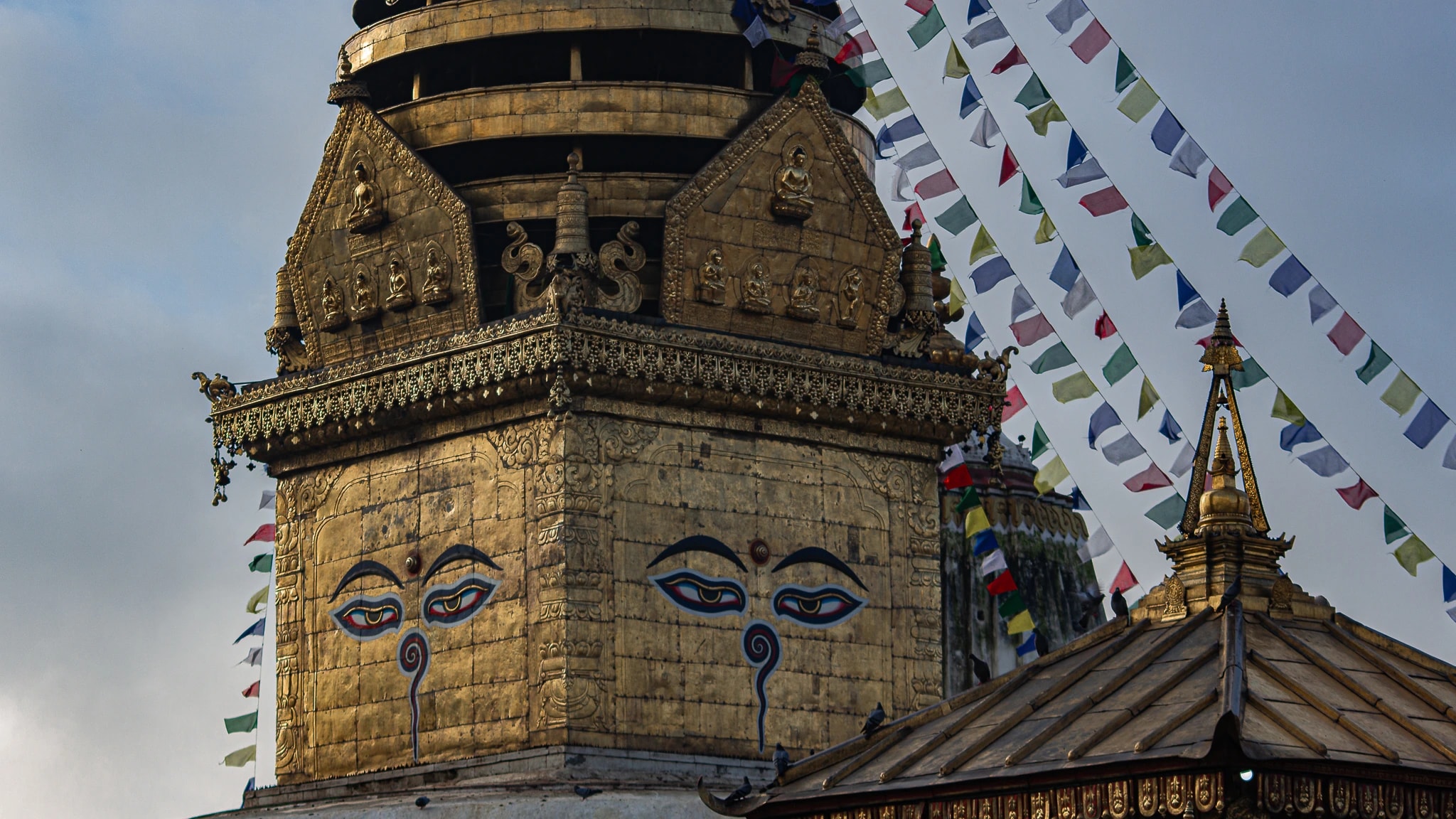
It is perhaps the most famous image of all Nepal; the huge white dome topped with a golden spire - and painted on all four sides of that spire, a pair of half-closed eyes that seem to watch the entire valley at once. Prayer flags snap overhead. Monkeys stroll the railings like they own the place (they kind of do - they're the reason foreign tourists nicknamed this the "Monkey Temple".)
Swayambhunath is one of the oldest and holiest Buddhist stupas in Nepal, sitting on a forested hilltop just west of central Kathmandu. It's a UNESCO World Heritage Site, it's roughly 1,500 years old, and it is almost certainly the first place any local will tell you to visit.
In Sanskrit, Swayam means "on its own" and bhu means "came into being." Put them together: it's the Self-Arisen. It is believed that sealed under this dome is a flame that no hand ever lit - the jyotirupa, the self-existent light. Every shrine, staircase, and gilded Buddha up here exists for one reason: to shelter that single, impossible thing.
And it belongs to almost everyone. For Newar Buddhists it's a sacred origin point. For Hindus it's home to the goddesses Saraswati and Harati. For Tibetans it's a once-in-a-lifetime pilgrimage. Hence, it is the shared ground, in the truest sense.
Legends & Myth
According to legend, this all happened during a Golden Age. Once, where Kathmandu now stands, there was no city at all, only a vast lake known as Nagdaha - the home of serpents (nagas). It was sacred water: from time to time buddhas and bodhisattvas, gods and goddesses, and the occasional earthly yogi would come down to bathe in it.
One day a great sage - Vipaswi Buddha - stood atop Jamacho hill (today's Nagarjun) on the valley's rim and looked out over the water. He scattered a handful of lotus seeds into the lake near what is now old Gujeshwari, close to present-day Balaju. From those seeds a single lotus bloomed with a thousand petals - and out of that lotus rose the Swayambhu Jyotirupa: the eternal, self-existent light, the spirit of the place. This is the flame the whole hill is built around. And it didn't come alone: five differently coloured rays streamed out of it, and alongside each ray appeared one of the five Dhyani Buddhas - Vairochana, Akshobhya, Ratnasambhava, Amitabha, and Amoghasiddhi.
Then came Manjushri, the bodhisattva of wisdom, travelling all the way from China. He climbed to the mountaintop at Nagarkot for the vantage and sat down to work through a very practical problem: this light is extraordinary, but it's stranded in the middle of a lake - how does anyone ordinary ever reach it? His solution was bold. He would drain the whole lake. He went to the southern rim and, with a stroke of his sword (tradition insists on the sword), cut open the hills at a gorge called Chobar. The water roared out through the gap and down toward the plains of India, and the lake floor dried into the valley millions live in today.
Historical Facts About Swayambhunath Stupa
Here's the twist that makes the legend even better: parts of it are true. Geologists confirm the Kathmandu Valley really was a lake, and it really did drain through the Chobar gorge - exactly where Manjushri supposedly swung his sword. The 15th-century scripture that records the myth, the Swayambhu Purana, was quietly telling a real geological event as a sacred one.
Beyond the geology, here's what the historical record actually shows.
-
The Licchavi era (around 450 CE). The documented story begins with King Vrisha Deva, credited with consecrating the great caitya - recorded in the old chronicle known as the Gopalarajavamsavali. By two centuries later, in the time of King Amshuvarman, the site was already famous under the name Swayambhu.
-
The early patrons. From the start, the pattern was tending, not just building. Vrisha Deva's grandson Manadeva offered a golden umbrella for the spire; King Shankara Deva endowed land for a monastery; King Dharmadeva laid out roads and a rest-house for the pilgrims already streaming to the hill.
-
The medieval raid (1349). Sultan Shamsuddin Ilyas of Bengal marched an army through the valley, looted Pashupatinath, and badly damaged Swayambhu - one of only two such incursions the valley ever endured. The stupa lay broken for a generation before it was rebuilt under officials of the rising strongman Jayasthiti Malla.
-
The Malla golden age (17th century). King Pratap Malla planted an enormous gilded vajra (thunderbolt) at the head of the eastern stairway and raised the twin white towers - Pratappur and Anantapur - that still frame the approach. In 1713, the central image of Vairochana was finally added to the dome.
-
The Tibetan renovation (18th century). A major restoration was carried out under the Tibetan lama Tshewang Norbu - one sign of a relationship with Tibet that runs back many centuries.
-
World Heritage status. Swayambhunath has been a UNESCO World Heritage Site since 1979.
-
The 2015 earthquake. The magnitude-7.8 Gorkha quake damaged several structures in the wider monument zone and prompted a UNESCO-guided Recovery Master Plan; the site was briefly listed as endangered. But the two things that matter most survived: the great dome with its flame, and the towering ancient stone Buddha on the western terrace, found without a scratch.
Behind all of this is the quiet, constant work that never actually stops. Weather, monkeys, birds, and millions of touching hands wear the stupa down - so for close to a thousand years, a coordinated economy of gilders, painters, and masons has kept patching it back up, organized through the community trust system. Repairing Swayambhu is treated as an act of worship in itself.
Major Attractions - A Self-Guided Walking Tour of Swayambhunath Stupa
The classic approach is up the eastern stairway - 365 stone steps, one for each day of the year, climbing steeply through the forest past monkeys, prayer wheels and painted Buddhas. It is a pilgrimage in itself, and it earns you the summit properly. (If your knees or time are against you, a road on the western side climbs almost to the top by vehicle; see How to Get There below.) Everything that follows is arranged the way you meet it.
- The great stupa and the watching eyes
At the summit, the whitewashed dome and its golden spire resolve into the most recognizable silhouette in Nepal. The dome represents the world, or the womb of creation. On the square harmika above it, the famous Buddha eyes gaze out in all four directions - wisdom and compassion watching the entire valley at once. Between them, where a nose would be, is a curl that is in fact the Nepali numeral one (ek), a symbol of unity and of the single path to enlightenment. Above rise thirteen gilded rings - the thirteen stages a mind must climb to reach awakening - crowned by a gilt parasol standing for enlightenment itself. Set into the four cardinal faces are the Dhyani Buddhas of the legend, with Vairochana at the centre. Ring the base are the prayer wheels; join the flow of pilgrims and spin them clockwise as you circle.
- The gilded Vajra
Where the eastern steps meet the terrace sits a great gilt-bronze Vajra (dorje, thunderbolt) - the Tantric emblem of indestructible power - resting on a circular mandala base, the Vajradhatu, ringed with the twelve animals of the Tibetan calendar and flanked by guardian lions. It was placed here by King Pratap Malla, and it is the first thing most climbers photograph.
- The Five Wisdom Buddhas
Remember the five coloured rays that shot out of the flame in the legend? Those became the five Dhyani Buddhas - and here they sit, one on each face of the spire, plus one hidden in the center. Think of them less as five separate gods and more as five moods of a single awakened mind, each one taking a very human problem and flipping it into something better.
Buddha | Face / | Ray Color | Elements | Poison it transforms | Hand Gesture |
Vairochana | Centre | White | Space | Delusion / Confusion | Dharmachakra - turning the wheel of teaching |
Akshobhya | East | Blue | Water | Anger / Hatred | Bhumisparsha - fingertips touching the earth |
Ratnasambhava | South | Yellow | Earth | Pride | Varada - open palm, giving |
Amitabha | West | Red | Fire | Desire | Dhyana - both hands folded in the lap |
Amoghasiddhi | North | Green | Wind | Envy / Jealousy | Abhaya - palm raised, "have no fear" |
- Pratappur and Anantapur
Framing the stupa stand two slender white shikhara towers, Pratappur (north) and Anantapur (south), raised by Pratap Malla in 1646 - the northern name for the king, the southern for his queen, Ananta Priya. Their doors stay closed but for rare ritual occasions. Between them, and around the terrace, look for the smaller elemental shrines - of fire, water, wind and earth - that most visitors walk straight past (more on these below).
- Harati (Ajima) Temple
Just below the main dome, its gilt roof catching the light, is the temple of Harati Devi - Ajima in Newari - the protector of children and healer of disease. Her story is one of the tenderest in the complex: once a demon who devoured children, she was turned by the Buddha into their guardian instead. Families still come to her for a child's health, and hers is one of the busiest shrines on the hill - a Hindu goddess honoured at the heart of a Buddhist stupa.
- Shantipur - the sealed temple
On the northern slope stands Shantipur, the "Place of Peace" - an unremarkable brick shrine hiding the most remarkable story on the hill. Beneath it lies a secret, permanently locked underground chamber where the tantric master Shantikar Acharya is said to have sealed himself centuries ago and, through meditation, attained a deathless state - believed to be down there still, in eternal samadhi, with power over the weather. Only Buddhacharya priests may enter, and the inner chamber stays sealed - which is exactly why the small temple feels, to this day, quietly ominous.
- The Western Summit: Parvasthan and the Saraswati Hill
Swayambhu has a second, quieter summit most visitors never reach - Parvasthan, a forested rise of stupas and shrines known locally as the Saraswati Hill. From the western (Paschimi) stupa, a left-hand path climbs to a clearing of five chaityas ringed by a mani wall of prayer wheels, then to the daily-worshipped Manjushri Chaitya, held to be some 1,500 years old. Its niche holds an image of Saraswati, goddess of learning; above it, half-hidden, sit two images of Manjushri, the bodhisattva of wisdom, with his sword carved into the ceiling.
- The Purano Stupa - the "old" Swayambhu
A narrow walkway leads north through a crumbling arch to the Purano Stupa (also Purano Swayambhu or Puchchhagra Chaitya) - revered by some as the original, legendary Swayambhunath. On its eastern side, a raised pair of stone feet is said to be the Buddha's footprints; legend holds that Manjushri and his shaktis dissolved into the sky here, their ashes enshrined in the dome. Nearby, look for a lingam-shaped stone and a large round block representing Basuki (Vasuki), the serpent king Manjushri appointed to guard the hill - an echo of the nagas who once ruled the lake. The path loops back to the western stupa and the World Peace Pond; the whole western complex is best reached by the northern walkway around the base of the hill.
What Most Visitors Miss
Most people climb the steps, circle the stupa once, photograph the eyes and leave inside the hour. The hill rewards the ones who linger.
The great secret hiding in plain sight is that Swayambhu is a map of the five elements. Set discreetly around the main stupa are five shrines - Vasupur (earth), Nagpur (water, a small tank with a serpent idol at its base), Agnipur (fire), Vayupur (wind), and, sealed and most mysterious of all, Shantipur - also called Akashpur, the Sky Place, standing for space or ether. Shantipur is said to conceal a tantric master in eternal meditation behind its walls. Find all five and you have walked the whole cosmology; most visitors never know they are there.
Come at dawn, when the hill belongs to the neighbourhood rather than the tour buses - pilgrims making the kora, monks unlocking the gompas, butter lamps being lit against the cold, and on a clear morning the Langtang peaks floating over the northern rim. Or come for sunset and the blue hour, when the valley below dissolves into a carpet of lights and the floodlit stupa turns luminous. Sit through the monastery chanting in the late afternoon. Walk the quiet courtyard of chaityas behind the dome to the old stone Buddha. And take a moment with the resident Tibetan community, whose monasteries and shops have made this hill a living outpost of Himalayan Buddhism. Swayambhu does not perform. It simply carries on - and the traveller who slows down gets let in.
How Swayambhunath Influenced Nepal and World Buddhism
Most heritage sites are places where things happened. Swayambhu is a place where things started. It has shaped Nepal - and reached far beyond it - in a few big ways.
It is the origin story of the valley itself. Strip away the temples and Swayambhu is the founding myth of Kathmandu: the light on the lake, the sword at Chobar, the water draining to leave dry land. To this day the Newars regard the hill as the sacred centre of the mandala that is the Kathmandu Valley - the fixed point the whole civilisation arranges itself around. You cannot tell the story of Kathmandu without beginning here.
It is a wellspring of Newar Vajrayana Buddhism. Swayambhu is the spiritual anchor of one of the last living non-Tibetan Vajrayana traditions on earth - the tantric Buddhism of the Kathmandu Valley's Newars, transmitted through household priests and the bahal courtyard-monasteries rather than through celibate monastic orders. Its foundational scripture, the Swayambhu Purana, is a cornerstone of that tradition. Where Vajrayana died out almost everywhere else in South Asia, here it survived - and this hill is its heart.
It is a bridge between the Himalayan Buddhist worlds. For centuries Swayambhu has been a major node on the pilgrimage circuit that links Newar and Tibetan Buddhism. Tibetan lamas funded its renovations (the 18th-century restoration under Tshewang Norbu among them); Tibetan pilgrims still count a visit here among the journeys of a lifetime; and after 1959, the hill became one of the anchors of a growing Tibetan exile community in Kathmandu. Newar, Tibetan and Hindu devotion meet on the same terrace - a rare, functioning example of shared sacred ground.
Its art travelled the world. The Kathmandu Valley's Buddhism was never only local. Its craftsmen carried Newar sacred art across Asia - most famously the 13th-century Newar master Araniko (Arniko), who led a team of artists to Tibet and on to the Yuan court of Kublai Khan in China, where his work, including the great White Stupa of Beijing, shaped Buddhist art far beyond the Himalaya. The metalcasting, the Paubha painting and the stupa-craft that Swayambhu helped keep alive became one of Nepal's quiet exports to the wider Buddhist world.
Put simply: this is not a monument the valley built. It is, by its own telling, the reason the valley is here at all.
Entry Fees, Tickets & Opening Hours
Entry fees: Foreign visitors pay a small entrance fee that helps fund the site's upkeep, collected at a booth near the base of the eastern stairway and at the road entrance. Nepal uses a tiered system, so what you pay depends on where you are from - and, usefully, Swayambhu is one of the best-value heritage visits in Kathmandu, a fraction of what the Durbar Squares charge. Carry cash in Nepali rupees, and SAARC nationals should bring a passport for the discount.
Visitors Category | Entry Fee (NPR) | Notes |
Foreign nationals | ~200 | Standard non-SAARC rate (Chinese nationals included) |
SAARC nationals | ~50 | Passport required as proof |
Nepali citizens | Free | |
Children under 10 | Usually free | Accompanied by an adult |
Opening hours. The hill has no gates and is effectively open around the clock - one reason dawn and after-dark visits are so rewarding. The ticket booth keeps daytime hours, and the practical visiting window runs from roughly first light to about 8pm. Individual monasteries and the small museum keep their own daytime schedules.
Practical ticket tips:
-
Fees at Nepal's heritage sites are revised from time to time, so treat the figures above as guidance and confirm the current rate at the booth.
-
Carry small notes in Nepali rupees; card payment is unreliable at the counter.
-
The fee covers the stupa complex; some individual monasteries may invite a small donation.
Visitor Rules & Guidelines
Swayambhunath is not a viewpoint with a temple attached; it is an active place of worship for Buddhists and Hindus alike, lived in daily by monks, priests and pilgrims. Move through it the way you would move through someone's shrine - because that is what it is. And here, more than at most sites, there is a second constituency to respect: the monkeys.
Guideline | What it means on the ground | Why it matters |
Dress modestly | Cover shoulders and knees, especially entering temples and shrines. There is no enforced dress code, but locals notice - and appreciate - those who make the effort. | These are active places of worship, not a photo backdrop. |
Remove your shoes | Take them off before stepping into any temple or shrine. Leather items are occasionally restricted at certain shrines. | Bare feet on temple ground is the oldest mark of respect in Nepal. |
Mind the monkeys | Do not feed, tease or make direct eye contact with the macaques; keep food out of sight and guard shiny items, phones and sunglasses. | They are bold, quick, and will snatch - and can bite if agitated. |
Photograph the stone, not the sacred | Photography is welcome across the open terrace; it may be restricted inside shrines and monastery halls, and flash is discouraged near old images. Watch for signage. | Flash and lenses damage pigments and interrupt devotion. |
Ask before you photograph a person | Always ask a resident, priest, sadhu or monk before raising your camera - and never photograph a puja or ritual in progress. Accept "no" gracefully. | People here are participants, not subjects. |
No drones or commercial filming without permission | Drone flights and any commercial shoot require prior clearance from the authorities. | Heritage airspace and ceremony both need protecting. |
Do not touch or climb | No climbing on plinths, monuments or temple struts; no handling of statues or offerings. Respect restoration fences and hoardings. | Much of what you see is centuries old and constantly under repair. |
Walk clockwise | Circle shrines, temples and stupas clockwise (pradakshina), as devotees do. | A small gesture that signals you understand where you are. |
Carry the right ticket and cash | Bring Nepali rupees for the entry booth and any monastery donation; card readers are unreliable. | Your fee funds the conservation you have come to admire. |
Best Time to Visit Swayambhunath Stupa
Best time of day:
Come at dawn. Between first light and about 8am the hill belongs to the pilgrims: the kora is unhurried, the light is soft and gold, the monkeys are calmer, and on a clear morning the Himalaya show themselves over the northern rim before the haze builds. The other sweet spot is sunset into the blue hour, when the stupa is floodlit and the valley below turns into a bowl of lights - one of the best sunset viewpoints in Kathmandu. Avoid the late-morning to early-afternoon stretch (roughly 11am–2pm): the crowds and tour groups peak, the light is flat and harsh, and the monkeys are at their boldest around visitors carrying food.
Best season:
October and November are the finest months - the monsoon has cleared, the air is sharp, the mountain views are at their best, and this is Nepal's peak travel season for good reason. Spring (March–April) is a close second: warm, largely clear, and rich with festivals, with Buddha Jayanti often falling in this window. The monsoon (June–September) brings lush green and dramatic skies but heavy afternoon rain and slick steps, while winter (December–February) is cool and quiet, with crisp, clear mornings if you do not mind the chill - and the fewest crowds of the year.
Where to Stay near Swayambhunath Stupa
Most visitors base themselves in Thamel, and for Swayambhu that works well - it is only 10–20 minutes away, which makes a pre-dawn taxi up the hill for sunrise entirely feasible. The hilltop itself has no accommodation, but the surrounding Swayambhu neighbourhood and nearby areas hold a scattering of quieter guesthouses and mid-range hotels for travellers who want to wake within walking distance of the steps and beat the crowds to the top. For a calmer, more local base than central Thamel - while staying close to the western sights - the lanes around the hill are worth a look.
Challenges & Preservation: Keeping the Flame
Swayambhunath is often called the oldest stupa in the valley. What makes it remarkable is also what makes it fragile: it is not a sealed relic but a working, weathering, monkey-inhabited hill that has been in continuous use for some fifteen centuries. Keeping it standing has always been a labor that never quite finishes.
When the 7.8 - magnitude Gorkha quake struck, Swayambhunath came off comparatively lightly where it mattered most: the great dome, its sealed flame and the ancient stone Buddha all survived, the stupa itself cracked but standing. The surrounding complex was not so lucky - the Anantapur tower collapsed and a monastery partially came down, and in the days afterward monks and shopkeepers were photographed digging golden relics and manuscripts out of the rubble by hand. The site was one of dozens across the valley damaged that spring; it was briefly placed on the endangered list and rebuilt under a UNESCO-guided Recovery Master Plan, with the Department of Archaeology leading the work. Anantapur was fully repaired by 2019.
Long before and ever since the earthquake, the real threat has been slower and more constant: weather. The gilded upper sections and the harmika need periodic re-gilding to hold off the elements, and the structure is worn continuously by rain, birds and the resident macaques - in 2023, a storm brought down the pinnacle, which locals noted had already been loosened by monkeys, and it was restored by the community conservation committee together with the Department of Archaeology and the city, then reset with a formal ritual of forgiveness. This is the pattern the whole hill runs on. Maintenance here is organised through a community management committee in the old guthi tradition, and the act of repair is treated not as a chore but as a form of worship in its own right.
Beyond weather and seismic risk, Swayambhu faces the pressures closing in on every heritage site in the valley: rising urbanisation and pollution creeping up the once-isolated hill, the fire risk that comes with thousands of butter lamps, and the sheer wear of ever-growing visitor numbers on a small, sacred summit. None of these is dramatic on its own. Together they are the reason the work never ends.
This is where the traveler comes in, and it is not passive. Your entry fee funds the upkeep. Respecting the monkeys, the monks and the ritual keeps the hill a place of worship rather than a spectacle. And the simplest act of all - climbing slowly, circling clockwise, treating the summit as a shrine rather than a photo stop - is itself a small form of preservation. Swayambhu has been tended by hand for a thousand years. The best thing a visitor can do is help it be tended for a thousand more.