
Bhaktapur Durbar Square: Ultimate Travel Guide 2026
Bhaktapur Durbar Square in time travel portal to medieval Nepal. The guide explores monuments, history plus local practical tips, entry free and timings.
Hidden Hymn
Author
Hidden Hymn writes for Hidden Hymn — long-form stories from the world's quietest corners.
September 5, 2026 · 12 min read
About Bhaktapur Durbar Square
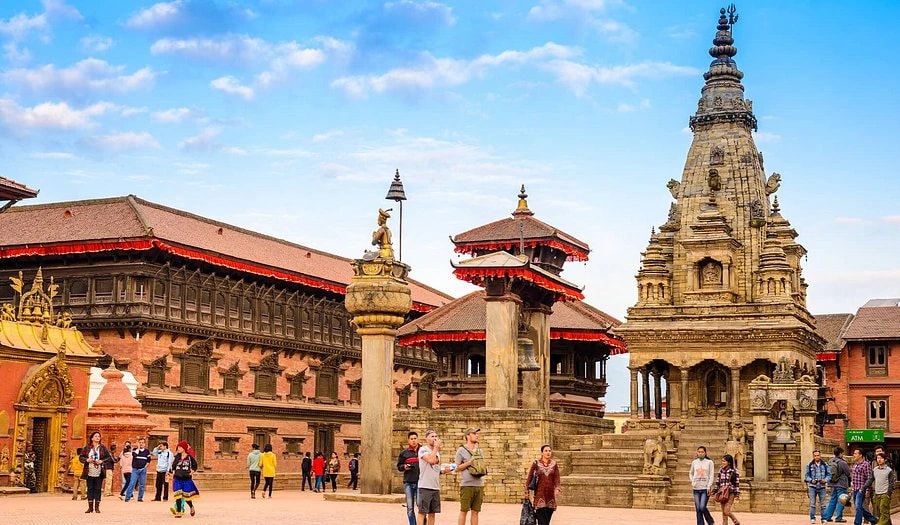
Bhaktapur Durbar Square lies in the heart of Bhaktapur, the ancient “City of Devotees” in the Kathmandu Valley. In 1979, UNESCO inscribed Bhaktapur Durbar Square, Nepal, as one of the seven monument zones of the Kathmandu Valley World Heritage Site.
It is about 13 km east of central Kathmandu and about 15 km east of Thamel, a 30–60 minute drive depending on traffic. Step through its gates and you enter the square to discover the pinnacle of Nepali architecture. Its monuments include the 55 Window Palace, the Golden Gate of Bhaktapur (Sun Dhoka), the Taleju Temple, the Vatsala Durga Temple, King Bhupatindra Malla’s Column, the National Art Museum Bhaktapur and the Nyatapola Temple in neighbouring Taumadhi Square, and Siddha Pokhari along with many more discussed below.
Bhaktapur Square is a living window into the old Newar way of life, where locals still worship, trade and craft as their ancestors did, making it a must-visit for anyone exploring Nepal. Between the sights, visitors can taste Juju Dhau, the creamy “king of curd” served in clay pots and Bhaktapur’s best-loved delicacy.
Bhaktapur Durbar Square at a Glance:
Detail | What to Know |
Location | Old town of Bhaktapur, about 13 km east of Kathmandu and about 15 km east of Thamel |
Also known as | Bhaktapur Durbar Kshetra (भक्तपुर दरबार क्षेत्र); the city is also called Bhadgaon, Khwopa and the “City of Devotees” |
UNESCO status | Part of the Kathmandu Valley World Heritage Site since 1979 |
Founded | 12th century under King Ananda Dev; the square is mostly the work of King Bhupatindra Malla (reigned 1696–1722) |
Monuments to see | 55 Window Palace, Golden Gate (Sun Dhoka), Taleju Temple, Vatsala Durga Temple, King Bhupatindra Malla’s Column, National Art Museum Bhaktapur, and the Nyatapola Temple in Taumadhi Square |
Entry fee | USD 15 (about NPR 2,000) for foreigners; about NPR 500 for SAARC and Chinese nationals; free for Nepali citizens. Covers the whole old city and can be extended free for up to 7 days |
Opening hours | The old city never closes. Ticket checkpoints are staffed roughly 6 am–7:30 pm. The National Art Museum is open 9 am–5 pm and closed Tuesdays and Wednesdays |
Best time to visit | Early morning (7–9 am) or late afternoon (4–7 pm); October–November and February–April; Bisket Jatra in mid-April |
Getting there | 30–45 minutes by taxi along the Araniko Highway, or by local bus from Ratna Park or Bagbazar |
Time needed | A full day, ideally with an overnight stay |
Altitude | About 1,401 m (4,596 ft) above sea level |
Area | Bhaktapur city covers about 6.88 sq km |
History of Bhaktapur Durbar Square
Pre-medieval period: When was Bhaktapur first settled?
Bhaktapur during the Kirati era and the rule of the Licchavi kings (around 4th to 9th centuries AD), was first settled as small farming villages recorded as Khopring, which later became Khwopa. An inscription from the reign of King Shivadeva I, now displayed in the National Art Museum (Bhaktapur museum), shows organized settlement here more than 1,300 years ago. On the hilltop north of Bhaktapur, the Changu Narayan Temple holds Nepal’s oldest dated inscription, carved in 464 AD under King Manadeva. At this stage there was no palace or durbar square yet, only scattered villages.
Medieval period: Who built Bhaktapur Durbar Square?
Bhaktapur Durbar Square was built between the 12th and 18th centuries by medieval kings of the Malla dynasty, beginning with King Ananda Deva (1147–1167) and ending with the last Malla king, Ranajit Malla (1722–1769).
-
Founding of Bhaktapur city (12th century): King Ananda Deva (1147–1167) founded the city by merging scattered villages and built its first royal palace. Around 1200, King Ari Malla became the first ruler to take the name “Malla,” which means “wrestler” in Sanskrit.
-
Capital of the Kathmandu Valley (1200–1482): From around 1200 until King Yaksha Malla’s death in 1482, Bhaktapur was the capital of the Malla kingdom and ruled the whole Kathmandu Valley. After his death, the valley split into three rival kingdoms, Bhaktapur, Kathmandu and Patan, each with its own Durbar Square.
-
Rivalry of the three Malla kingdoms (17th–18th centuries): From the late 17th century, Kings Jitamitra Malla, Bhupatindra Malla and Ranajit Malla gave Bhaktapur square most of the monuments seen today. Their rivalry with Kathmandu and Patan filled the whole valley with temples and palaces.
-
Jitamitra Malla extended the palace and built the golden Sundhara spout in 1688.
-
King Bhupatindra Malla (1696–1722) added the Ugrachandi and Ugra Bhairav statues (1701), the Nyatapola Temple (1702) and the carved windows of the 55 Window Palace.
-
The last Malla king, Ranajit Malla (1722–1769), cast the Taleju Bell (1737) and completed the Golden Gate in 1754.
-
Modern period: What happened to Bhaktapur Durbar Square after the Malla kings?
The Shah period
In 1769, King Prithvi Narayan Shah of Gorkha captured Bhaktapur, ending the Malla era and making it the last of the three Malla kingdoms to fall. Bullet marks from that attack can still be seen in the palace’s Mul Chowk courtyard. Under Shah rule the palace lost its royal role, and parts of the 55 Window Palace were later used as the city’s post office. In 1960, the government turned the Simhadhwaka palace wing into the National Art Gallery, now the National Art Museum Bhaktapur.
Earthquakes and restoration
The 1934 Nepal–Bihar earthquake and the 7.8-magnitude Gorkha earthquake of 25 April 2015 caused the greatest damage in the square’s history. The 1934 earthquake destroyed many temples and palace wings, and of the palace’s legendary 99 courtyards, only a handful survive today. The German-funded Bhaktapur Development Project of the 1970s and 1980s then helped restore much of the old city. The 2015 earthquake collapsed the Vatsala Durga Temple and damaged the Phasidega Temple and parts of the palace. With local and international support, the Siddhi Laxmi Temple was rebuilt by 2018, and the Vatsala Durga Temple was fully restored in 2021. Today the square is again one of Nepal’s best-preserved royal squares.
Things to Do in Bhaktapur Durbar Square
1. Explore the Royal Palace Complex
The Royal Palace Complex was the home and seat of government of the kings of Bhaktapur city. It stands on the north side of Bhaktapur Durbar Square. King Ananda Deva built the first palace in the 12th century, and the Malla kings, above all King Bhupatindra Malla, expanded it until 1769. Visitors can see its carved facade, its gilded gateway and the surviving courtyards of a palace that tradition says once had 99. The complex was badly damaged in the 1934 earthquake and again in 2015, and its main buildings have since been restored.
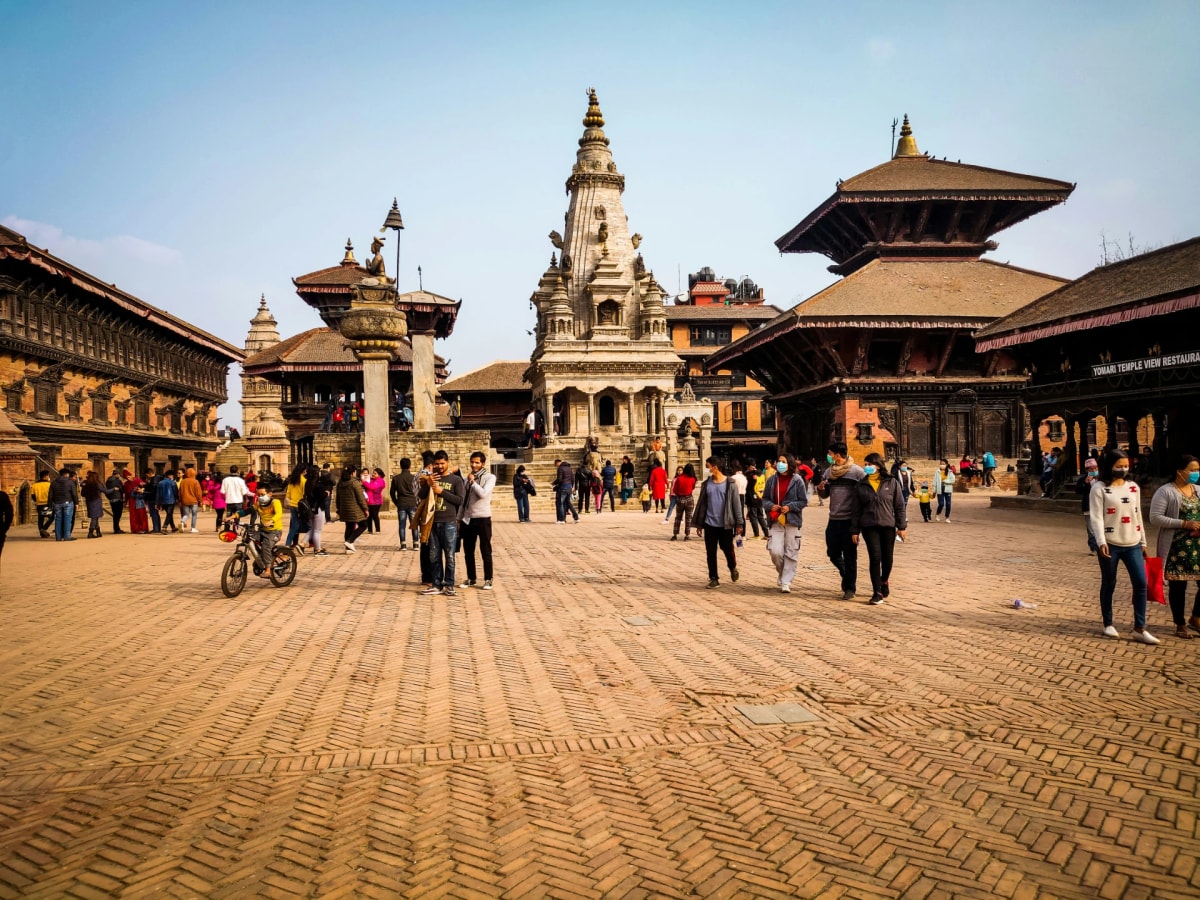
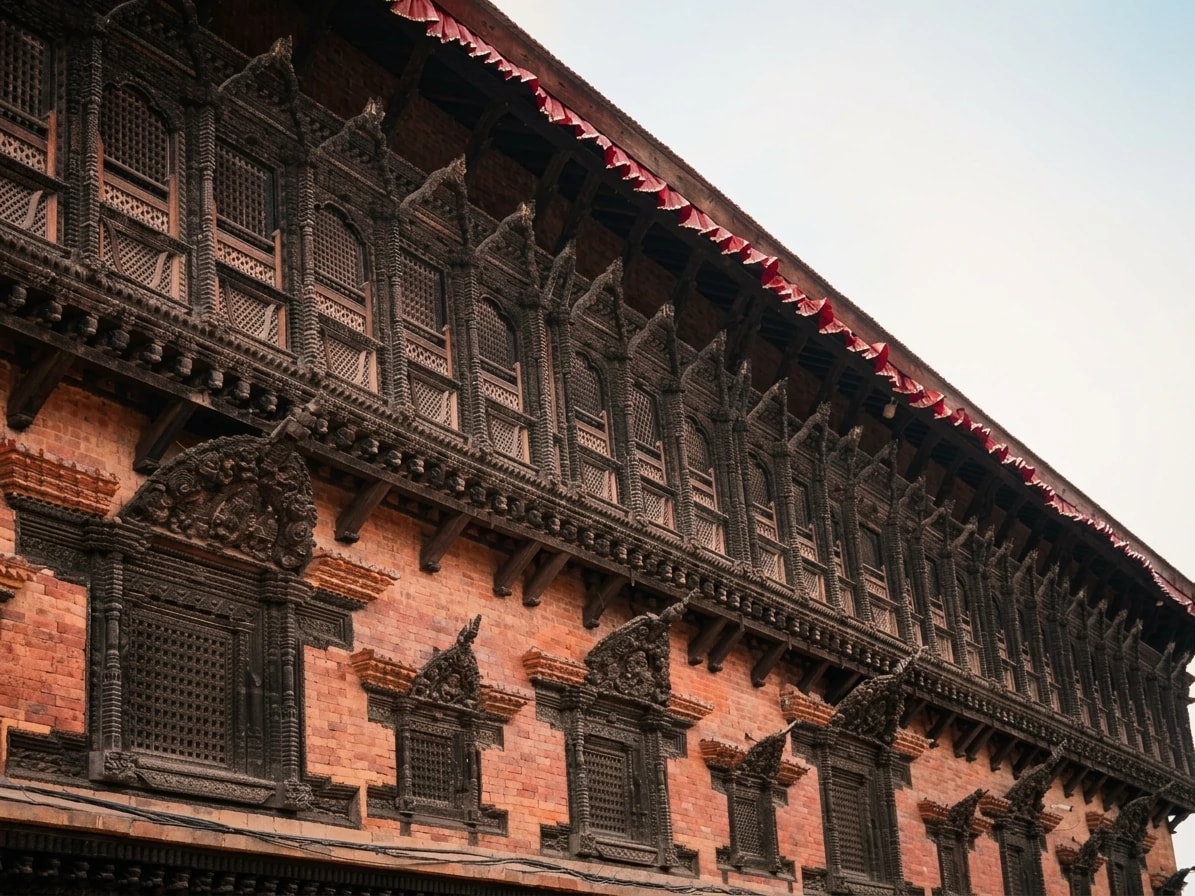
55 Window Palace (Pachpanna Jhyale Durbar)
The 55 Window Palace is a three-story brick royal palace famous for its 55 carved wooden windows. It stands on the north side of Bhaktapur Square, directly beside the Golden Gate. Its foundations date to King Yaksha Malla’s reign in the 15th century, and King Bhupatindra Malla added the carved windows in 1708. The palace interior is closed, so visitors admire its sal-wood windows from the square. The palace survived the 2015 earthquake without major structural damage, except for its badly hit Lal Durbar wing.
Don’t miss: the view of the 55 Window Palace from the steps of the Chyasilin Mandap at sunset.
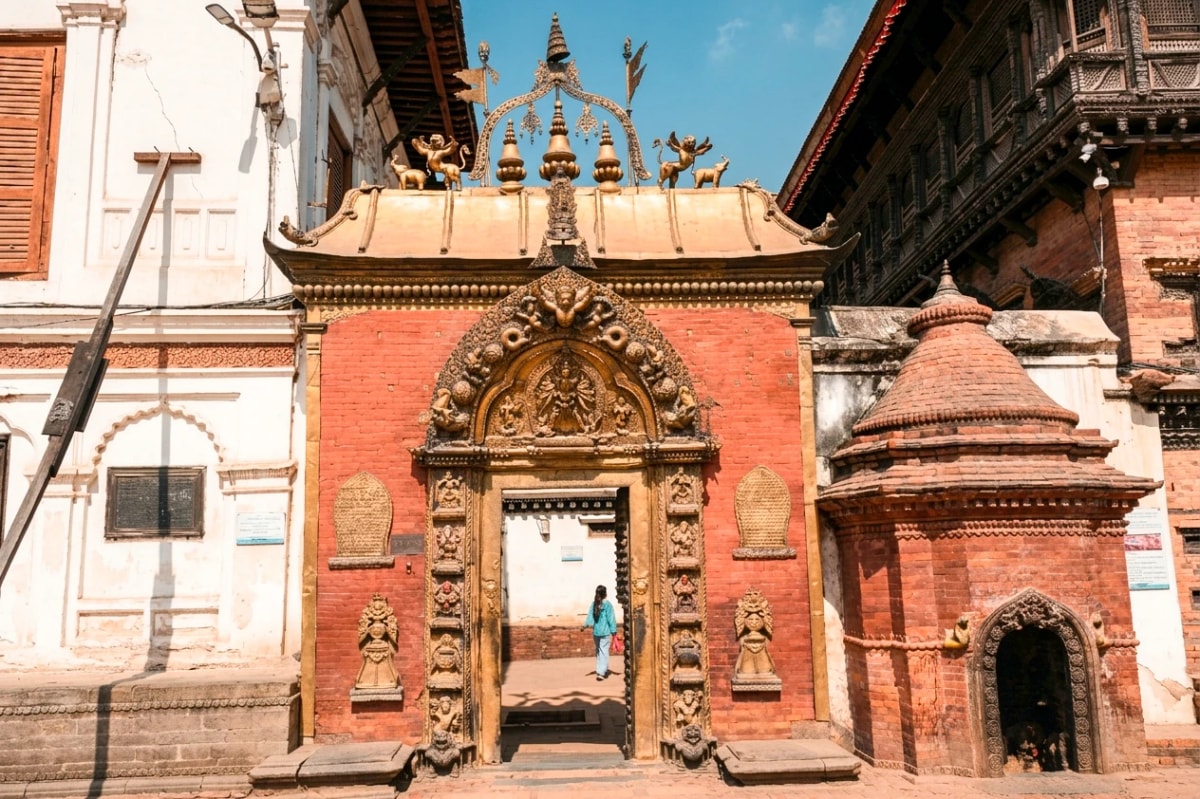
The Golden Gate Bhaktapur (Sun Dhoka)
The Golden Gate, or Sun Dhoka, is the gilded copper entrance to the inner bhaktapur palace and one of the finest pieces of metalwork in Asia. It is set into the palace wall beside the 55 Window Palace, facing King Bhupatindra Malla’s Column. King Bhupatindra Malla began the gate, and the last Malla king, Ranajit Malla, completed it in 1754. Visitors can photograph its carving of the four-headed, ten-armed Goddess Taleju Bhawani with Garuda above her, then walk through it into Yama Dwar Chowk, which is open to non-Hindus. The gate suffered only minor damage in the 2015 earthquake.
Taleju Temple Bhaktapur and Mul Chowk
The Taleju Temple is the royal temple of the Malla kings and is considered the oldest Taleju temple in Nepal. It stands in Mul Chowk, the palace’s main courtyard, reached through the Golden Gate. It is dedicated to Taleju Bhawani, the guardian goddess of the Malla kings, who was brought to Bhaktapur in the 14th century. Mul Chowk dates from the 12th–13th centuries, and King Bhupatindra Malla gave the temple its golden roof and eleven gold pinnacles in 1703. The temple complex suffered moderate damage in 2015 and remains in active worship today.
Keep in mind: Entry is limited to Hindus, and photography, leather and shoes are not allowed inside. The one exception is Maha Navami during Dashain, when the temple opens to the wider public.
Royal Courtyards (Chowks)
The royal courtyards, or chowks, are the open squares inside the palace where the Malla kings held rituals and court. They lie behind the Golden Gate and the 55 Window Palace. Successive Malla kings built them between the 12th and 18th centuries. Of the 99 courtyards that tradition describes, about 17 survive, and visitors can enter 9 of them. The most notable are:
Courtyard | What it is known for | Access |
Kumari Chowk | Restored by Jitamitra Malla (inscription of 1677); Bhaktapur’s living goddess sits on its stone pedestal during Dashain | Restricted |
Bhairava Chowk | Eighteen carved wooden Bhairava figures and murals of King Bhupatindra Malla | Restricted |
Nasal Chowk | Holds the white horse of Taleju, visible through a corridor window | Restricted |
Dumaju Chowk | A small pond believed to cure children’s colic | Open to visitors |
Bhandarkhal Chowk | The old state treasury, with its pond and the square’s only all-stone gateway | Reached through the National Art Museum Bhaktapur |
Several courtyards were damaged in the 1934 and 2015 earthquakes, and restored areas such as Bhandarkhal Chowk are open again.
Royal Bath: Naga Pokhari Bhaktapur and Sundhara
The Royal Bath, or Naga Pokhari, is a sunken stone bath fed by a natural spring and ringed by stone nagas (serpent water deities). It lies in Sundari Chowk, at the back of the palace complex just outside the Taleju Temple. King Jitamitra Malla built it in the late 17th century, and an inscription dates its golden spout, the Sundhara (Lun Hiti), to 1688.
Don’t miss: The gilded spout, where water falls from a goat’s head that a makara, a mythical sea creature, appears to swallow. Water for Taleju’s daily worship is still drawn from it.
2. Explore the National Art Museum (Bhaktapur Museum)
The National Art Museum, also known as the Bhaktapur Museum, is the main art museum of Bhaktapur city. It is housed in the former Simhadhwaka (Malati Chowk) palace, which King Bhupatindra Malla built in 1698. It stands on the north side of Bhaktapur Square, just west of the Golden Gate, where two stone lions guard its entrance. Inside, visitors can see Licchavi and Malla stone inscriptions and sculptures, rare paubha paintings and illustrated manuscripts, carved wooden deities and colorful Mithila paintings.
3. Explore Taumadhi Square and Nyatapola Temple
Taumadhi Square is one of Bhaktapur’s four historic squares. Since the Malla period, it has been the city’s main gathering place for religion, trade and festivals. It lies about 200 meters southeast of Bhaktapur Square, a two- to five-minute walk. The square has two major monuments: the Nyatapola Temple and the Bhairavnath Temple.
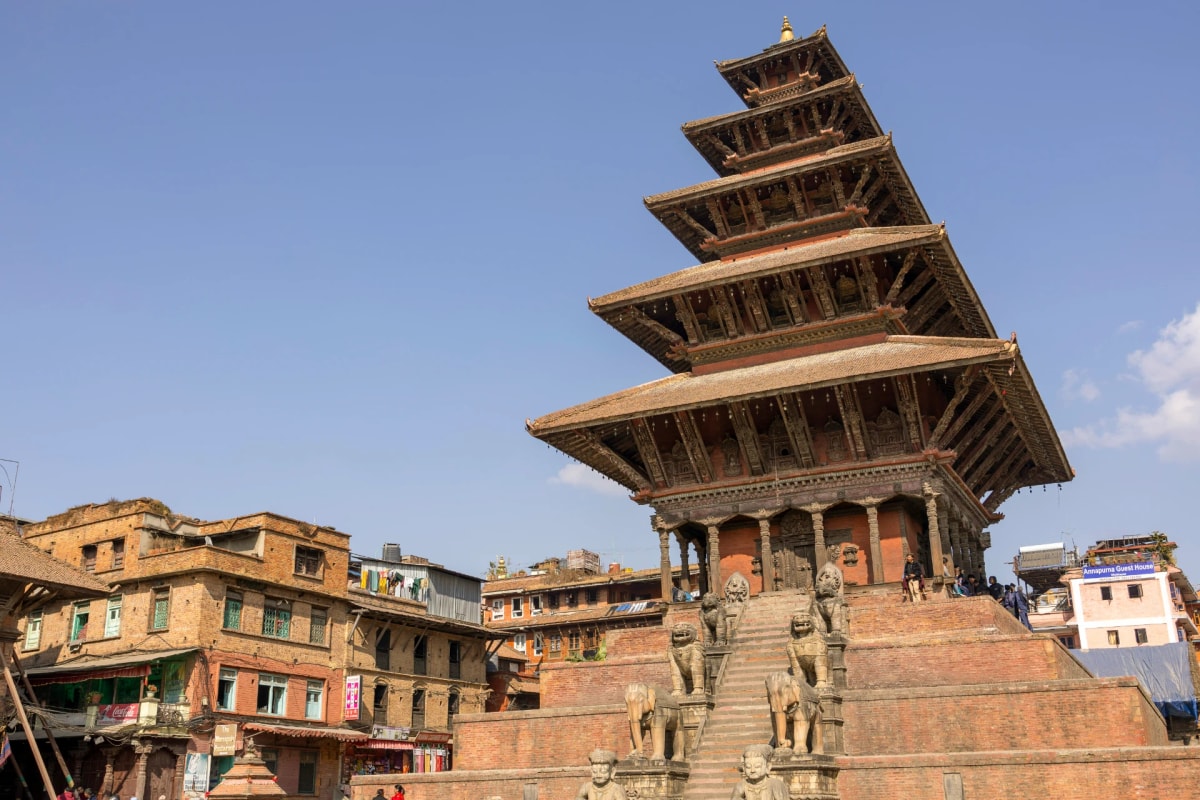
The Nyatapola Temple is a five-tiered pagoda. Dedicated to Siddhi Lakshmi, a fierce form of Goddess Durga, it is the tallest temple in Nepal at about 30 meters. King Bhupatindra Malla built it in 1702. Visitors climb a stairway guarded by five pairs of stone figures. The wrestlers Jayamal and Phattu, elephants, lions, griffins and the goddesses Baghini and Singhini stand in turn, each pair said to be ten times stronger than the one below. Only priests may enter the shrine at the top. The temple survived both the 1934 and 2015 earthquakes. Read our complete guide to Nyatapola Temple.
Must do: Enjoy some of the best views in Bhaktapur from the temple’s upper steps or the rooftop cafés around Taumadhi Square.
4. Taste Juju Dhau: The King of Curd
Juju Dhau is Bhaktapur’s famous sweet curd. Its name means “king of curd” in Nepal Bhasa, from juju (king) and dhau (curd). It is made from fresh buffalo milk and set in an unglazed clay pot called a katauro. The recipe dates to the Malla era. Legend says a Malla king judged Bhaktapur’s curd the best in the Kathmandu Valley.
You can buy it at small dairies around Bhaktapur Square, Taumadhi Square, Pottery Square, Dattatreya Square and Siddha Pokhari. A small cup costs about NPR 50–100, a medium pot about NPR 120–150 and a one-litre pot about NPR 200–400.
Must do: Eat Juju Dhau straight from its clay cup at a local dairy, ideally after a morning walk around Bhaktapur Durbar Square.
5. Visit Pottery Square
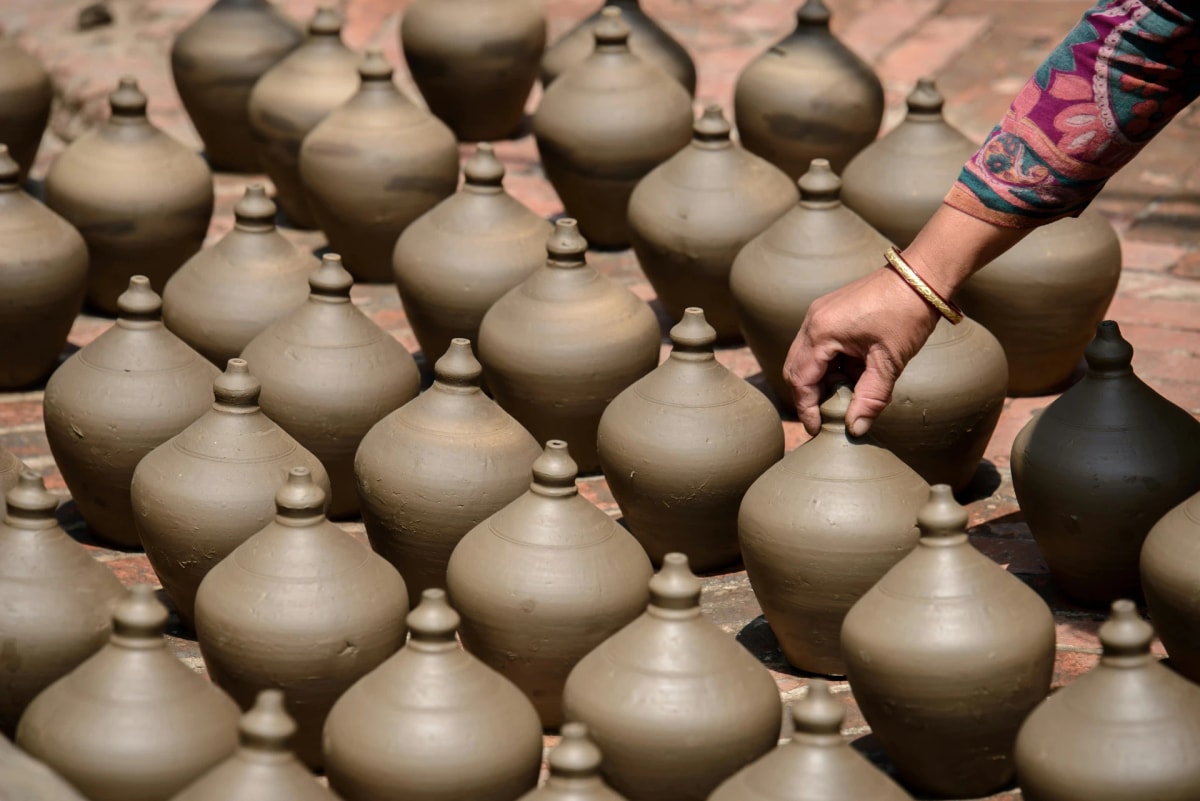
Pottery Square is Bhaktapur’s traditional potters’ quarter. Newar potter families have worked clay here for generations. It lies about 300 meters south of Bhaktapur Durbar Square, a five-minute walk. Its oldest landmark is the 14th-century Jeth Ganesh Temple. In the main square, Talako Tole, potters shape clay by hand while rows of pots dry in the sun. The quieter Suryamadhi Tole nearby is popular for buying pottery in bulk. Visitors can watch the craft up close and buy handmade pots and souvenirs. It is the best place to see pottery in Bhaktapur. Come on a sunny day, because the potters stop work when it rains. Plan your visit with our Bhaktapur pottery guide.
Must do: Try the potter’s wheel at a workshop and take your piece home.
6. Paint Sacred Newari Sacred Masks (Mukhando)
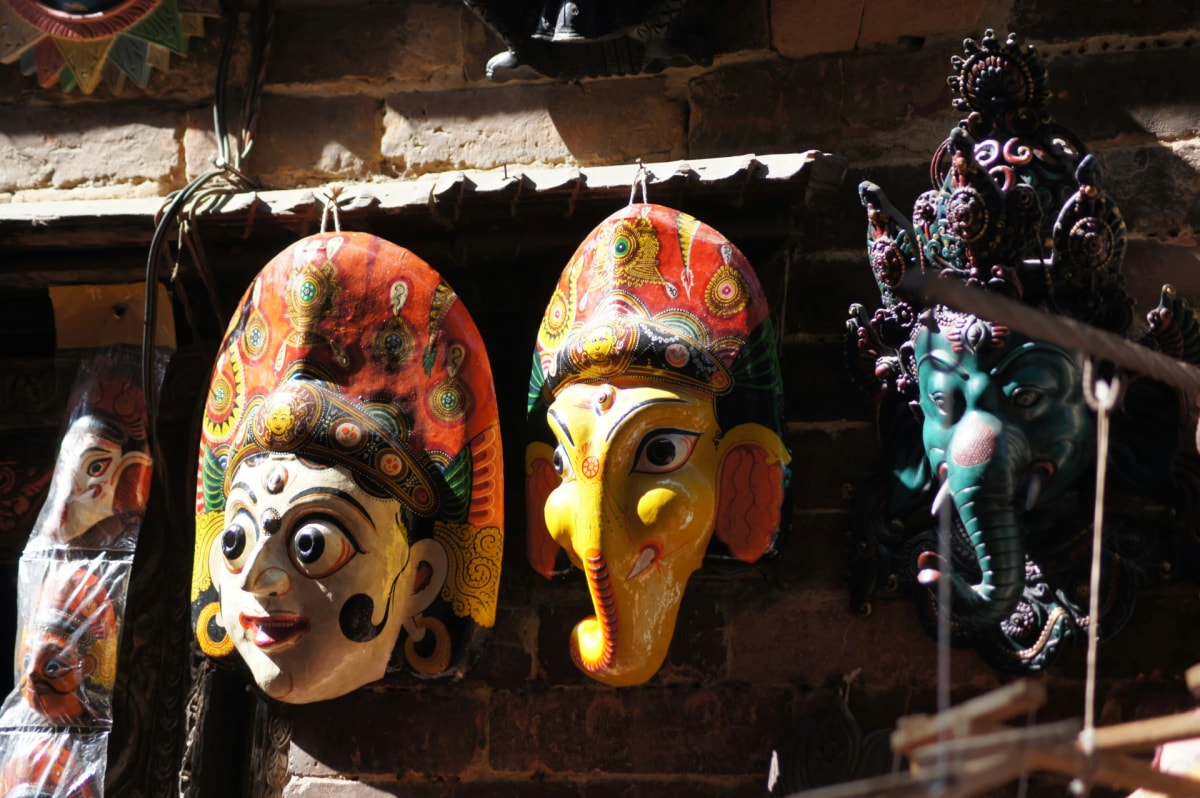
In traditional Newar culture, sacred masks (Mukhando) represent divine deities and protective spirits used during ritual dance performances like Bisket Jatra and Gai Jatra.
-
What you do: Learn how artisans blend natural clays, cotton, and paper pulp to form lightweight masks, then paint traditional iconographic symbols using bold colors.
-
Why it’s unique: Mask-making is a sacred hereditary art that bridges religious ritual and fine craftsmanship. You take home a lightweight, hand-painted artifact directly linked to Nepal's living festival culture.
7. Explore Dattatreya Square and the Peacock Window
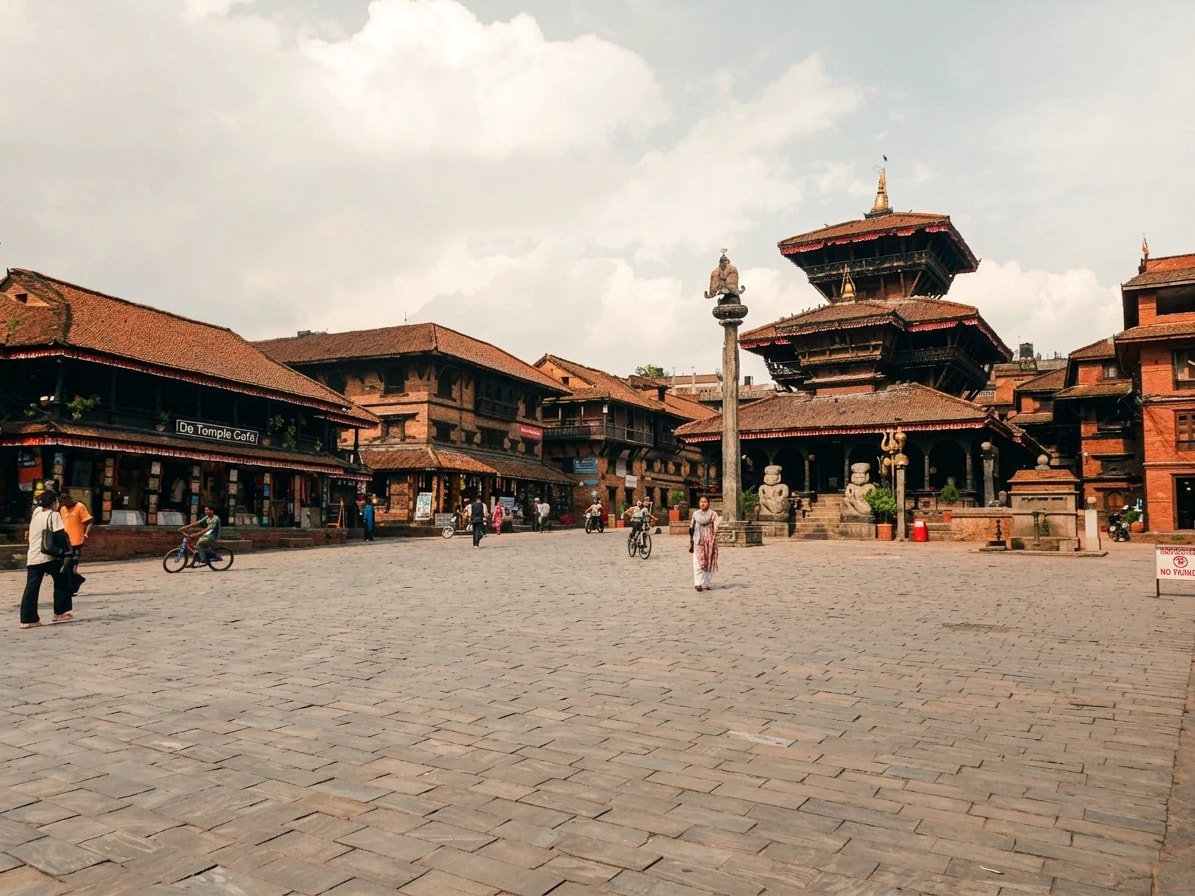
The Dattatreya Temple is a three-tiered pagoda. It honors Dattatreya, a deity who combines Brahma, Vishnu and Shiva. Legend says King Yaksha Malla built it in the 15th century from the timber of a single tree. Beside the temple stands Pujari Math, a 15th-century priests’ house. It holds the famous Peacock Window, often called the “Mona Lisa of Nepal.” The window survived the 2015 earthquake undamaged. Pujari Math is now the Woodcarving Museum, and the Brass and Bronze Museum is also in the square. The National Art Museum ticket covers both, so visitors can pair the temple with two museums in one stop. See our full guide to Dattatreya Square.
8. Roam around Siddha Pokhari
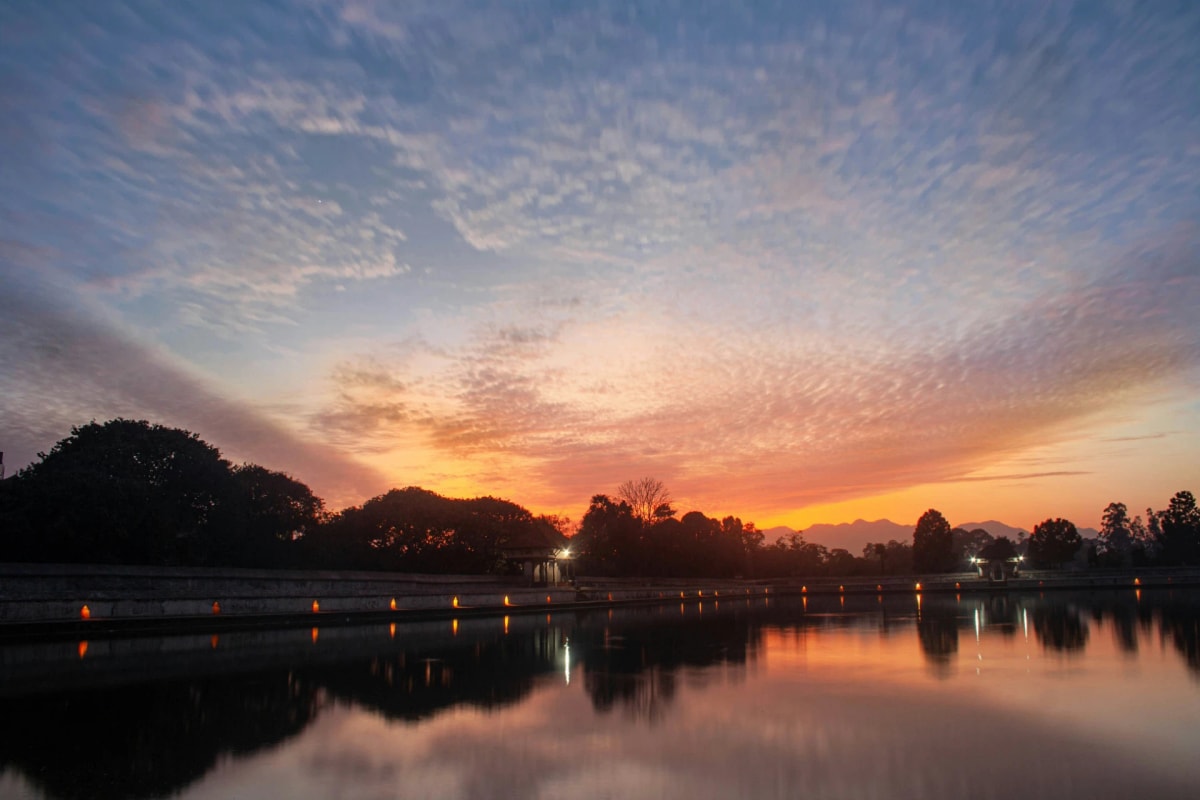
Siddha Pokhari is Bhaktapur’s largest traditional water tank, a rectangular pond beside the old city’s western gate. It lies a 10–15 minute walk west of Bhaktapur Square, beside the Dudhpati bus stop for Kathmandu buses. Most sources date it to King Yaksha Malla’s early 15th-century reign; the Nepal Tourism Board says the Licchavi period. The 171-by-73-meter pond is lined with whitewashed walls and Hindu and Buddhist shrines. Visitors stroll its banks, feed birds and fish, or take a short paid boat ride, but swimming is banned
Bhaktapur Durbar Square entry fee
Bhaktapur Durbar Square charges foreign visitors USD 15 (about NPR 2,000) to enter. SAARC and Chinese nationals pay about NPR 500, while Nepali citizens and children under 10 enter free. One ticket covers all four squares of Bhaktapur city. Show your passport to extend it free for up to seven days.
Visitor Category | Entry Fee | Notes |
|---|---|---|
Foreign nationals (non-SAARC) | USD 15 / ~NPR 2,000 | Covers all four squares; valid for the day |
SAARC nationals | ~NPR 500 | Passport required as proof |
Chinese nationals | ~NPR 500 | Treated on the SAARC rate |
Nepali citizens | Free | |
Children under 10 | Free | Accompanied by an adult |
National Art Museum + Woodcarving + Brass & Bronze | ~NPR 150 (foreigners) | Separate ticket, covers all three |
Opening hours of Bhaktpur Durbar square
Bhaktapur Durbar Square is open all day, every day, because it is a part of Bhaktapur city. Ticket checkpoints are staffed roughly from 6 am to 7:30 pm. The National Art Museum opens 9 am–5 pm and closes on Tuesdays, Wednesdays and holidays. The Taleju courtyards remain closed to non-Hindus.
Typical Hours | Notes | |
The historic city | Effectively open all day | Ticket checkpoints staffed roughly 7am–7pm |
National Art Museum | ~10:00am–5:00pm | Closed one day a week and on public holidays - reports vary between Tuesday and Saturday; verify locally |
Temples & courtyards | Roughly daytime hours | Taleju courtyards closed to non-Hindus |
Entry Fee of Bhaktapur Museum
The museum has its own ticket, separate from the Bhaktapur Durbar Square entry fee: NPR 150 for foreigners, NPR 50 for SAARC nationals and NPR 25 for Nepali citizens. The same ticket also covers the Woodcarving and Brass and Bronze museums in Dattatreya Square
Keep in mind - The museum ticket is separate from the Bhaktapur Durbar Square entry fee.
Visitor | Entry Fee | Photo camera | Video camera |
Foreign nationals | NPR 150 | NPR 100 | NPR 200 |
SAARC nationals | NPR 50 | NPR 75 | NPR 150 |
Nepali citizens | NPR 25 | NPR 50 | NPR 100 |
Nepali students | NPR 10 | NPR 50 | NPR 100 |
One ticket covers three museums: the National Art Museum, the Woodcarving Museum and the Brass and Bronze Museum in Dattatreya Square.
Opening Hours of Bhaktapur Museum
Bhaktapur Museum is open Thursday to Monday, 9:00 am to 5:00 pm, and closed on Tuesdays, Wednesdays and government holidays.
Hours | |
Open days | Thursday to Monday |
Museum hours | 9:00 am – 5:00 pm |
Ticket counter (29 January – 31 October) | 9:15 am – 4:30 pm |
Ticket counter (1 November – 28 January) | 9:30 am – 3:30 pm |
Closed | Tuesdays, Wednesdays and government holidays |
Temples, Statues and Monuments in Bhaktapur Durbar Square
Bhaktapur Durbar Square is home to 33 temples. It also holds royal palaces, courtyards, statues and stone water spouts. Together they showcase the finest medieval Newar art and architecture. Look for intricate stone carving, woodcarving and gilded metalwork. These Bhaktapur Durbar Square temples and monuments are a must-see.
Vatsala Durga Temple
The Vatsala Durga Temple is a sandstone shikhara temple. It stands on the east side of the square. It is dedicated to Goddess Durga. King Jitamitra Malla built it in 1696. King Bhupatindra Malla later rebuilt it. It is carved with 32 tantric images. Inside sits a sacred kalash topped by a Sri Yantra. It collapsed in 2015 and was restored in 2021 with public donations.
Pashupatinath (Yaksheshwor Mahadev) Temple
The Pashupatinath Temple, or Yaksheshwor Mahadev, is a pagoda-style temple. It stands north of the Vatsala Durga Temple. It is dedicated to Lord Shiva. King Yaksha Malla built it in 1475 as a replica of Kathmandu’s Pashupatinath. It is one of the oldest surviving temples in the square. Its roof struts carry famous erotic carvings. It was damaged in 2015 and was still under reconstruction in 2023. Check access before visiting.
Siddhi Laxmi Temple
The Siddhi Laxmi Temple is a stone shikhara temple. It stands just southeast of the 55 Window Palace. It honors Siddhi Laxmi, a fierce form of Durga. King Jagat Prakash Malla built it in the 17th century. Pairs of stone guardians line its stairway. They range from attendants and horses to rhinos and camels. It was destroyed in 2015 and rebuilt by 2018.
Char Dham Temples
The Char Dham temples are a group of four shrines. They stand at the western end of the square. They recreate India’s four great pilgrimage sites: Jagannath (Gopinath), Badrinath, Rameshwor and Kedarnath. The Radhakrishna temple stands beside them. King Bhupatindra Malla built most of them in the early 18th century. Come at 7–8 am for the daily puja. After 2015, Badrinath regained its original shikhara form.
Phasidega (Silu Mahadev) Temple
The Phasidega, or Silu Mahadev Temple, sits on a tall stepped plinth. It stands at the eastern end of the square. It is dedicated to Lord Shiva. King Jitamitra Malla built it in the late 17th century. Before Nyatapola rose, it was said to be Bhaktapur’s tallest temple. Its plinth still offers views over the square. It was destroyed in 1934 and damaged again in 2015. It has since been rebuilt with local funds and reopened.
Erotic Elephants (Shiva-Parvati) Temple
The Erotic Elephants Temple is a small two-roofed temple. It stands about 100 meters before the square’s western entrance, beside a stone water tank. It is dedicated to Shiva and Parvati. Most guides do not record its builder or date. Its roof struts are famous for their carvings. One shows a pair of mating elephants. It is a popular photo stop on the way in.
Smaller Shrines in the Square
Beyond its main temples, the square holds many smaller shrines. Ones worth finding include:
-
the dome-like Shankar Narayan temple, southeast of the 55 Window Palace;
-
the brick-sealed Annapurna temple behind Siddhi Laxmi;
-
the Tribikram Narayan temple;
-
the sunken hiti behind the Chyasilin Mandap, one of Bhaktapur’s oldest stone water spouts.
Bhairavnath Temple Bhaktapur
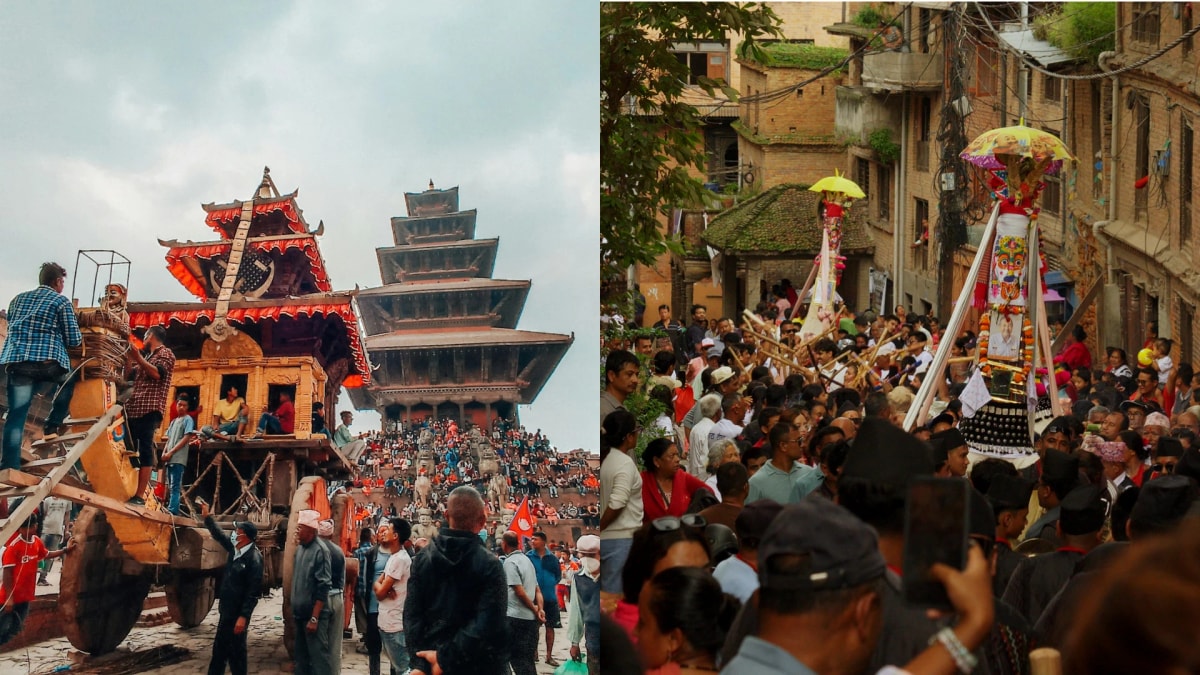
The Bhairavnath Temple is a three-tiered pagoda. It is dedicated to Bhairav, the fierce form of Lord Shiva, and stands beside Nyatapola in Taumadhi Square. King Jagat Jyoti Malla (1613–1637) first built it as a one-story temple. King Bhupatindra Malla raised it to three tiers in 1718. Legend says only Bhairav’s head is kept inside. The temple was destroyed in the 1934 earthquake and later rebuilt. The huge wooden wheels stacked beside it belong to the Bisket Jatra chariot, which crowds pull through the city streets every April. Learn more about the Bhairavnath Temple in Bhaktapur.
King Bhupatindra Malla’s Column
King Bhupatindra Malla’s Column is a tall stone pillar. A gilded bronze statue of the king sits on top. It stands in front of the Vatsala Durga Temple, facing the Golden Gate. It was raised during his reign (1696–1722). The king sits cross-legged with folded hands. He bows toward the goddess Taleju. Legend says it was built to outshine Kathmandu’s royal column. Today it is my favorite photo subject.
Ugrachandi and Ugra Bhairav at the Lion Gate
Ugrachandi and Ugra Bhairav are a pair of fierce stone deities. They guard the Lion Gate at the square’s western entrance. King Bhupatindra Malla set them up in 1701. Ugrachandi has 18 arms and slays a buffalo demon. Ugra Bhairav has 12 arms. Legend says the sculptor’s hands were cut off so he could never repeat the work. Both statues remain in place today.
Hanuman Bhairav and Narasimha Statues
Hanuman Bhairav and Narasimha are two stone guardians. They flank the entrance of the National Art Museum Bhaktapur, west of the Golden Gate. King Bhupatindra Malla installed them beside a pair of stone lions. Narasimha is still worshipped regularly. Offerings have worn it down. The rarely touched Hanuman Bhairav remains in good condition.
Taleju Bell and Barking Bell
The Taleju Bell is a large bronze bell. It hangs in front of the Vatsala Durga Temple. King Ranajit Malla cast it in 1737. It is still rung every morning and evening for Goddess Taleju. The smaller Barking Bell hangs beside it on the temple plinth. King Bhupatindra Malla added it in 1721. Its ring is said to set local dogs barking. Both bells survived the 2015 earthquake.
Chyasilin Mandap
The Chyasilin Mandap is an octagonal two-story wooden pavilion. It stands opposite the 55 Window Palace. King Bhupatindra Malla (1696–1722) built it as a royal meeting hall. It also served as a shield against the power of the Pashupatinath Temple. It was destroyed in 1934 and rebuilt with a steel frame. It came through 2015 unharmed. Its upper floor offers sunset views over the square.
Stone Lions (Lanpadegal)
The Lanpadegal are two monolithic stone lions. They stand in the open road near the Phasidega Temple, at the east end of the square. They once guarded a pagoda-style Harihar temple. That temple collapsed in 1934 and was never rebuilt. Their name means “temple blocking the road.” Today they are a quirky reminder of the lost temple.
How to Reach Bhaktapur Durbar Square from Kathmandu
Bhaktapur Durbar Square is about 13–15 km east of Kathmandu, a 30–60 minute trip by road depending on traffic. The cheapest option is the local bus (NPR 30–50). The fastest is a taxi or a ride-hailing app.
By local bus, take a Bhaktapur bus from Ratnapark or Bagbazar in central Kathmandu, a 15–20 minute walk from Thamel. Buses leave every few minutes, cost about NPR 30–50 and take 45 minutes to an hour, longer at rush hour. On the Kamal Binayak route, get off at Dudhpati, beside Siddha Pokhari. On the Suryabinayak route, get off at Suryabinayak Chowk. From either stop, the square is a 10–15 minute walk. Buses are crowded, so keep your bag in front of you.
By taxi, the trip from Thamel costs about NPR 900–1,500 one way and takes 30–45 minutes along the Kathmandu–Bhaktapur road. Taxis rarely use the meter, so agree on the fare before setting off. Most drivers drop you at the tourist bus park (Sano Byasi), a 3–4 minute walk from the square. For a fee agreed in advance, many will wait a few hours for the return trip. From Tribhuvan International Airport, expect NPR 1,000–1,500.
By ride-hailing app, the price is fixed before you ride and is usually cheaper than a street taxi. A car costs about NPR 580–900 on inDrive, NPR 600–900 on Yango, NPR 650–1,000 on Pathao or NPR 700–1,100 on Uber. A motorbike ride on Pathao, inDrive or Yango costs much less and takes about 20–30 minutes. Set “Bhaktapur Durbar Square” as your destination.
Note: the old city is closed to traffic, so wherever you are dropped, you walk the last stretch. Buy your entry ticket at the booth on the way in and keep it with you, because inspections are common.
Best Time to Visit Bhaktapur Durbar Square
Best time of day:
6–9am is the finest window. The ticket counter opens, temple bells ring, and locals make their morning offerings of flowers and butter lamps. The Juju Dhau shops open, and the courtyards are empty enough for clean photos.
4–7pm is the second-best window. The light turns golden, and the Chyasilin Mandap offers sunset views over the square.
Avoid 10am–3pm, when tour groups arrive, photo spots get crowded and harsh overhead light flattens photos.
Best season:
October and November are the finest months, with clear skies, mild days of around 20–25°C and Himalayan views from nearby Nagarkot. Dashain and Tihar bring rituals to the square.
February to April is a close second. In mid-April, Bhaktapur celebrates Bisket Jatra, its New Year chariot festival.
June to September is the monsoon. Heavy afternoon rain makes the stone paving slippery and clouds hide the mountains. The potters in Pottery Square also stop work. The exception is Gai Jatra in August or September, which is worth braving the rain for.
Festivals at Bhaktapur Durbar Square - must experience festival of Bhaktapur
Bisket Jatra | Gai Jatra | |
Local name | Biska: Jatra (Nepal Bhasa) | Saa Paru (Nepal Bhasa) |
Meaning | Popularly “after the death of the snakes,” from a legend of slain serpents | “Cow festival” (gai = cow, jatra = festival) |
When | Nine days around the Nepali New Year, about Chaitra 27 to Baisakh 5 (mid-April) | First day of the waning moon in Bhadra (late August or early September); about a week in Bhaktapur |
Why it is celebrated | Marks the start of the Bikram Sambat year and honors Bhairav and the goddess Bhadrakali | Families who lost a loved one in the past year take part; Hindus believe the cow guides the dead safely to the afterlife |
How it begins | A tantric ritual at the Bhairavnath Temple in Taumadhi Square | Worship of Taleju |
Main events | The city’s upper and lower halves pull Bhairav’s giant three-tiered chariot in a fierce tug-of-war through the streets. On New Year’s Eve, crowds topple the tall wooden Yosin pole at Bhelukhel | About 29 tahamacha (tall bamboo-and-cloth structures with photos of the deceased) are paraded around Nyatapola and the Durbar Square area. Young men perform the Ghintang Ghisi stick dance to dhime, bhusya and khin drums |
What makes it special | Bhaktapur’s biggest festival, with the chariot tug-of-war at its heart | It turns mourning into a joyful, week-long street celebration |
What visitors can experience | Drums, packed lanes, rooftop crowds and the chariot tug-of-war; watch from a safe distance | Join the crowds, watch the dancers and feel the community spirit |
Comparison Patan Durbar Square vs Kathmandu Durbar Square vs Bhaktapur Durbar Square
In Nepal’s heart the Kathmandu Valley has three royal durbar squares, all UNESCO-listed, and travelers with limited time often ask which to prioritize. Patan wins for fine art and a relaxed atmosphere close to the capital; Bhaktapur wins for scale and a car-free, frozen-in-time feel.
Patan Durbar Square | |||
City | Lalitpur (Patan) | Central Kathmandu | Bhaktapur |
Best for | Fine art, Newari craft, calm | Central location, grandeur | Scale, car-free medieval feel |
Crowds | Moderate | Moderate–heavy | Moderate |
From Thamel | ~20–40 min | ~10–15 min (walkable) | ~45–60 min |
Foreign entry (approx.) | ~NPR 1,000 (museum incl.) | ~NPR 1,000 (museum incl.) | ~NPR 2,000 |
Signature sight | Krishna Mandir · Patan Museum | Kumari Ghar · Hanuman Dhoka | 55-Window Palace · Nyatapola |
Signature festival | Rato Machhindranath Jatra | Indra Jatra | Bisket Jatra, Gai Jatra |
Final Thoughts on Bhaktapur Durbar Square
Bhaktapur Durbar Square is more than a collection of old monuments. It is the living heart of Bhaktapur, the “City of Devotees,” about 13 km east of Kathmandu. The altitude of Bhaktapur city is 1,401 meters (4,596 feet), and the city covers just 6.88 square kilometers. It has been part of the Kathmandu Valley UNESCO World Heritage Site since 1979. From here, the Malla kings once ruled the Kathmandu Valley. Their royal palace, with its 55 Window Palace, Golden Gate and Taleju Temple, still shows Newar woodcarving and metalwork at their finest. The National Art Museum Bhaktapur holds centuries of stone, paint and wood inside it. Around the palace, the Vatsala Durga Temple, King Bhupatindra Malla’s Column and dozens of temples fill the square. A short walk leads to the Nyatapola Temple in Taumadhi Square, Pottery Square and Dattatreya Square, all on the same ticket. Siddha Pokhari and Changu Narayan Temple lie close by. Between the sights, a clay cup of Juju Dhau completes the experience. Come early in the morning, between October and April, or during Bisket Jatra in April. Locals still worship, trade and craft here as their ancestors did. For travelers seeking an authentic Nepali experience, Bhaktapur Durbar Square is a must-visit.