How Swayambunath Influenced Nepal & World Buddhism
Sworup Shrestha
Author
Sworup Shrestha writes for Hidden Hymn — long-form stories from the world's quietest corners.
August 7, 2026 · 10 min read
Before first light, the eastern stairway belongs to the people who use it - people carrying a brass tray of marigolds and vermilion, walking the steps at the pace the steps demand. An old man who stops at the same landing he has stopped at for forty years, not because he is tired but because that is where one stops. A boy sent ahead with a thermos, taking the stone two at a time, overtaking everyone. The macaques are awake and uninterested. The city below is still a grey suggestion of itself, and the first thing that resolves out of it, as you climb, is not the stupa but the smell - juniper smoke, butter lamps, wet stone.
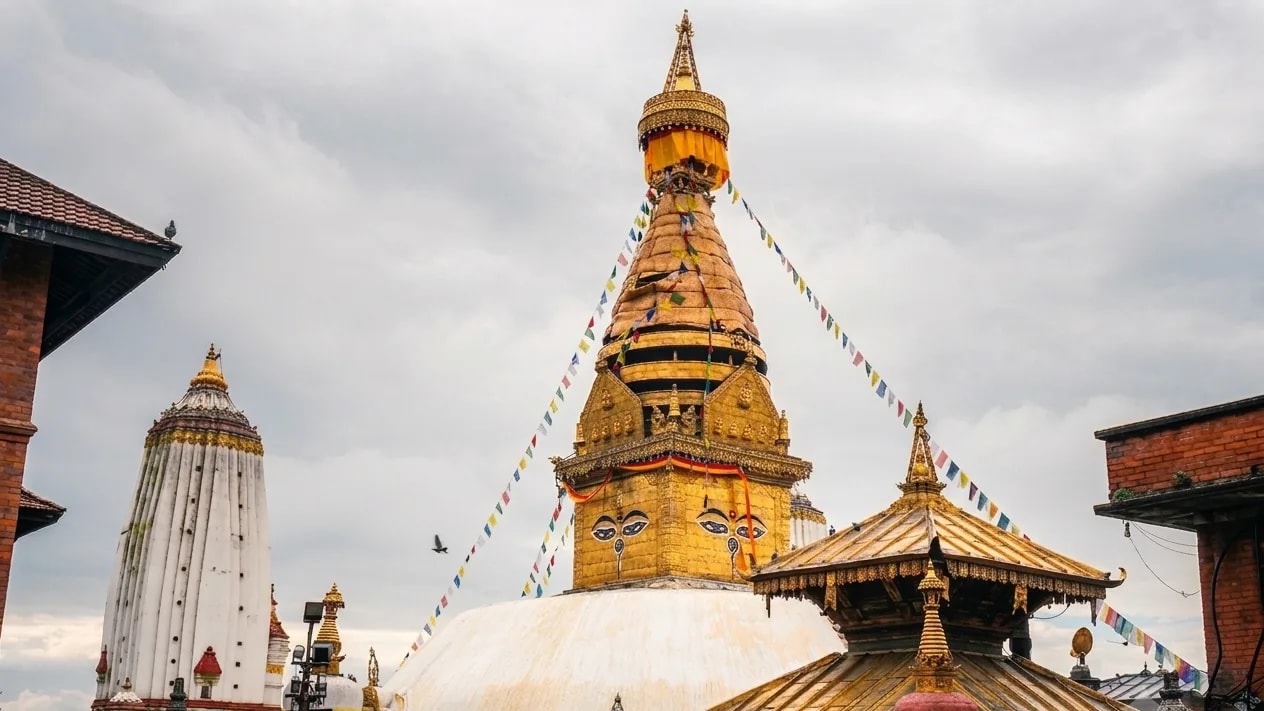
Then the dome, and above it the eyes. They are painted on all four faces of the gilded cube at the summit, one pair to each cardinal direction, and they are the single most reproduced image Nepal has ever exported. They appear on aircraft tails and tourist bags and the letterheads of trekking agencies in cities that have never heard of the Kathmandu Valley. They are, by some distance, the most famous eyes in the Himalaya.
The Valley's Origin Story
Most sacred sites sit within the story of the place that holds them. Swayambhunath is the rare exception. In Nepal's own telling, the Kathmandu Valley exists because of it.
The Swayambhu Purana describes the valley as a vast lake with a lotus at its centre, giving off a self-arisen light - swayambhu, self-born. Manjushri, the bodhisattva of wisdom, saw that light from the surrounding hills and travelled south to reach it. With a stroke of his sword he cut the gorge at Chobar and let the waters drain away.
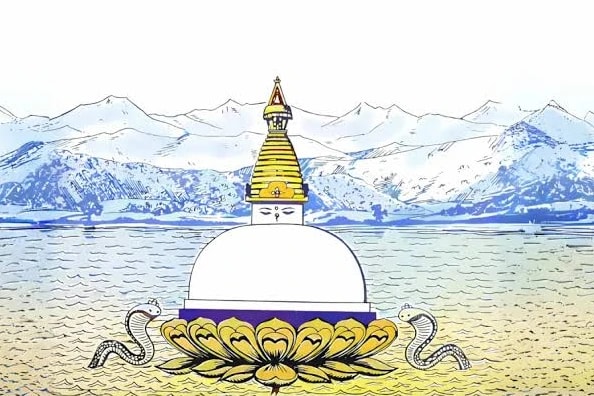
The land that emerged was not incidental to the story. It was made habitable so that the light could be approached and served. The valley's first settlement, Manjupattan, is said to have been founded on the ground between Swayambhu and Guhyeshwari.
One detail is worth adding. Geologists agree the valley genuinely was a lake, drained over millennia by natural processes at its southern end. The Purana's central claim about the landscape happens to be true. What the story supplies is not the fact but the reason - and in doing so, it places this hill at the beginning of civilization in the valley rather than somewhere within it.
A Shrine Shared by Hindus and Buddhists
Beside the dome stands the pagoda of Harati Ajima, a goddess of Hindu origin adopted by Buddhists as guardian of children and protector against epidemics - worshipped daily by Hindu and Buddhist mothers alike, particularly when a child falls ill. Manjushri himself is identified by many with Saraswati, and the hill west of the stupa carries her name. Chaityas and Hindu shrines stand within metres of one another.
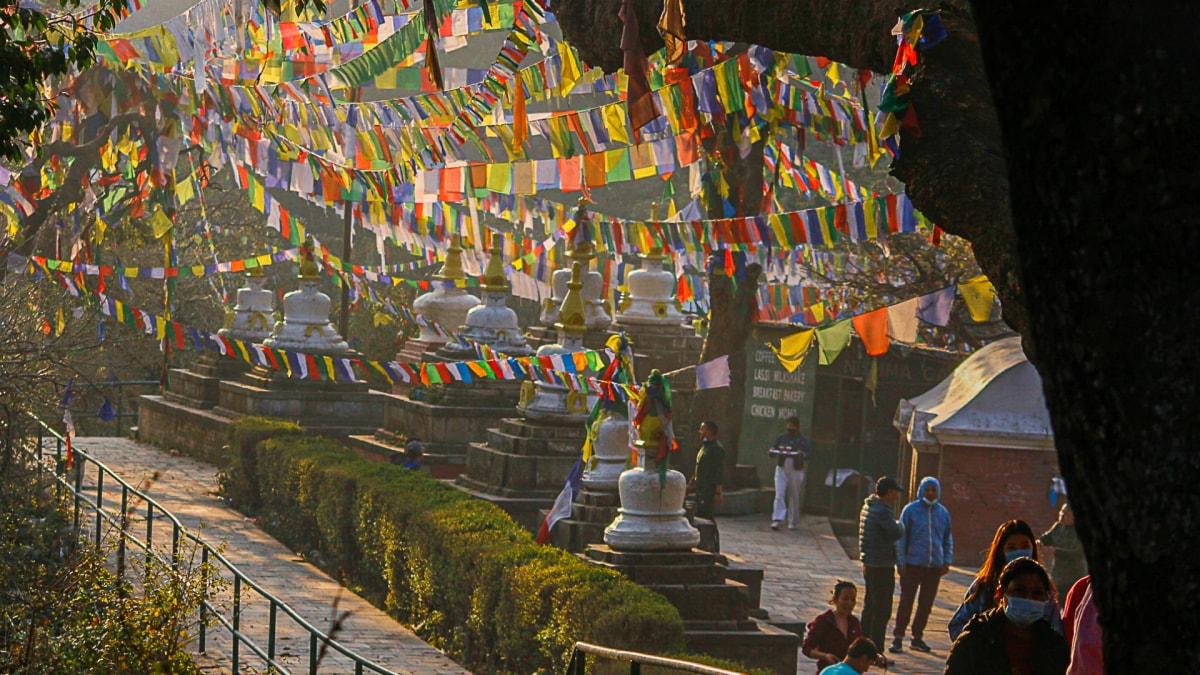
This is not a recent accommodation. Licchavi rulers patronised both faiths from the early centuries CE. The Malla kings, Hindu by affiliation, funded Buddhist institutions throughout their reigns - Pratap Malla erected Vajrayana shrines at Swayambhunath in 1658 and donated land to the site.
For Nepal, the hill is therefore more than a Buddhist monument. It is one of the clearest demonstrations of how the country's two great traditions have shared ground rather than divided it, worked out over centuries in practice rather than declared as policy.
The Centre of Newar Buddhist Life
For the Buddhist Newars - the valley's indigenous community, and the people who built and have maintained the site - Swayambhunath is the most sacred place there is.
Its authority is structural rather than sentimental. Every Newar courtyard monastery in the valley, of which roughly a hundred still function, holds a miniature stupa at its focal point representing Swayambhu. The ritual calendar turns around the hill, most visibly during Gunla, the holy month of Newar Buddhism falling in the monsoon. Daily ritual at the stupa is carried by the Buddhacharyas, hereditary Newar caretaker-priests whose families rotate the custodianship between lineages. The obligation is inherited rather than appointed, and it has passed down this way for centuries.
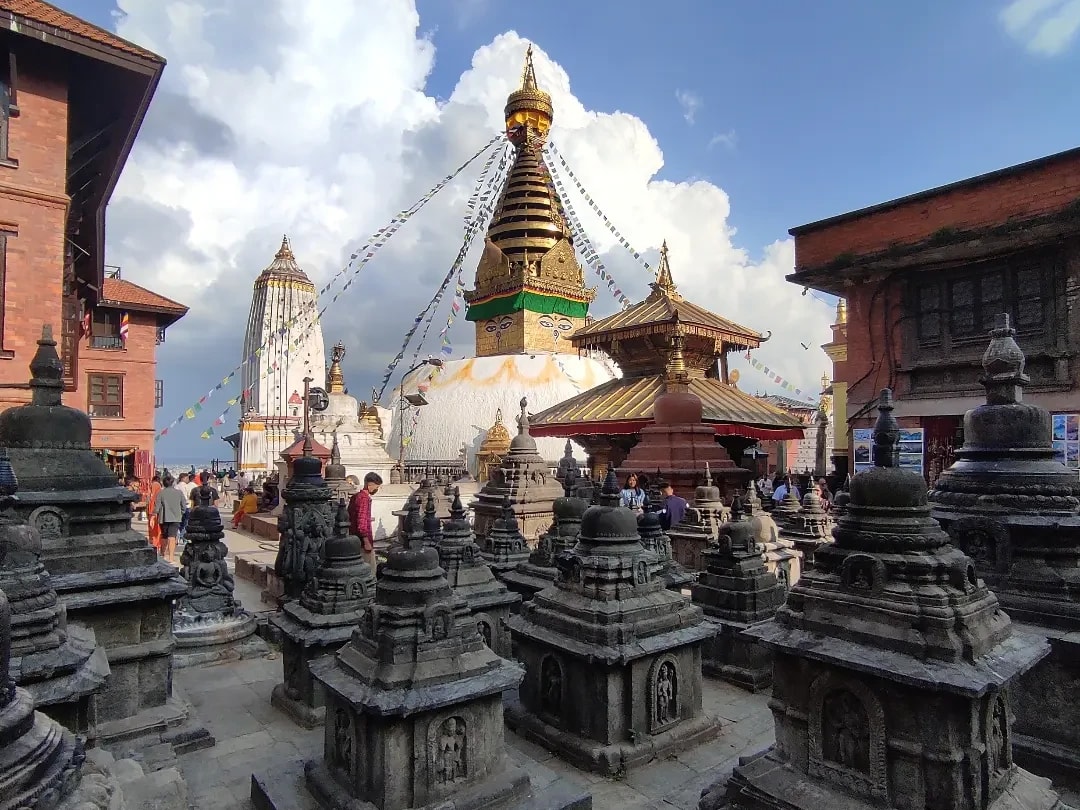
That continuity has been tested repeatedly. The stupa was damaged and stripped of its gold when an army from Bengal reached the valley in 1349. It has been restored roughly fifteen times in its recorded life. In 2015 an earthquake brought down two seventeenth-century temples on the hill and left a monastery beyond saving - though the stupa itself stood, helped by flexible timber reinforcement Newar builders had set into the brickwork of its base.
Each time, the ritual resumed. It resumed because the people responsible for it were never an institution that could be dissolved. They were families.
The Living Sanskrit Buddhist Tradition
What Swayambhunath has is not age. It is continuity - and continuity is rare to the point of being almost unique.
Consider what happened to Buddhism everywhere else. In Tibet, China, Japan, Korea and Sri Lanka it survived magnificently, but it survived by being carried across a language barrier: the Sanskrit was rendered into Tibetan, into Chinese, into Pali, and the original was let go. Those translations are extraordinary achievements. They are also, unavoidably, a kind of loss. Every translated tradition is a tradition that has been handed to someone else to keep.
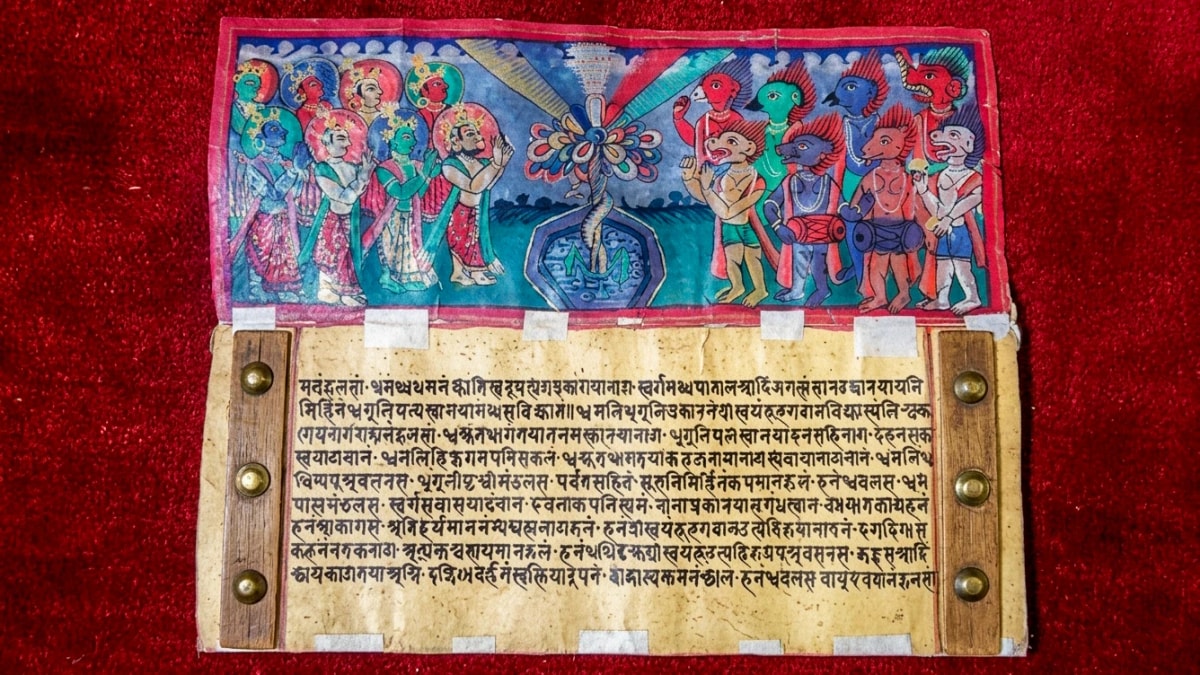
In the Kathmandu Valley, Buddhism was never handed over. It was kept, in Sanskrit, in the same script, by the same families, through an unbroken succession of priests who married and had sons and taught them the rituals their fathers had taught them.
“The hill is not important because it is old. It is important because it is the place where a thread that snapped everywhere else was never cut.”
Newar Buddhism is the result: a distinct form of Vajrayana, separate from the Tibetan and Japanese traditions, and the last living Sanskrit Buddhist tradition anywhere in the world. For Buddhist Newars, whose origin story and daily practice both centre on this hill, Swayambhunath is the most sacred site there is.
Araniko: The Artist Nepal Sent to China
In 1260, an emissary arrived in the valley looking for craftsmen. He came for Drogön Chögyal Phagpa, the Sakya lama who had become imperial preceptor to Kublai Khan, and the commission was a golden stupa in Tibet. Phagpa did not send to China for artisans. He was sent to Nepal, because everyone in the trans-Himalayan world already knew where the finest metalworkers and image-makers were.
Eighty Newar artisans were recruited. Asked to nominate a leader, a boy of about sixteen volunteered. His name was Araniko. He finished the Tibetan work, was sent on to the Yuan court, and stayed for the rest of his life. Between 1271 and 1279 he supervised the White Stupa at what is now Beijing's Miaoying Temple, bringing Newar brickwork technique into Chinese practice. He was appointed overseer of the empire's artisans. His recorded output runs to three stupas, nine Buddhist temples, two Confucian shrines and one Daoist temple, and an entire school of Yuan-period art carries his name.
He died in China in 1306, having never returned home. In 2019, ahead of a state visit, China's president named both Araniko and the White Stupa as symbols of friendship between the two countries. The point often missed is that Araniko did not appear from nowhere. He came from a valley with such depth of Buddhist artistic training that a Mongol emperor's preceptor knew to send here first - and such surplus that eighty qualified artisans could leave without visible cost to the place behind them.
The Manuscripts That Reached Europe
Brian Houghton Hodgson arrived in Kathmandu in 1820 and stayed, mostly as a British Resident, until 1843. The posting left him time, and he used it. He collected birds, mapped languages, and became the first European to understand that the Kathmandu Valley held a complete, living Sanskrit Buddhist literature. He could not read it. Hodgson was not a Sanskritist. So he worked with a Newar Buddhist scholar named Amritananda, who guided his understanding of the texts and supervised teams of copyists from around 1825.
In April 1837, twenty-four Sanskrit manuscripts reached Paris - sutras and tantras long lost in India and preserved only in Nepal. They were passed to a young scholar named Eugène Burnouf, whose work on them produced Introduction à l'histoire du Buddhisme indien in 1844 and a translation of the Lotus Sutra published in 1852. These founded Buddhist studies as an academic discipline in Europe. Before them, Buddhism was known to have begun in India, but no Sanskrit sources had been found. Hodgson eventually distributed around four hundred manuscripts to libraries across India, Britain, France and Germany.
Burnouf's Lotus translation carries a dedication naming Hodgson as the founder of the true study of Buddhism through texts and monuments.
Amritananda had died in 1835 - two years before the Paris shipment arrived, and long before the discipline he helped enable acquired a name. His contribution deserves more recognition than it has had. And behind him stands the larger point. Those manuscripts existed because Newar scribes had copied and recopied them, in Sanskrit, for centuries - with no external reason to continue. The shipping was Hodgson's contribution. The library was Nepal's.
Read next: Swayambhunath Stupa - History, Legends and Travel Guide
A Refuge for Tibetan Buddhism
Tibetan attachment to Swayambhu is old. The Tibetan name for the site, 'Phags pa Shing kun, appears in pilgrimage literature; Kagyu lamas made Kimdol Vihara below the stupa their own through the seventeenth and eighteenth centuries; the sixth Shamarpa built shrines at the four cardinal directions in 1614. For Tibetan Buddhists the hill has long ranked second only to Boudha.
For centuries the traffic ran one way. Tibet came to this valley for artisans, texts, teachers and consecration. After 1959, it reversed. Around twenty thousand Tibetans arrived in Nepal, and settlements were established through the early and mid-1960s - one of them at Swayambhunath. The hill that had supplied Tibet for a thousand years became a place where Tibetan Buddhism was rebuilt.
There is a detail here worth knowing. The stupa's most recent full renovation was completed in May 2010, the first major work since 1921, with the shrine re-gilded using some twenty kilograms of gold. The funding came from a Tibetan Buddhist centre in California.
Given long enough, the thread runs in a circle.
Why It Matters
The story of world Buddhism is usually told as transmission outward from India, with the Himalaya as a corridor between larger places.
For a critical stretch of that history, the Kathmandu Valley was not a corridor. It was the centre point.
The stupa form that reads as Buddhist across half the world was carried out of this valley by its artisans. The Sanskrit texts that founded Western Buddhist scholarship survived here because families copied them for centuries without being asked to. A tradition that vanished from its homeland stayed alive in its original language because a few thousand households in three small cities decided to keep it — through invasion, isolation and earthquake.
The eyes look out in four directions, and have never needed anyone to notice. But it would be a mistake to keep treating the hill as a picturesque survivor of something that happened elsewhere. It is where the thing was kept.