Mahabuddha: Patan's Hidden Temple of a Thousand Buddhas
Hidden in the lanes of Patan, Mahabuddha is a terracotta tower where nearly every brick bears the Buddha - the story of the Temple of a Thousand Buddhas.

Sarvagya Shakya
Author
Sarvagya Shakya writes for Hidden Hymn — long-form stories from the world's quietest corners.
July 19, 2026 · 7 min read
Beyond Patan Durbar Square: Mahabuddha Temple
Most travelers come to Patan for the medieval grandeur of Patan Durbar Square, a UNESCO World Heritage Site of Nepal and a fixture on every Nepal itinerary. But the square is only the opening line. The sentence you'll remember is hidden a few minutes walk away, buried so deep in the residential lanes that you cannot see it until you are standing directly beneath it.
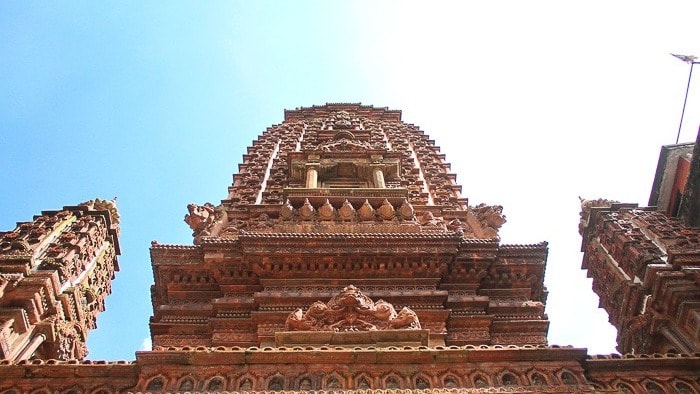
There's no grand approach. Instead, you follow a slim covered passage that threads between brick houses pressed so close they seem to lean in overhead. And then the lane opens - and the temple is suddenly above you: a slender, soaring tower of red terracotta, crammed into a courtyard barely wide enough to hold it, straining upward like a plant reaching for a sliver of sky. Because the buildings crowd in so tightly, you never see the top as you approach. The full spire appears all at once, out of nowhere, the moment you step clear of the passage.
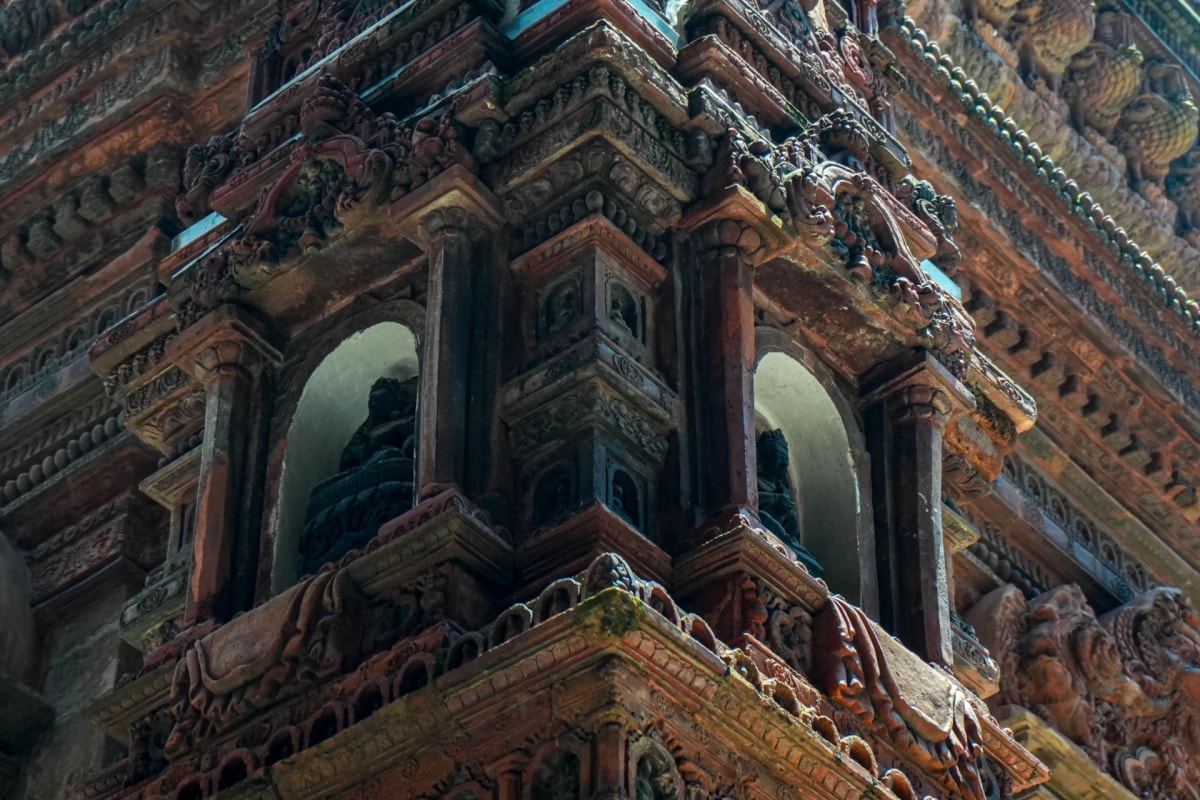
This is Mahabuddha - the Temple of a Thousand Buddhas - and it is worth understanding before you stand there, because what looks at first like a single beautiful tower is really a five-hundred-year argument about devotion. It was dreamed in India, paid for by a coin mint, built by one family across generations, knocked flat by an earthquake, and rebuilt from memory by people who refused to let it stay fallen. Some of the most profound things in this valley are not displayed in the open. They are hidden, and they ask you to come and find them. This is one of them.
Why Is It Called the Temple of a Thousand Buddhas?
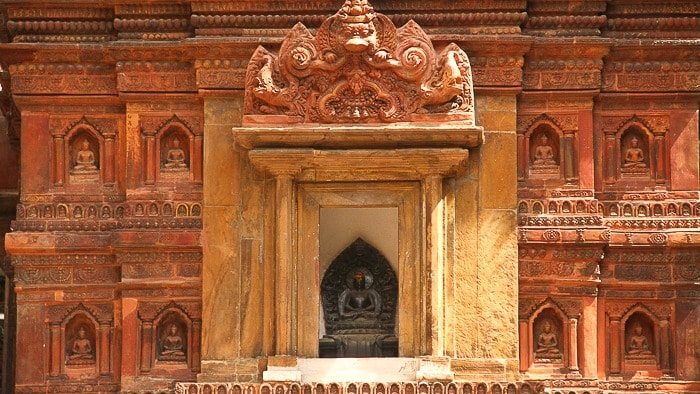
The temple takes its popular name from a single, extraordinary fact: nearly every brick and terracotta tile on its surface is stamped with an image of the Buddha. Look closely and the spire dissolves into countless seated figures, repeated from base to pinnacle in disciplined rows. Many of them show the Buddha in the earth-touching gesture - the moment he called the ground itself to witness his awakening.
How many are there? It depends on who's counting, and when. Some call it the Temple of a Thousand Buddhas; others say one thousand and eight, or nine thousand, or even ten thousand. (The nine-thousand figure, confusingly, seems to refer to the total bricks beneath the tiles rather than the Buddhas on them.) The precise count has never really mattered. What matters is the effect - a building that is, in essence, made of Buddhas.
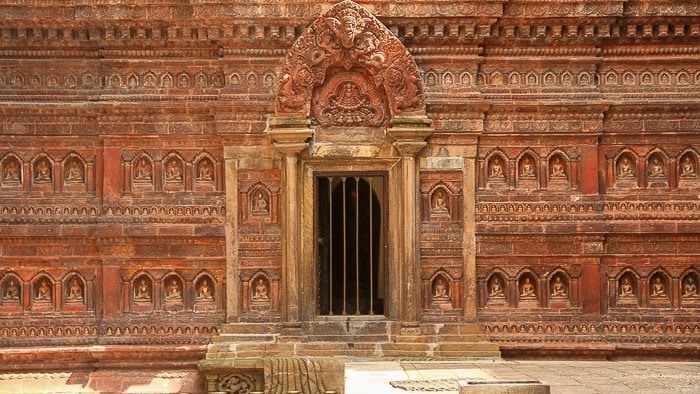
Just as striking is its shape. Most temples in the Kathmandu Valley follow the tiered, pagoda form, with sloping roofs stacked one above another. Mahabuddha is different. It is a shikhara - a tall, curvilinear tower in the North Indian style, rising to a single point. This makes it one of the first and finest shikhara style Buddhist temples in Nepal, an architectural rarity standing apart from everything around it.
The spire is crowned with golden, stupa-like finials; by tradition, the crowning elements are read as symbols of the five primal elements. Inside the small sanctum sits a gilded image of the Buddha. It is the kind of monument that rewards patience - there is always one more carved face to find, one more detail in the terracotta you missed the first time.
Who Built Mahabuddha?
In the 16th century, a devout priest of Patan named Abhaya Raj Shakya - a member of the Uku Baha monastery, of which Mahabuddha is now a branch - made the long pilgrimage to Bodhgaya in India, the place where the Buddha is said to have attained enlightenment. There he stood before the great Mahabodhi Temple and was so moved that he resolved to bring a vision of its beauty home to his beloved city.
According to local accounts, Abhaya Raj returned with more than inspiration. While in India he is said to have learned the art of smelting copper and minting coins - a highly prized skill at a time when Kathmandu controlled the lucrative trade in coins used across the Himalaya. On his return, the king recognized the value of this expertise and installed him as a royal coinmaker. The position was a profitable one, and many believe it provided the means to begin building the temple he had dreamed of in Bodhgaya.
To this day, a few of the old Newar houses ringing the temple's courtyard are remembered as homes of the metal craftsmen - and some are said to still belong to Abhaya Raj's descendants. The narrow lanes around the temple remain lined with workshops selling Patan's renowned bronze and metal statues, an unbroken thread connecting the temple's origins to the living craft of the neighborhood.
How Long Did It Take? A Temple Built Across Generations
Great vision rarely fits inside a single lifetime. Abhaya Raj began the work, but he died before his temple was finished. The task passed to his sons, and then to their children after them - a project carried forward across generations of one family.
One legend captures the difficulty of the undertaking. Of Abhaya Raj's sons, all but the youngest are said to have died with the temple still incomplete. The last son, exhausted and on the verge of abandoning the work, was visited by a goddess who urged him to continue. He did. The monument was finally completed around the year 1601 - decades after the dream first took shape in Bodhgaya.
Its consecration was witnessed by Siva Simha Malla, the king who had conquered Lalitpur in 1597 and who ruled both Kathmandu and Patan until his death in 1619. By then the Mahabuddha was no longer one man's ambition but a shared inheritance - a piece of the city itself, built by patience as much as by faith.
More Than a Monument: The Living Craft Around the Temple
It's tempting to file Mahabuddha under "hidden photo spot" - find it, photograph the spire, move on. That misreads it completely.
This was never just a building to look at. It is the still-beating heart of a working neighbourhood. The narrow lanes around the courtyard remain lined with the workshops of Patan's metalsmiths - the bronze- and copper-casters whose statues are sought the world over - an unbroken thread running straight from Abhaya Raj's royal mint to the craftsmen hammering away a few doors down today.

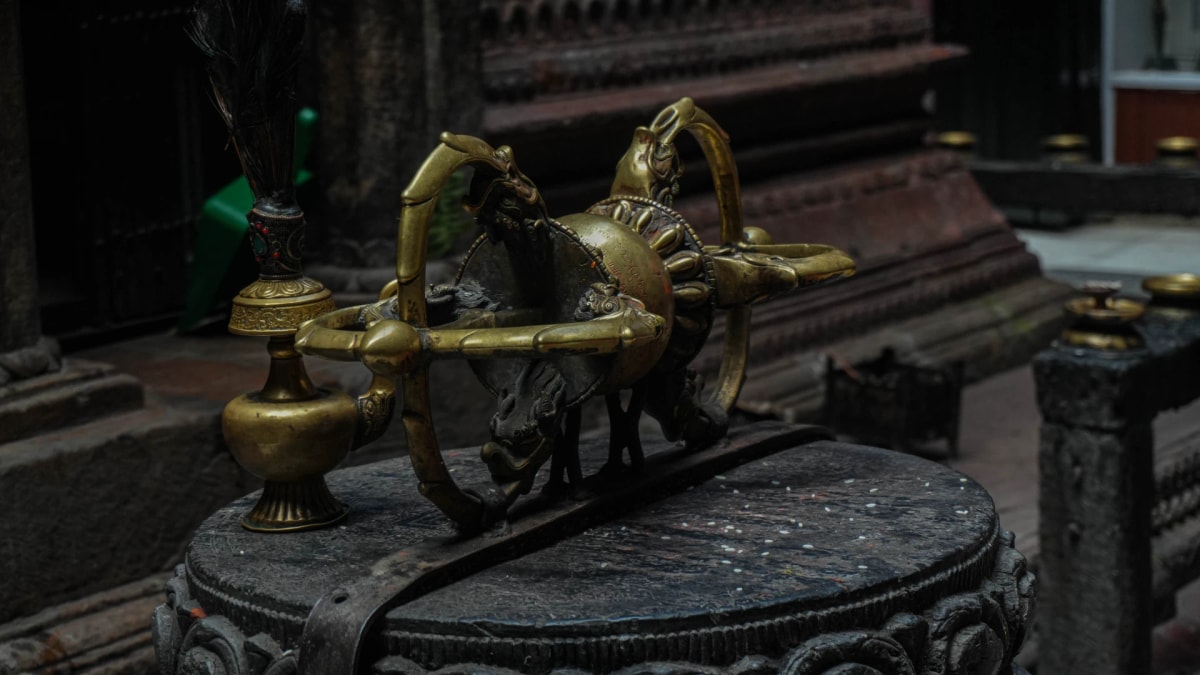
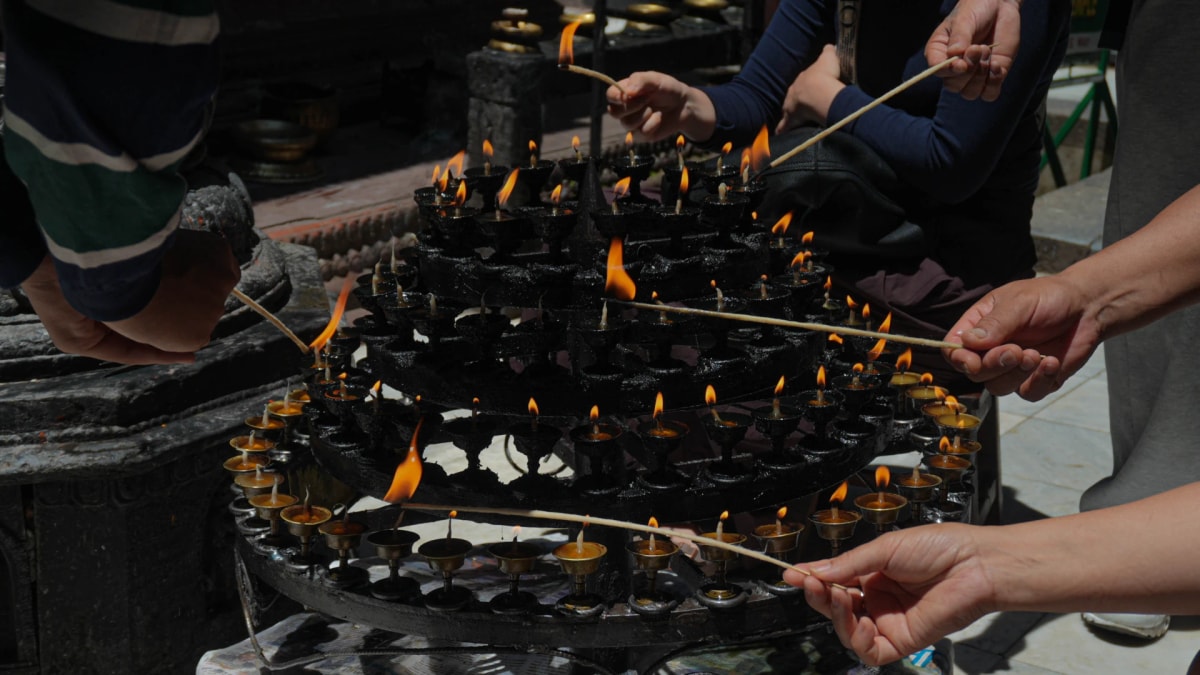
The temple is also a living shrine, a branch of the Uku Baha monastery, where devotees still circle the tower clockwise and light butter lamps at the stand by the entrance.
In other words, to the people who live here, the temple is not just a monument. It is a place of work and worship they have organised their lives around for four centuries - and that, more than the carvings, is what makes the courtyard feel the way it does.
Impact of Great Earthquakes of Nepal - Destruction and Rebirth
The great earthquake of 1934 struck the temple so severely that it was effectively destroyed and had to be rebuilt almost entirely from the rubble.
Here the story takes a curious and rather beautiful turn. The builders who reconstructed the temple had no original plans, drawings, or photographs to work from. They rebuilt from memory and from the scattered carved bricks - and the temple that rose again did not look quite the same as the one that had fallen. Stranger still, when the spire was complete, there were many carved Buddha-bricks and tiles left over. Rather than discard them, the builders used the surplus to construct a smaller second shrine in the corner of the courtyard, dedicated to Maya Devi, the mother of the Buddha. That little shrine - born from the leftovers of a rebuilt temple - still stands beside the main tower today.
Mahabuddha was shaken again by the major earthquake of April 2015, though this time the damage was comparatively minor and the spire stood firm. Restoration work followed, with the temple and its surroundings repaired by 2022; more recently, the cramped entrances to the courtyard were reworked to give the site a little more breathing room. Through every collapse and recovery, the temple has remained what it has always been: a place where the community returns, again and again.