Lo Manthang: Inside Nepal's Last Walled City
Sworup Shrestha
Author
Sworup Shrestha writes for Hidden Hymn — long-form stories from the world's quietest corners.
September 2, 2026 · 13 min read
You will hear the word forbidden long before you get there. It is on the trekking brochures, on the agency websites, in the mouth of every driver who takes you up the Kali Gandaki. The Forbidden Kingdom. The Last Forbidden Kingdom. Nepal's Forbidden City.
It is a good word for selling a trip and a poor word for understanding a place. Nothing about Lo Manthang was ever forbidden to the people who live in it. What the word actually describes is a permit regime - a set of rules written in Kathmandu, decades ago, for reasons that had far more to do with the Cold War than with mystery.
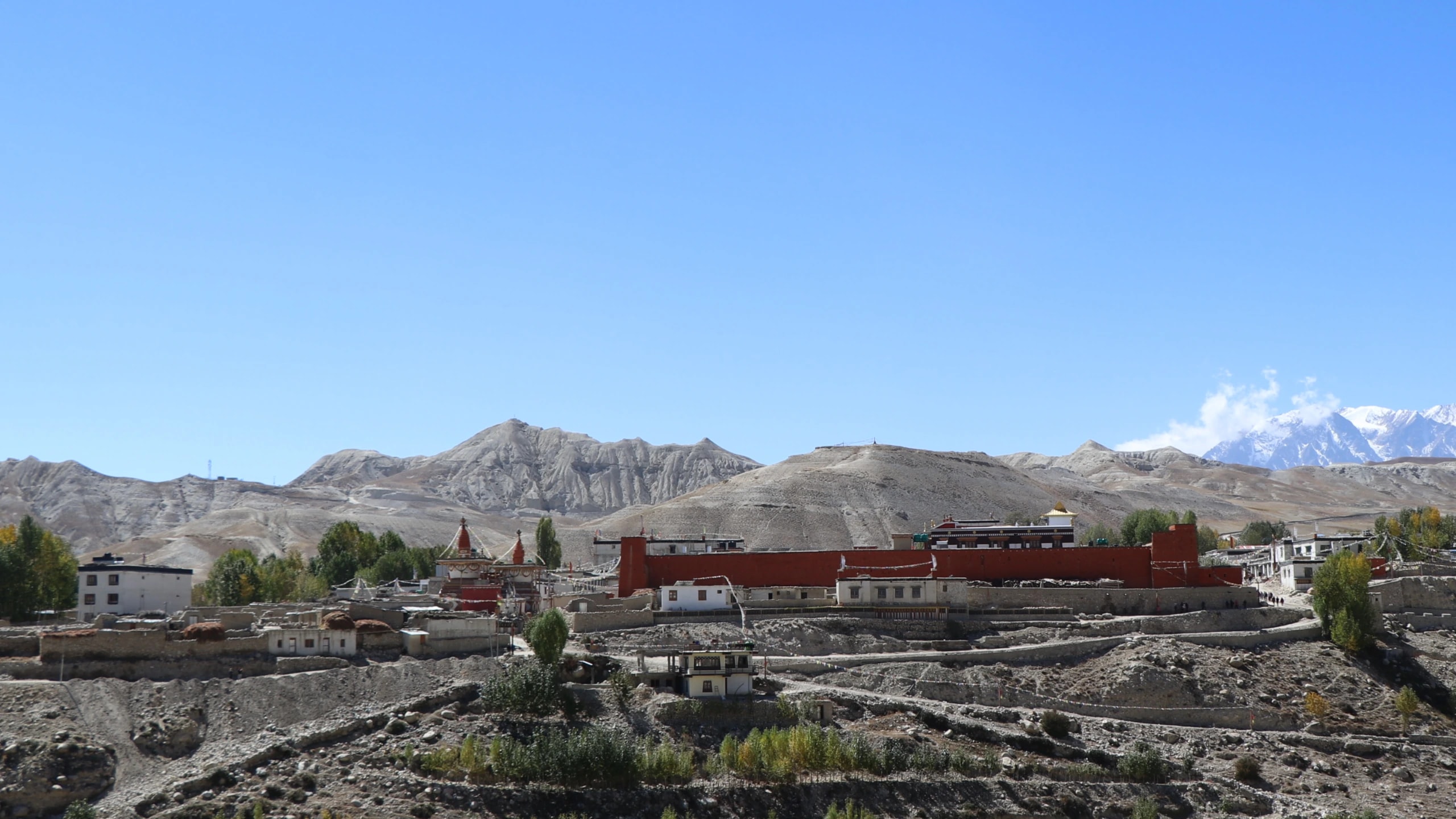
So set the word down at the gate. What is actually waiting on the other side is a working town of mud, raised on a windswept plain in 1380, still standing because it almost never rains here, still lived in by people whose great-grandparents paid taxes to a king. Roughly 170 houses pressed shoulder to shoulder inside a single earthen wall.
Lo Manthang: Nepal's Only Walled City
Lo Manthang sits at roughly 3,840 metres at the northern end of Nepal's Mustang district, close enough to the Tibetan border that you can drive to it in an afternoon. It was the capital of the Kingdom of Lo - an independent Himalayan state that ruled this valley for six centuries and it is the only settlement in Nepal still enclosed by its original city wall.
The name repays a moment's attention, because the translations disagree in an interesting way. Lo is the indigenous name of the kingdom itself. Manthang is usually broken into Tibetan roots meaning "plain of medicine" or "plain of aspiration" - the heart's desired land. Both readings survive locally, and nobody here seems especially bothered about settling it.
Detail | What travelers should know |
Location | Northern Mustang district, Nepal; the Tibetan border sits a short drive north |
Altitude | Approximately 3,840 m |
Founded | 1380 CE, by Ame Pal, first king of Lo |
The wall | Rammed earth and stone; sources give lengths between roughly 560 and 860 metres |
Inside the walls | A royal palace, four monasteries, and roughly 170–180 houses |
Opened to foreigners | 1992, and still a restricted area requiring a permit and licensed guide |
Best months | March–May and September–November; summer is dry here, unlike the rest of Nepal |
Lo Manthang sits in the rain shadow behind Annapurna and Dhaulagiri, which is the single fact that explains everything else. Monsoon clouds arrive from the south, break themselves against the two eighth-thousanders, and pass over this valley with nothing left to give. The result is a high desert on the other side of the Himalaya - and a city built almost entirely of mud that has stood for six hundred years, because the weather that would have dissolved it anywhere else in Nepal simply never arrives.
The buildings are made of the ground they stand on: rammed earth, sun-dried adobe brick, stone, and timber hauled from far below. Local elders say yaks were driven back and forth across the wet clay to compact the original wall.
Who Built Lo Manthang?
In the fourteenth century, this valley was not a kingdom but a scatter of feuding fortress chiefs, each holding a stretch of the Kali Gandaki. Ame Pal, a Buddhist warrior of Tibetan descent, brought them under one authority and decided his new territory needed a permanent capital.
Ame Pal prayed through the night and then followed a herd of sacred goats, letting them choose. In some tellings he simply walked where they walked. In others he fell asleep and woke to see the goats emerging from the ground itself on the smooth plain below. Either way the animals stopped, and on that spot he laid out a palace and built a wall around it. The year given is 1380.
Historians add a less mystical layer, and the two do not contradict each other so much as explain each other. The Kali Gandaki cuts the lowest corridor through the entire Himalayan chain. For centuries, caravans carrying Tibetan salt and wool south and Nepali grain north had no better route. Whoever held this plain held the tollbooth on one of the great trade arteries of High Asia - and the Kingdom of Lo grew wealthy taxing traffic that had nowhere else to go.
That wealth is the reason a remote mud town contains fifteenth-century wall paintings of a quality that art historians rank among the finest surviving anywhere in Asia. Lo was not a backwater that happened to acquire treasures. It was rich, and it spent its money the way rich Buddhist kingdoms did.
Ame Pal's line ruled for twenty-five generations. Gorkha armies folded the kingdom into a unifying Nepal in the late eighteenth century, but distance did what independence could not: the Rajas of Mustang kept real local authority and enormous ceremonial standing for another two hundred years.
Inside the Walls: A Palace, Four Monasteries, and 170 Houses
There is one gate, on the eastern side. Within living memory it was shut at dusk and opened at dawn, and people organised their days around it.
From outside, the wall reads as a fortification. From inside, it reads as a room. The alleys are barely wide enough for two people to pass, the houses are flat-roofed and stacked with firewood along the parapets - winter fuel, and a quiet index of a household's standing - and the whole town can be crossed on foot in about 20 minutes. The counts differ depending on who is doing the counting and when. Most sources put the houses at 170 to 180. The wall is variously measured at 560, 750, and 860 metres. Nobody appears to have settled it, and after a while in Lo Manthang you stop expecting them to.
Four religious buildings anchor the town:
Thubchen Gompa, built in the 1470s, is the great assembly hall - a broad, dim, pillared space where the wall paintings run in registers of turquoise, malachite, cinnabar and gold. It is the one most visitors remember.
Jampa Lhakhang, raised a couple of years later and dedicated to Maitreya, the Buddha yet to come, holds what is widely described as the largest collection of painted mandalas in the world. Where Thubchen overwhelms, Jampa rewards patience. The mandalas are diagrams of entire cosmologies, and you can stand in front of one for a long time before it resolves.
Chode Gompa, from the 1700s, is the working monastery - home to the monks who spend months rehearsing the masked dances of the Tiji Festival each spring.
Choprang Gompa, known locally as the new gompa, completes the four.
And in the middle of it all, the palace - Tashi Gephel, the fortunate palace - rises several storeys above every other roofline. Twenty-five kings lived in it. Nobody lives in it now.
The Empty Palace: What Happened to the King of Mustang?
Jigme Dorje Palbar Bista was born in the Lo Manthang palace in 1930, educated in Shigatse in Tibet, and succeeded to the throne of Lo in 1964. He was the twenty-fifth in Ame Pal's direct line.
In 2008, Nepal became a republic and abolished its own monarchy, and the royal title of Lo lapsed with it. He kept the deference of his people anyway, in the way that titles removed by legislation are not always removed in practice. He died in Kathmandu in December 2016, at eighty-six. His funeral began there with prayers and monks chanting and continued in Lo Manthang with processions through the walled town.
The palace has stood empty since.
His nephew and heir, Jigme Singhi Palbar Bista, is the twenty-sixth of the line and carries no official standing. He attends the ceremonies. He runs a hotel. In an interview with National Geographic he described a hope of turning the family's inherited collection into a living museum, and observed with some humour that what the project chiefly requires is money he does not have.
There is something clarifying about that. A dynasty that lasted six hundred years now depends on whether enough travellers come up the valley - and on whether the money they bring stays in it.
Who Are the Loba, the People of Upper Mustang?
There is a word the people of Upper Mustang use for themselves. They are Loba. It means, simply, the people of Lo. In Tibetan it carries the sense of the south, which tells you exactly where the naming was done from. To be Loba is to be, by the geography of an older empire, a southerner.
500-Year-Old Murals Being Repainted
Here is where Lo Manthang stops being a monument and becomes an argument.
By the 1990s the murals inside Thubchen and Jampa were in serious trouble - roofs leaking, plaster separating from the wall, pigment lifting away in flakes. At the king's request, the American Himalayan Foundation took on the restoration and brought in the conservation architects John Sanday Associates, with Italian mural specialists advising. Work began at Thubchen in the late 1990s and extended to Jampa, and onward to monasteries at Tsarang and Lo Gekar.
Then the April 2015 earthquake arrived. It cracked plaster at Jampa Lhakhang and left shards of a five-hundred-year-old fresco lying on the floor. It weakened the palace. It ruptured the drainage system, letting water into monastery walls and raising the risk of mold in a building that had been dry for five centuries.
The restoration that followed opened a genuine disagreement, and it is worth understanding before you walk in.
Mainstream Western conservation practice is deeply reluctant to repaint. The ethic is minimal intervention: stabilise what survives, make losses visible, never invent. Retouching a damaged fifteenth-century image is, in that tradition, close to forgery.
The Loba community's position is entirely different, and entirely coherent. These are not paintings. They are Buddhas. A devotee should not have to pray to a damaged image of the Buddha, and keeping the images whole is not vandalism but obligation - a duty that has passed down families here for generations, exactly as the murals themselves did.
So the murals have been cleaned and retouched, and the people doing the retouching are largely local artists, trained in the traditional idiom, restoring images their own ancestors commissioned. Journalists documenting the work have described young Loba painters speaking about the nervousness of touching something irreplaceable.
You can hold both of these positions in your head at once and still not know which is right. That is the point. Lo Manthang is one of the few places left where the question is lived rather than settled - where a community still has the standing to decide what happens to its own sacred art, instead of having a foreign conservation philosophy applied to it. Whatever you conclude, the murals in front of you are the result of people making that choice for themselves.
Lo Manthang Now: The Road, and the Question of Who It Is For
For most of the modern era, reaching Lo Manthang meant days of walking up the deepest gorge on earth. That is no longer true. The road now runs up the Kali Gandaki to the walled city and onward toward the Tibetan border, and a journey that once took the better part of a week can be done by jeep.
Ask what the road has done and you will get answers that do not agree, from people who are all correct.
It has ended a genuine isolation that made illness dangerous and trade difficult, and Loba who spent their lives walking now have a choice about it. It has also collapsed the multi-day trek that was Upper Mustang's tourism economy into a drive-through, so that visitors pass villages instead of sleeping in them, and the lodges along the old walking route watch the dust go by. Chinese goods come more cheaply than local ones. Young people leave more easily than they used to, and the town has houses standing empty.
This is the unresolved question at the centre of Lo Manthang, and it will not be settled by travellers. But how you travel here is not neutral. Sleeping two nights in the walled city instead of one, eating where the money stays local, hiring a Loba guide rather than one flown up from Kathmandu, paying for the monastery ticket that funds the roof - these are small, and they are also the entire mechanism by which a place like this either survives on its own terms or becomes a photograph of itself.
We have written about this at length in The Road That Changed Mustang.
Why Lo Manthang Is Worth the Journey
Most people arrive in Lo Manthang having been promised a lost world and spend their first hour mildly disoriented, because the town does not perform. There is no viewing platform, no spectacle waiting at the gate. There is a wall, some alleys, firewood on the roofs, and an old woman turning a prayer wheel who has no interest in you whatsoever.
Give it a day and the register changes.
You start to notice that the monastery you walked through is not a museum but a workplace, that the courtyard where the masked dances happen every spring is, the rest of the year, somewhere children play, and that the fifteenth-century mandala you stood in front of was painted for people whose descendants were praying beside you. Six hundred years of continuity are not announced here. They are simply the condition of the place, unremarked, the way weather is unremarked.
And then the palace, with nobody in it, and the empty houses, and the road running north - and you understand that you have not arrived at a preserved past at all. You have arrived in the middle of something being decided.
That is the reason to come, and the reason to come carefully. Lo Manthang has survived six centuries of wind, war and empire because it was too far away to matter to anyone. It is not too far away anymore. What it becomes next depends in part on the people now able to reach it.
Come slowly. Stay longer than you planned. And when you leave through the eastern gate, understand that the town does not need you to have been moved by it - only to have paid attention.