Yenyā Punhi (Indra jatra): The Festival of Kathmandu
Discover Yenyā Punhi (Indra Jatra) 2026: the meaning, history, deities, and demons of Kathmandu's root festival, and how it unites the city every year.

Sarvagya Shakya
Author
Hello fellow explores !! I am Sarvagya Shakya a cultural enthusiast , explorer and storyteller by heart . Bring out hidden stories from by Himalayan kingdom - Nepal
September 16, 2026 · 17 min read
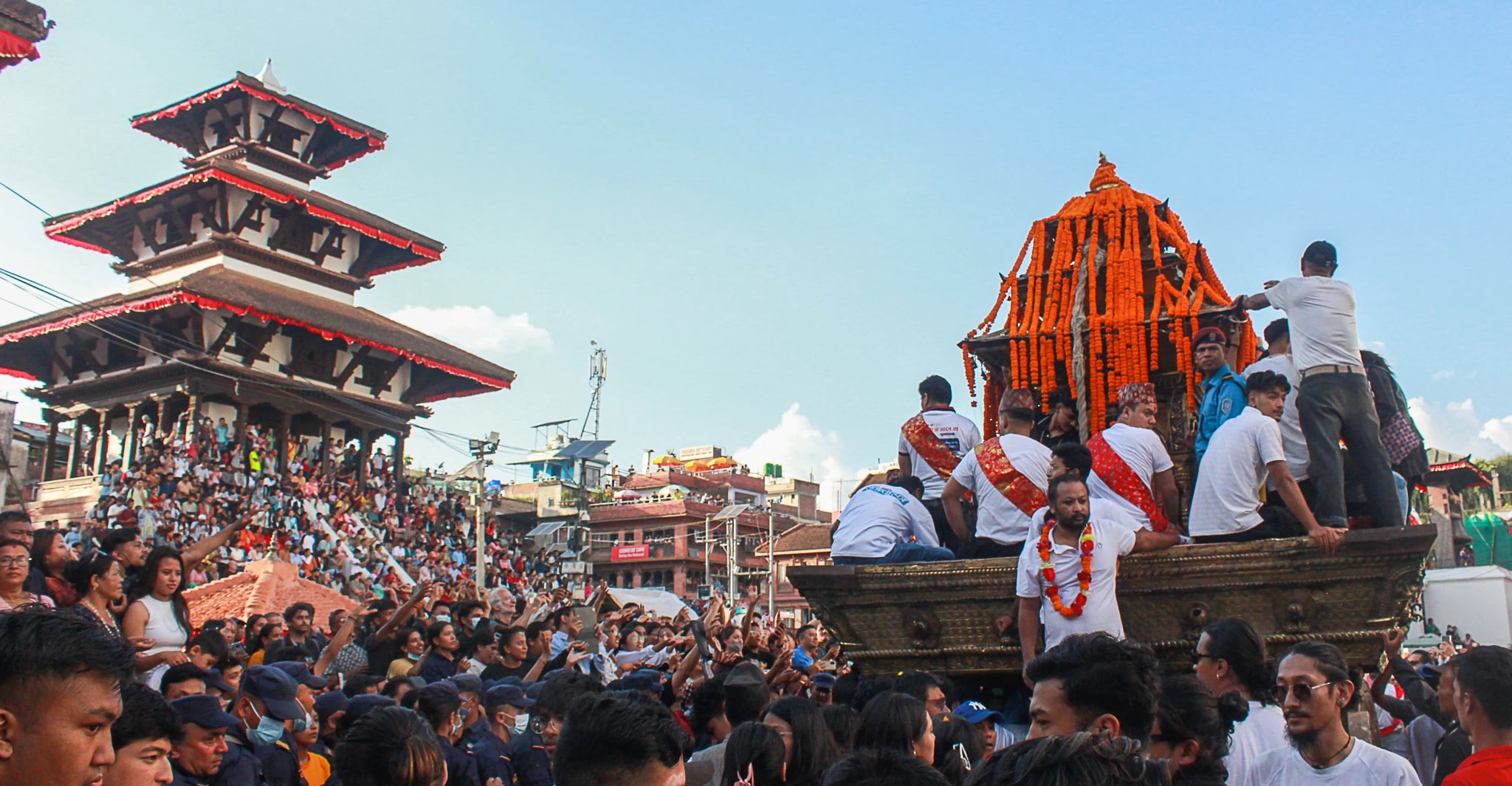
Imagine a city that, once a year, stops pretending to be a modern capital. For eight days, a god sits tied up in the street. A mask of Bhairab the size of a doorway pours rice beer into the mouths of a cheering crowd. A red-faced demon runs wild through the lanes, and the neighborhood loves him for it. A little girl, worshipped as a living goddess, rides a wooden chariot past rooftops packed with thousands of people. And somewhere in the dark, an elephant made of straw mats runs from alley to alley, searching for a master who never came home. This is not a carnival for visitors or even the locals this is how Kathmandu remembers who it is.
Introduction to Yenyā Punhi
What does "Yenyā Punhi" mean?
The name comes from Nepal Bhasa, the language of the Newar people of the Kathmandu Valley.
Part | Meaning |
Yen (Yem) | Kathmandu, the city's old Newar name |
yā | Festival or procession (the Newar form of jātrā) |
Punhi | Full moon |
Together, Yenyā Punhi means "the full-moon festival of Kathmandu." It takes its name from the full moon of Yaṃlā, the sixth month of the Newar calendar, when the festival reaches its peak.
From Yenyā to Indra Jatra
There are two explanations for how the name developed. The more widely accepted one is the breakdown above, where Yenyā comes from Yen, Kathmandu. A second view, recorded by the anthropologist Gérard Toffin, holds that Yenyā is a local, shortened form of the words "Indra Jātrā," changed over centuries of everyday speech.
The two names are used by different groups. Among the Newars, the festival has long been known as Yenyā. After the unification of Nepal in the late eighteenth century, the Shah court and Nepali-speaking officials referred to it by its Sanskrit name, and the religious calendar records the pole-raising as Indradhvajotthāna, "the raising of Indra's banner." Over time, Indra Jatra became the name most widely used across the country, while Yenyā remains the name used within the Newar community.
One festival , multiple festivities
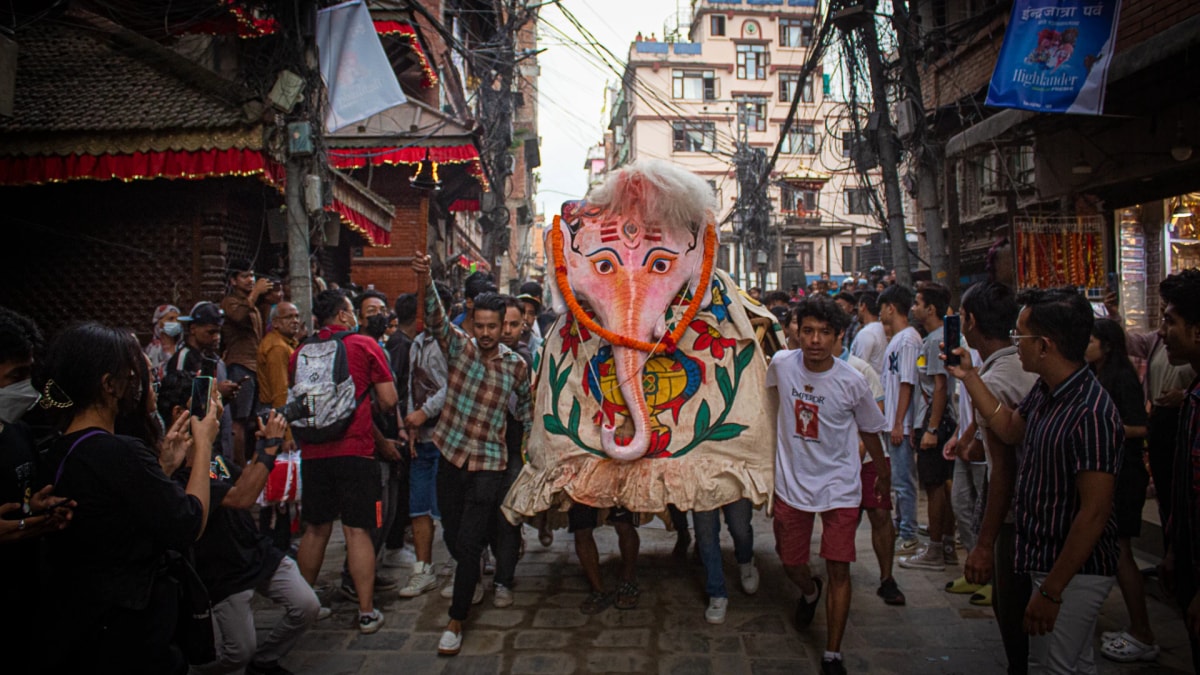
Yenyā Punhi is not a single event but a set of rituals, processions, masked dances, and rites for the dead that take place together over eight days.
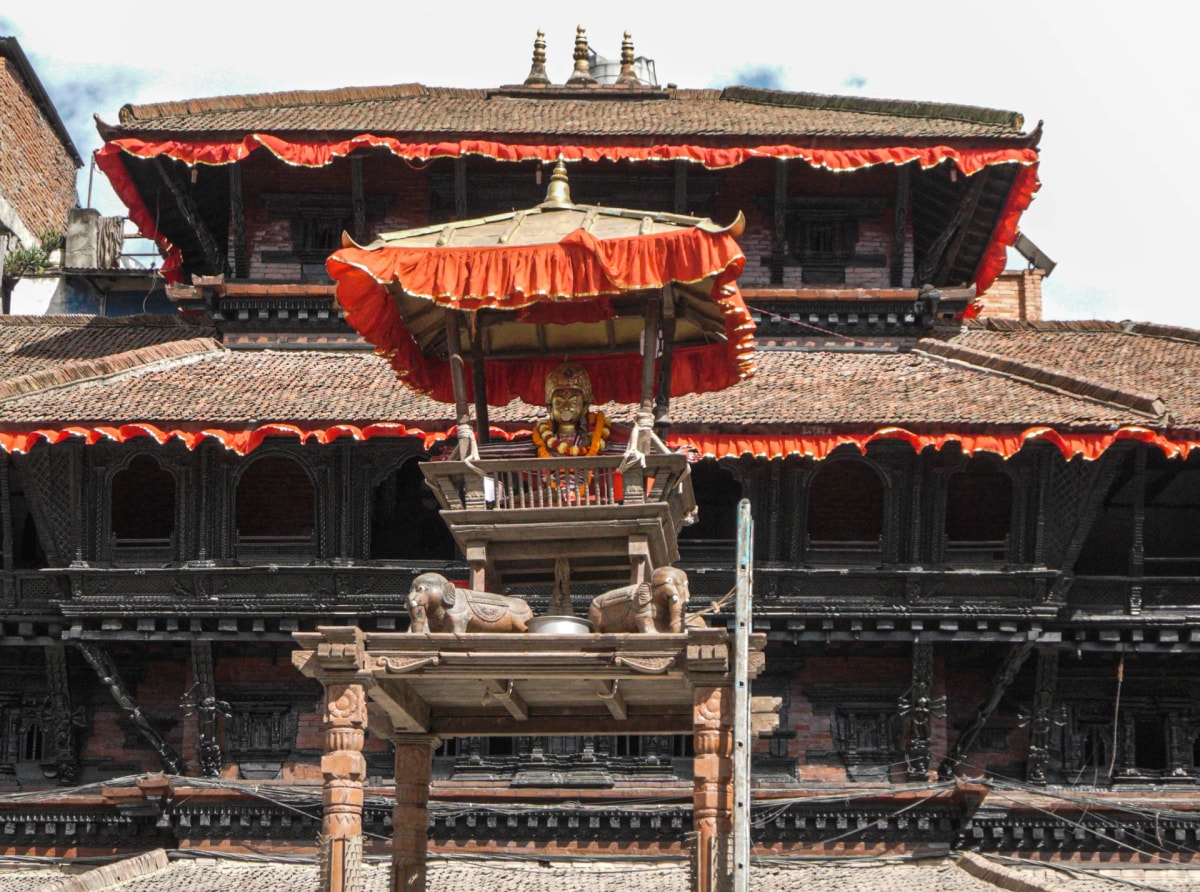
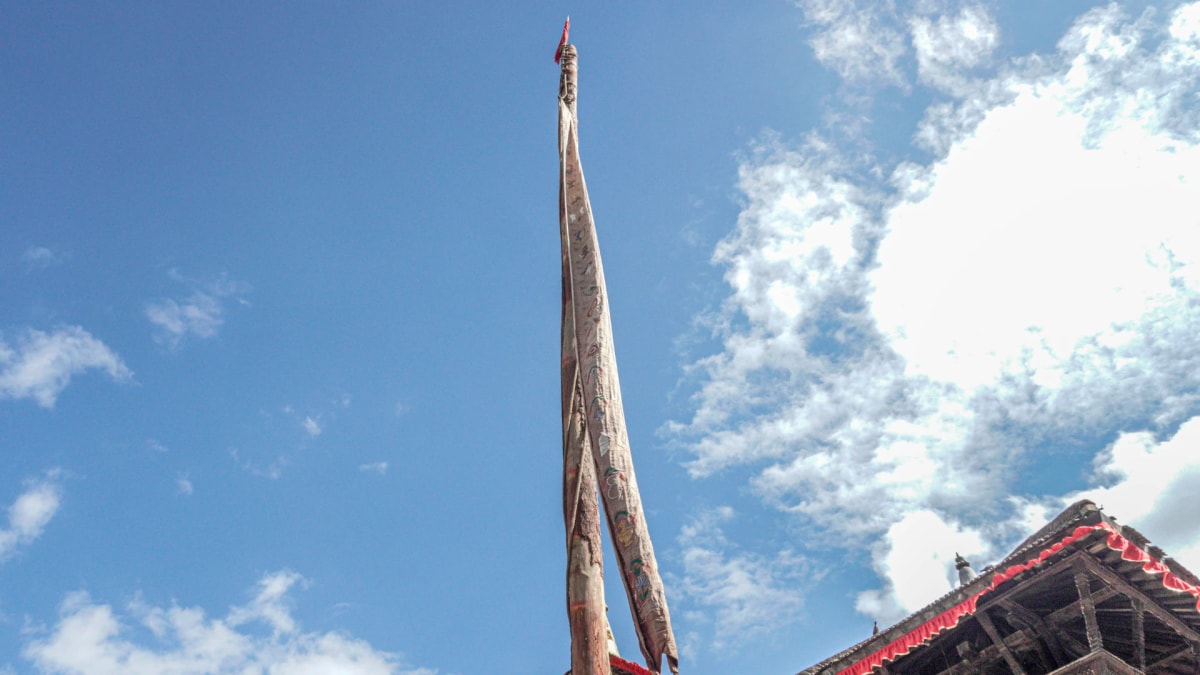
The festival begins on the twelfth day of the bright half of Bhadra, when a tall wooden pole, the yaḥsi, is raised in front of the old royal palace at Hanuman Dhoka. It ends on the fourth day of the dark half of Ashwin, when the pole is lowered. Preparations begin well before this, including selecting and bringing the tree from the forest.
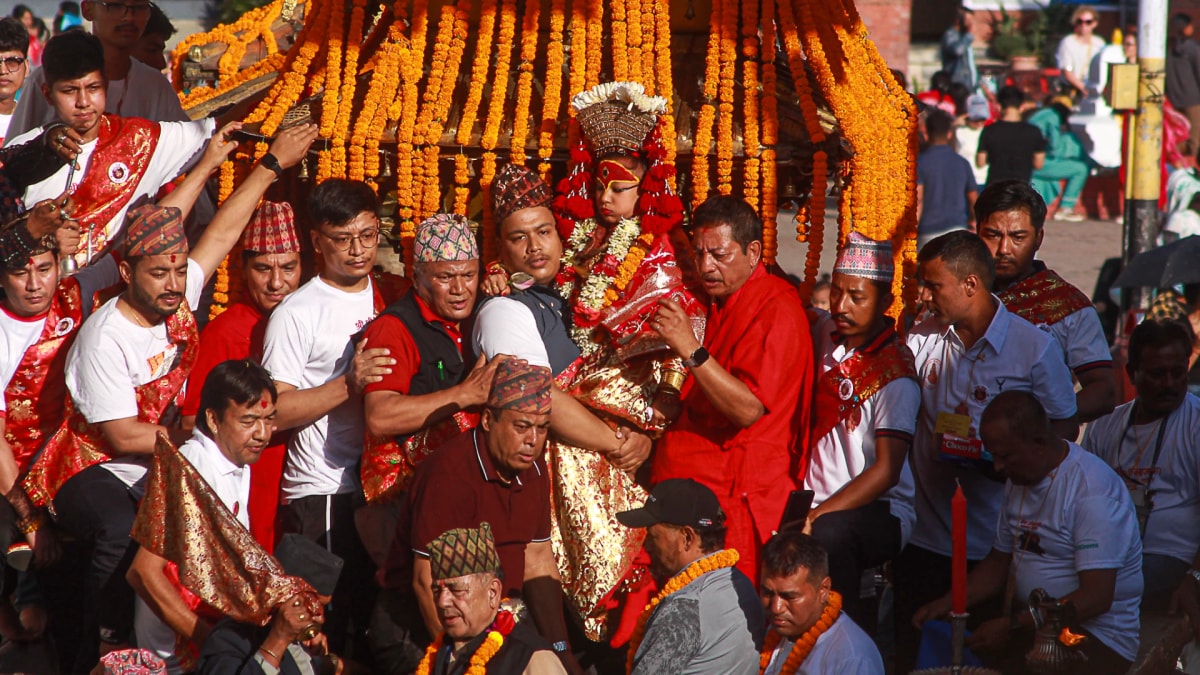
During these eight days, the worship of Indra, the chariot processions of the living goddess Kumārī, the display of Bhairab's masks, and a number of street performances all take place across the old city. Each of these has its own story and meaning, covered in the Deities and Demons section. Because the festival brings so many of the city's gods, communities, and neighbourhoods together, it is known as Kathmandu's mūl jātrā, its “root festival”
The Origin of Yenyā Punhi
The Indra festival of ancient India
Yenyā Punhi has its roots in a much older tradition. In ancient India, kings held an annual festival for Indra, the king of the gods in early Hindu tradition. Sanskrit texts call it Indramaha or Indradhvaja, the festival of Indra's banner.
The Mahābhārata gives an origin story for it. King Vasu of Chedi wished to give up his kingdom and live as a hermit. Indra gave him a bamboo pole as a reminder of a king's duties: to protect his people, create prosperity, and uphold dharma. Vasu raised the pole the following year in Indra's honour, and later kings followed his example. According to the texts, a kingdom that held this festival would be protected and would prosper.
The festival followed a set pattern. It was held in the bright half of Bhadra during the rainy season. A tree was chosen from the forest, brought into the city, raised as a pole in the presence of the king, and later lowered and taken to a river.
How the tradition survived in Kathmandu
Over time, the worship of Indra declined across India, and by around the tenth century his cult had largely faded there. Today, the royal form of the festival survives in India only at the Jagannath temple in Puri, Odisha. In the Kathmandu Valley, however, the tradition continued. Scholars note that images of Indra became more common in Nepal from roughly the same period that his worship declined in India.
Kathmandu's Yenyā Punhi still follows the main outline described in the classical texts: the timing in Bhadra, the tree brought from the forest, the pole raised before the palace, and its removal to the river at the end. Around this classical core, the city added its own local deities, myths, and rites for the dead, which gave the festival its distinct Newar character.
Local tradition connects the festival's beginnings in Kathmandu to King Gunakamadev, who is credited in the chronicles with founding the city. That story is covered in the next section.
Celebrating the Birth of Kathmandu
The king credited with founding the city
Yenyā Punhi is linked to the founding of Kathmandu itself, and that story begins with King Gunakamadev. He was a Thakuri ruler credited with founding Kathmandu, reigning from around 949 to 994 CE, and is also credited with starting Yenyā and the Lakhey Jatra. Toffin confirms that the later chronicles plainly state that Gunakamadev established the festival.
Two settlements, one city
Before Kathmandu existed as a single city, there were two neighbouring settlements. During the Licchavi period, the northern settlement of Yambu (Thahne) and the southern settlement of Yangal (Kone) together formed the area that would become Kathmandu. According to Newar tradition, Gunakamadev founded Kantipur, the historical name for Kathmandu, along the Bishnumati River, uniting these two earlier settlements. The division between Thane (upper) and Kone (lower) Kathmandu still shapes the festival today. Kumārī's chariot processions, for example, travel separately through the upper and lower parts of the old city.
The foundation stone at Maru
By Nepal Sambat tradition, Kathmandu is believed to have been founded on Yenyā Punhi, with Gunakamadev laying the foundation stone at Maru Tole, where it is said to remain. Maru is the community just beside the Kathmandu durbar square - the meeting point of the once separated city now a symbol of unity.
The sword-shaped city
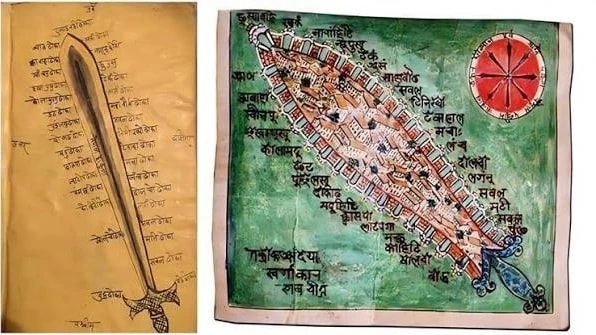
Local legend holds that Gunakamadev laid out the city in the shape of the Chandrahrasa, the sword Manjushri used to drain the valley's lake. Toffin records it as the goddess Kali's sword. In both versions, the city was drawn as a sacred weapon, meant to protect the people living within it
Deities and Demons of Yenyā Punhi
During the eight days, gods, goddesses, guardians, and masked demons share the streets of old Kathmandu. Each character has its own story and its own place in the festival.
The sacred center
Character | Who or what it is | What it represents |
Yosin (Yaḥsi), Indra's pole | A tree chosen in the forest near Nala. Toffin records that a goat was released there and the tree it rubbed against was selected. The pole is raised at Hanuman Dhoka with eight small Mother Goddess poles around it. | The cosmic axis linking heaven and earth. With the eight goddesses, it forms a mandala of the city. |
Indra | The king of the gods, shown in a unique pose: seated, arms stretched out and bound. In Newar tradition he is khun dyah, the thief god, caught picking pārijāt flowers. | Humility and forgiveness. In return for his release, Indra's mother promised dew and mist for the winter crops. |
Indra's Mother (Dāgin) | She came searching for her son and led the souls of the recently dead toward heaven. A masked Jyapu man takes her role in a procession of grieving families. | Grief, remembrance, and the passage of the dead |
The living gods
Character | Who or what it is | What it represents |
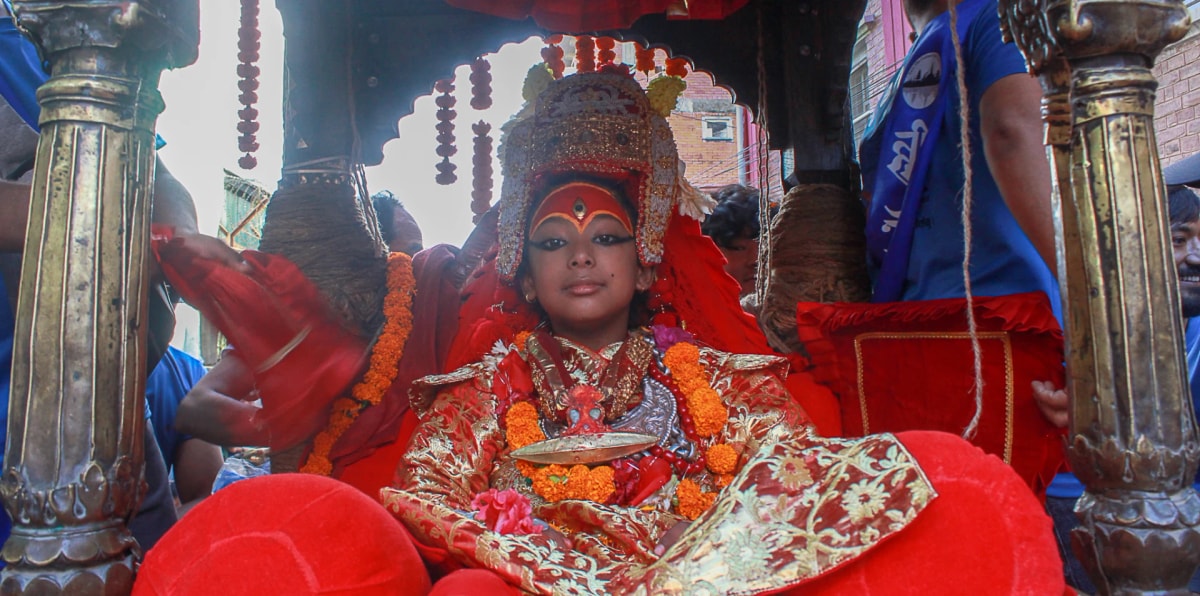
Kumārī | The living goddess, a young girl from the Shakya clan, worshipped as an embodiment of Taleju. Her chariot procession was led by Jaya Prakash Malla. | Divine power in a pure, human form. She blesses the head of state. |
Ganesh and Bhairab | Two young boys who ride their own chariots with Kumārī. The tradition says they are chosen from the Shakya clan as infants and, unlike Kumārī, return home to their families after the festival. | Ganesh opens the way; Bhairab protects. Tradition holds that their chariots are pulled to protect Kumārī. |
The guardians and Bhairabs
Character | Who or what it is | What it represents |
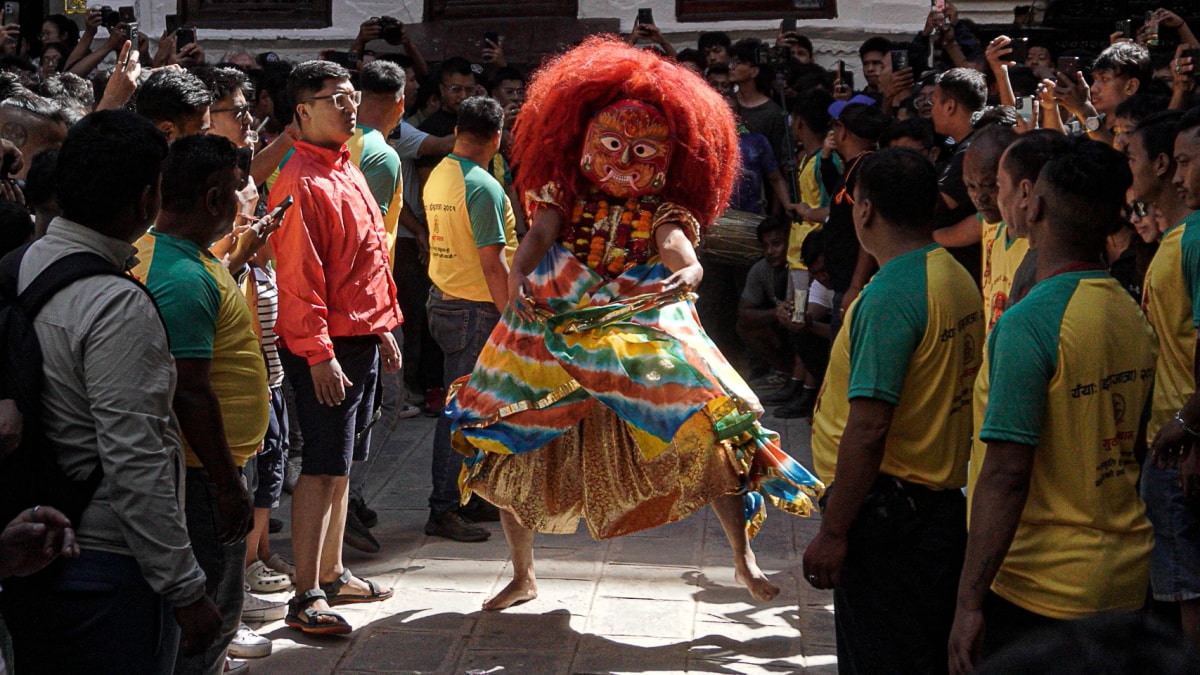
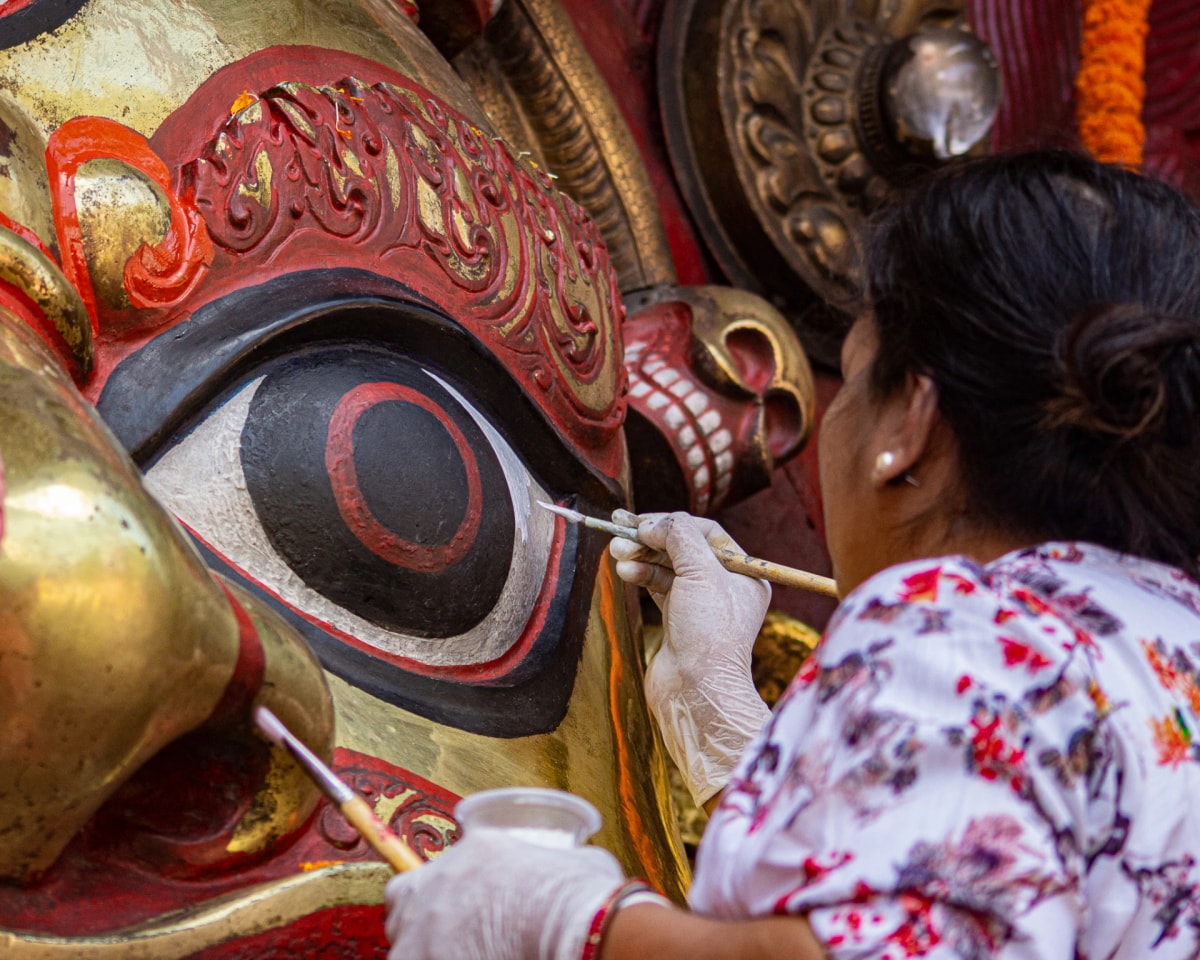
Majipā Lākhey | A red-faced demon, also called the Peaceful Bhairab and the protector of children, whose dance appears only during this festival week. Legend says he fell in love with a girl from Majipa, was captured, and was allowed to stay in the city after promising the king to protect its children. His dance is performed by the Ranjitkar community. | A feared outsider who becomes a guardian |
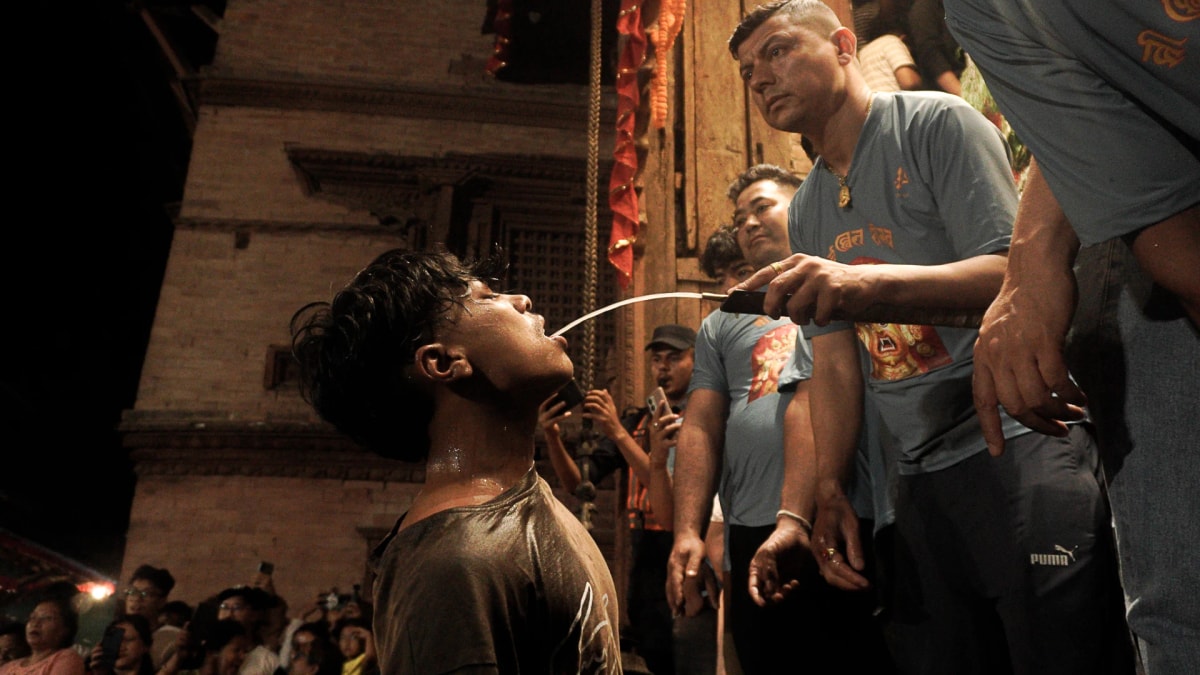
Swet Bhairab | A huge gilded mask on the wall of Hanuman Dhoka, kept behind a wooden screen all year. During the festival, rice beer flows from a pipe in his mouth. Toffin records it was offered by Rana Bahadur Shah in 1795. | Abundance and shared blessing |
Ākāsh Bhairab | A large Bhairab head displayed in Indra Chowk. Some tellings link it to the Mahabharata, while others believe it is the head of Yalamber, the first Kirat king. According to Toffin, Indra was held captive before his temple. | The sky guardian and the valley's ancient past |
Halchowk Bhairab (Sawa Bhakku) | A dance group from Halchowk on the western edge of the valley. Bhairab appears in blue with a sword, followed by two attendants in red. | Protection brought in from the valley's edge |
Street performances
Performance | Who or what it is | What it represents |
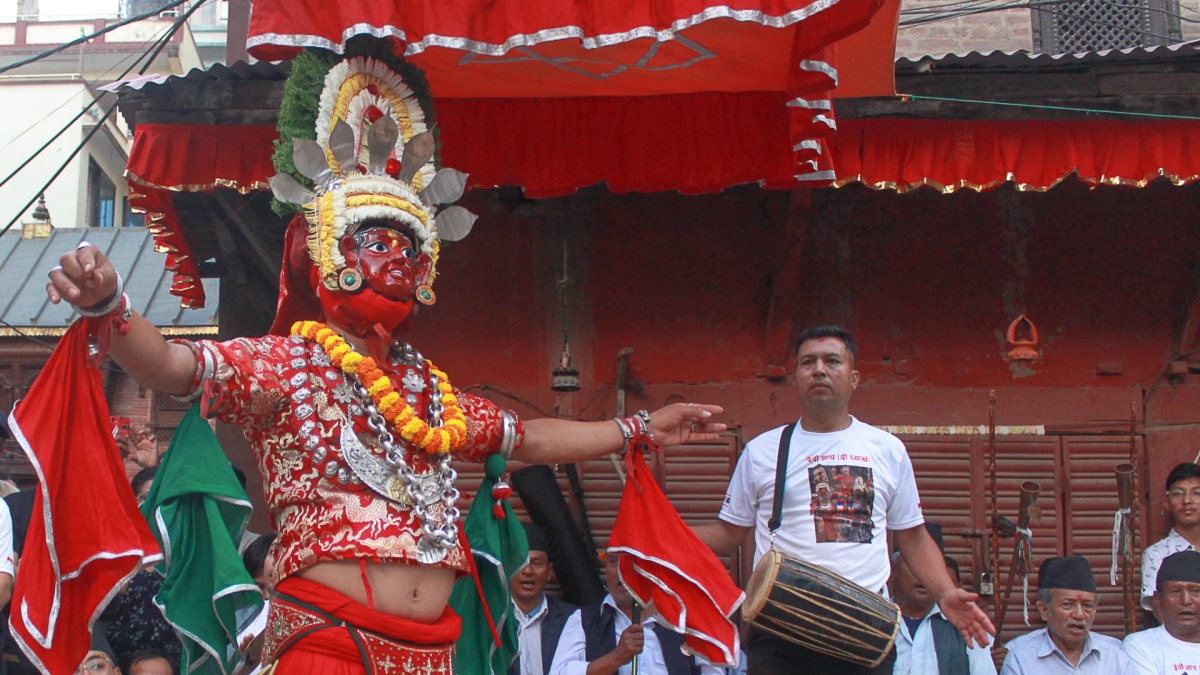
De Pyākhā (Devi Pyākhā) | A masked dance by Jyapu farmers of Kilagal. Kumārī, Bhairab, Chandi, and Betal face a demon, and Kumārī finally defeats him. | Good overcoming evil, told through music and dance |
Dasavatār | Nightly dance-dramas of the ten incarnations of Vishnu, performed on a stage in front of Hanuman Dhoka. Toffin notes the king once watched from a movable throne. | Devotion taught through performance |
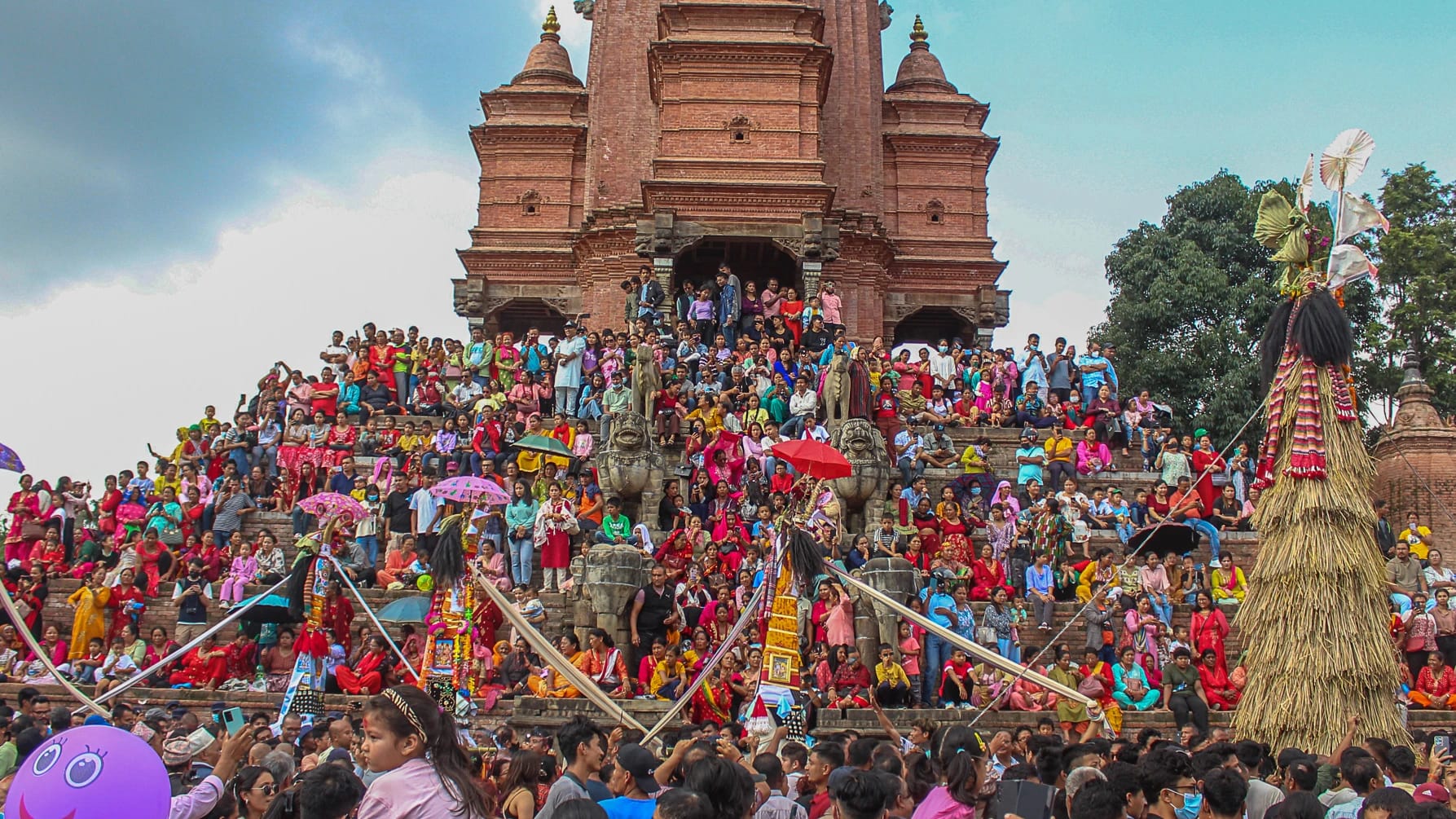
Pulukisi | Indra's white elephant, made from woven mats, danced through the streets at night by boys from Kilagal searching for their master. Baltutis notes the name comes from the mats a dying person is laid on. | Loyalty, searching, and the festival's ties to death |
Read more: The Travel Guide of Indra Jatra
Yenyā Beyond Kathmandu
Yenyā Punhi belongs to Kathmandu, but Indra is honored across the valley during the same weeks. In Pyangaon (Lalitpur), Toffin records two joined pine poles, one male and one female, raised in the village street for an eleven-day festival. In Thecho, farmers put up five or six cross-shaped poles for Indra, as some Kathmandu neighborhoods also do.
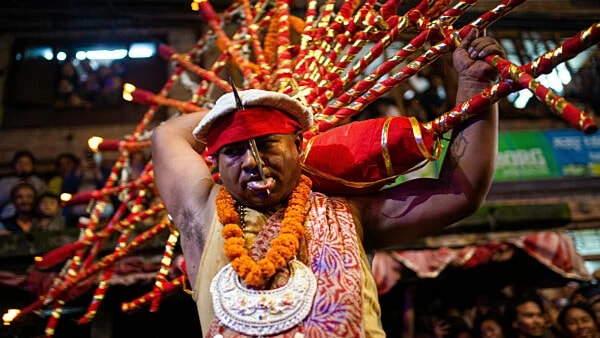
In Madhyapur Thimi, the day after Indra Jatra is marked by a tongue-piercing ritual, while Kathmandu pulls the chariots of Kumārī, Bhairab, and Ganesh.
Yenyā: Connecting the Society, Then and Now
A festival many hands carry
No single group can perform Yenyā Punhi alone. Each ritual belongs to a particular community, and the festival only works when all of them take part.
Community | Their role in the festival |
Manandhar (oil-pressers) | Historically cut, hauled, raised, and lowered Indra's pole |
Jyāpu (farmers) | Perform the De Pyākhā, display Indra's images, carry Pulukisi, and lead the Dāgin procession |
Ranjitkar (textile printers) | Perform the Majipā Lākhey dance |
Shakya (goldsmiths) | The families from which Kumārī is chosen |
Vajrāchārya and Rājopādhyāya priests | Buddhist and Hindu priests who each serve different Indra images |
Parbatiya Brahman (Priest of the hills) | Worships Indra's caged image at the pole every morning and evening |
Putuwār (palanquin bearers) | Guards the Indra image at Hanuman Dhoka for eight days |
Toffin notes that the festival involves nearly all Newar city-dwellers, Buddhist and Hindu, from both higher and lower castes. Baltutis adds that street processions draw people of every age, gender, caste, and ethnicity into gatherings they might not share in daily life.
The festival also joins the living and the dead. On the first evening, families who have lost someone during the year walk the city's boundary together. On the main day, bereaved families follow Dāgin through the streets and scatter grain so their dead will not forget the way home. Grief that is private for most of the year becomes something the whole city shares.
Indra Jatra - Then and Now
Yenyā Punhi has passed through Malla kings, Shah kings, Rana prime ministers, democracy, and a republic, adapting to each while keeping its core. The king once received Kumārī's blessing; in 2007 it went to the prime minister, and today the President observes the procession and receives blessings from Kumārī, Ganesh, and Bhairab. Hands have changed. Manandhar oil-pressers once hauled and raised the pole, a task Toffin found taken over by army and police recruits by 1992. In 1951, compulsory attendance for officials was abolished, and guthi funding later passed to the Guthi Sansthan.