Gai Jatra Festival 2026: Nepal's Festival of Cows

Sarvagya Shakya
Author
Sarvagya Shakya writes for Hidden Hymn — long-form stories from the world's quietest corners.
August 7, 2026 · 11 min read
In the Western world, mourning is often a quiet, behind-closed-doors affair. But in the Nepal, grief is dragged into the daylight, dressed in vibrant colors, and danced through the streets. Grief is rarely symmetrical, yet every August, the ancient city of Bhaktapur attempts to give it a shape during the Gai Jatra festival.
What is the Gai Jatra (Sa Paru) Festival ?
Gai Jatra - known locally in the indigenous Newari language as Sa Paru (The Festival of Cows) - Nepal’s most profoundly beautiful and paradoxical holiday.
Rooted in a syncretic blend of Hinduism, the festival centers around a singular, comforting belief: the departed must cross the mythical, perilous Baitarani River to reach the afterlife. The sacred cow, with its pure and gentle nature, is the only creature that can safely guide them across. Once a year, the city opens the gates to the heavens, ensuring no soul is left wandering in the dark.
Festival at a Glance: Dates, Location & What to Expect in 2026
Detail | Information for Travelers |
Local Name | Gai Jatra (Nepali) / Sa Paru (Newari) |
When to Go | 29 August, 2026 (The Nepali month of Bhadra) |
Where to Be | Bhaktapur Durbar Square, Taumadhi Square, and Dattatreya Square |
The Vibe | A profound transition from quiet, intimate morning mourning to raucous afternoon street festivals, satire, and dancing. |
Key Highlight | The Ghintang Ghisi (Stick Dance), The Towering Taha-Macha (Surrogate Cow), Khyala (Satirical Street Theater), Newari Traditional Music |
Morning Rituals at Gai Jatra: How Bhaktapur's Families Begin the Day
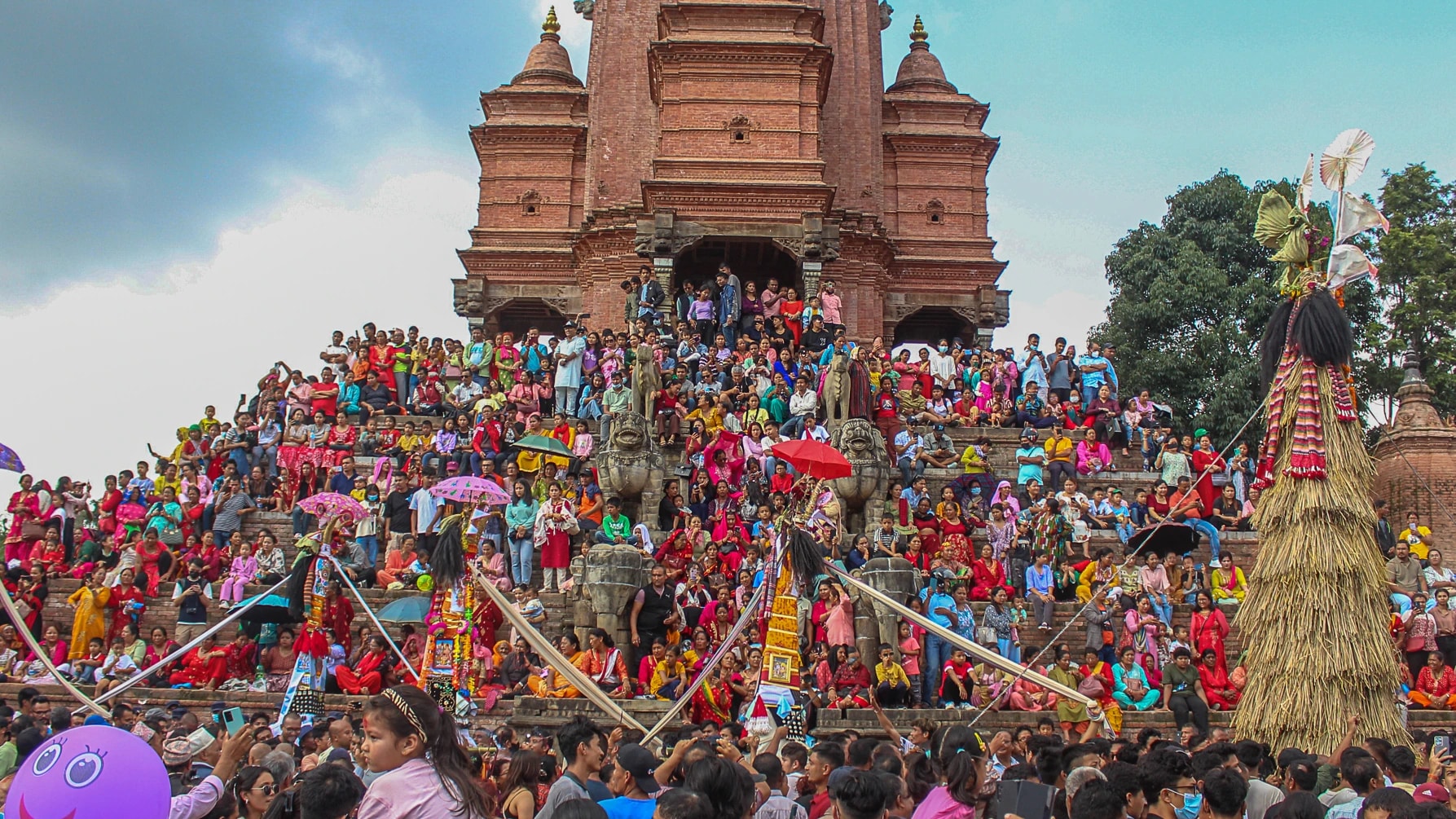
Before the monsoon sun breaks over the Nyatapola Temple, the labyrinthine alleys are suspended in a heavy, damp silence. In the same terracotta-dusted courtyards where clay is usually spun into vessels and set to dry, a different kind of architecture is quietly being assembled. Behind carved wooden doors, grieving families sit on woven mats, binding raw bamboo and cloth to construct the Taha Maccha - the towering physical manifestation of a recently departed loved one.
At this hour, it is not yet a festival; it is a private, devastating communion.
Building the Taha-Macha: How Families Build the Symbolic Surrogate Cow
The festival’s namesake translates directly to the "Parade of Cows" - the sacred creature believed to guide the departed across the cosmic river of death. Yet, what emerges from these terracotta courtyards is rarely a living animal. Instead, grieving families construct the Taha-Macha, a towering, dramatic surrogate.
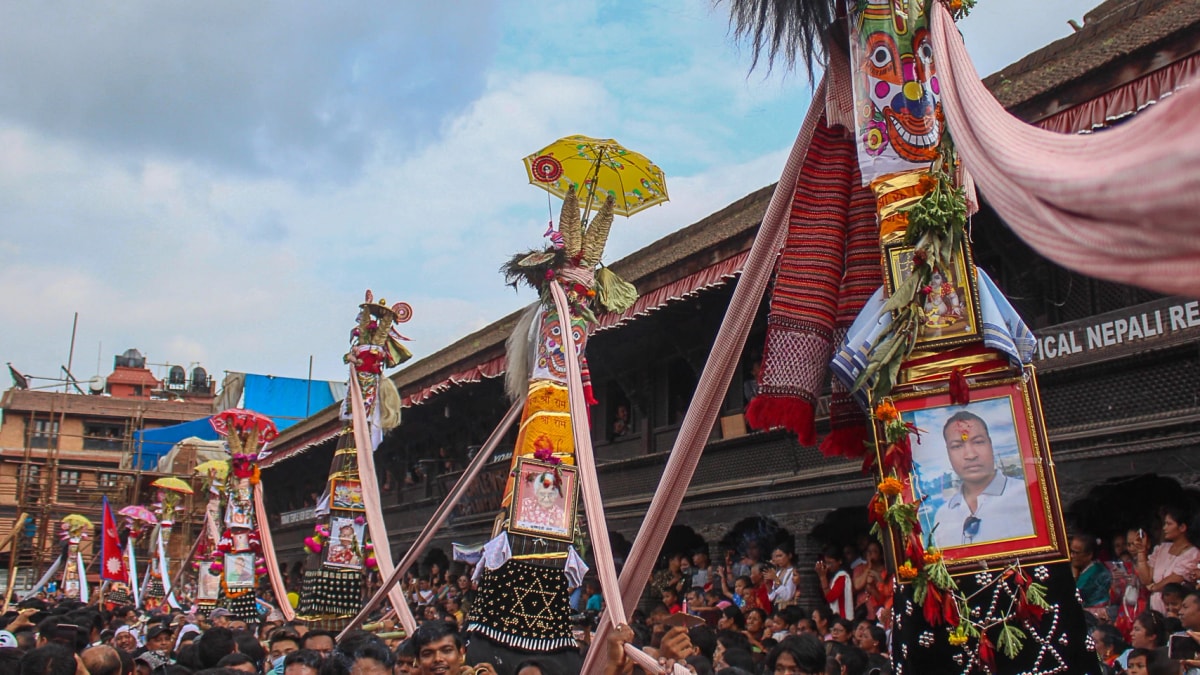
The architecture of this artificial cow is profoundly intimate.
-
The Frame: Immense bamboo poles form the rigid spine, crowned with horns meticulously woven from dry straw.
-
The Dress: The structure is then dressed to reflect the specific identity of the deceased. The bamboo is bound tightly in a Hakupatasi - the traditional Newari black sari with a striking red border - to honor a lost matriarch, or draped in austere, simple cloth for a patriarch.
-
The Crown: At the very apex, an open umbrella is fastened to the frame, providing a fragile shelter for the wandering spirit as it navigates the crossing.
Local belief dictates that the gates of heaven remain closed throughout the year. The meticulous creation of the Taha-Macha is the physical key required to open those gates, allowing the ancestors to finally attain moksha (liberation).
The History of Gai Jatra: From King Pratap Malla's Royal Decree to Today
This intimate ritual is rooted in a 17th-century mandate born of royal tragedy. During the Malla Era, King Pratap Malla’s second eldest son, Prince Chakrabartendra, was tragically trampled to death by an elephant. The Queen fell into an abyss of depression, refusing to eat or sleep.
In a desperate bid to console her, the King ordered the construction of Rani Pokhari, filling it with the waters of sacred rivers. But stone and water couldn't cure the soul. When the sacred pool failed to ease her suffering, the King issued a decree: every family in the kingdom who had lost a member that year must walk together in a public procession.
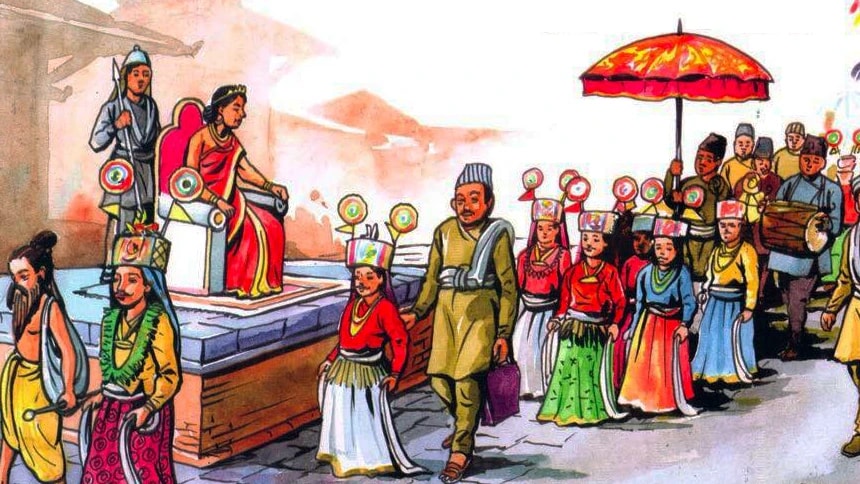
Four centuries later, Gai Jatra continues to serve this exact, ingenious psychological function. It acts as an emotional release valve - a brilliant mechanism for a community to carry their most isolating, private tragedies out into the open air. By mapping their grief onto the public squares of Bhaktapur, sorrow is witnessed, shared, and ultimately metabolized by the unbreakable solidarity of the collective.
How to Experience Gai Jatra in Bhaktapur
To truly understand Gai Jatra, one must look away from the main thoroughfares and step into the artisan squares of Bhaktapur.
- The Morning Rituals in the Narrow Alleys
The procession does not begin in grandeur; it starts in the tight, claustrophobic corridors of the city's residential blocks. Walking through these narrow lanes, bordered by towering terracotta walls and overhanging wooden eaves, the physical constraint mirrors the tightness of fresh grief.
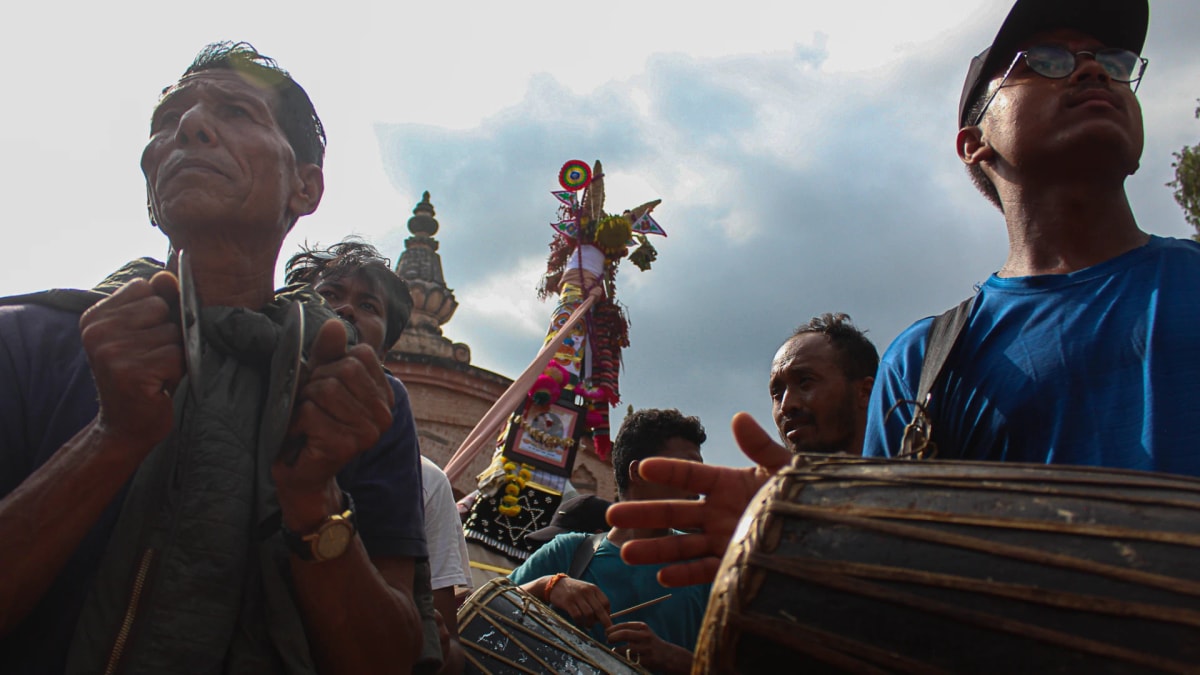
Here, mourning is contained, intimate, and kept close to the chest. The architecture naturally limits the audience, forcing neighbors shoulder-to-shoulder and binding the immediate community in a shared, quiet sorrow before they face the rest of the city.
- Afternoon Celebrations in Taumadhi and Dattatreya Squares
As the mourners follow the traditional Pradakshina (circumambulation) route, the city's architecture does something remarkable: it exhales. The winding, shadowed alleys abruptly spill out into the vast, sunlit expanses of Taumadhi and Dattatreya squares.
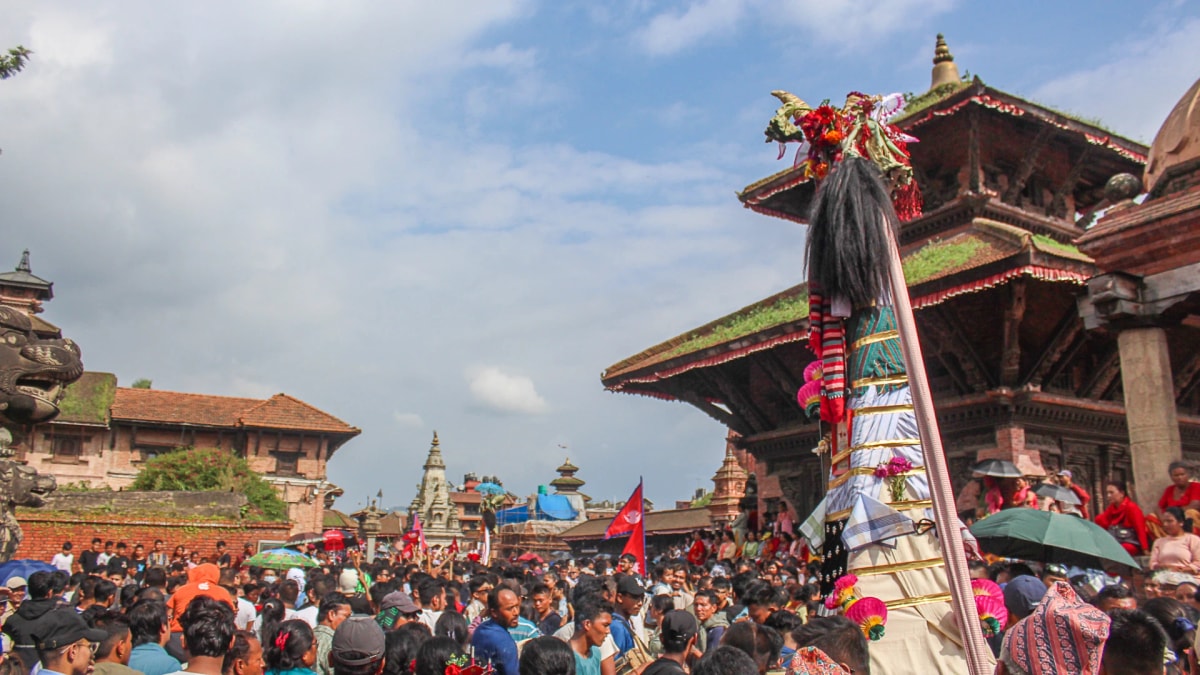
This sudden spatial expansion acts as a psychological trigger. Stepping into the open air beneath the towering, five-tiered Nyatapola Temple, the private pain carried through the alleys is immediately absorbed by the collective mass of the city. The spatial release directly mirrors the emotional release. By physically funneling its people from the shadows of private courtyards into the brilliant light of the public squares, the city insists that no one is left to mourn in the dark.
How Gai Jatra Transforms Grief Into Comedy: Satire, Skits & Street Theater in Bhaktapur
By mid-afternoon, the quiet, claustrophobic mourning of the morning completely shatters. The festival undergoes its most remarkable alchemy: the transmutation of heavy grief into brilliant, raucous comedy.
Following the ancient King’s original decree to make his grieving Queen smile, the entire city shifts gears. The streets transform from corridors of sorrow into stages for theatrical defiance, using shared joy to remind the grieving families that while death is inevitable, life, stubbornly and beautifully, continues.
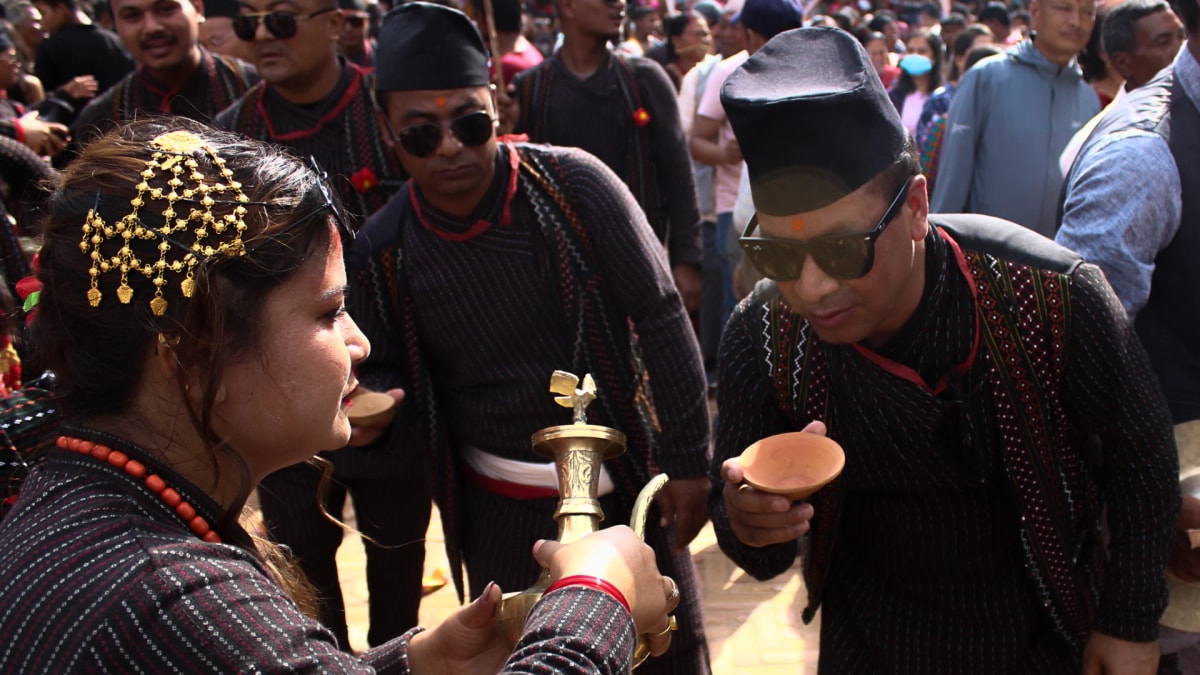
Here is how the afternoon unfolds in the squares of Bhaktapur:
The Procession of the Divine
The shift begins when the towering Taha-Macha effigies emerge from the residential courtyards and converge in the main squares. They do not walk alone. The procession is fiercely led by representations of Bhairab (the fearsome manifestation of Lord Shiva) and succeeded by the protector goddess Ajima Badrakali. The presence of these deities signals that the mourning has been officially recognized by the divine, granting the community permission to release their sorrow and begin the celebration of the ancestors' journey to heaven.
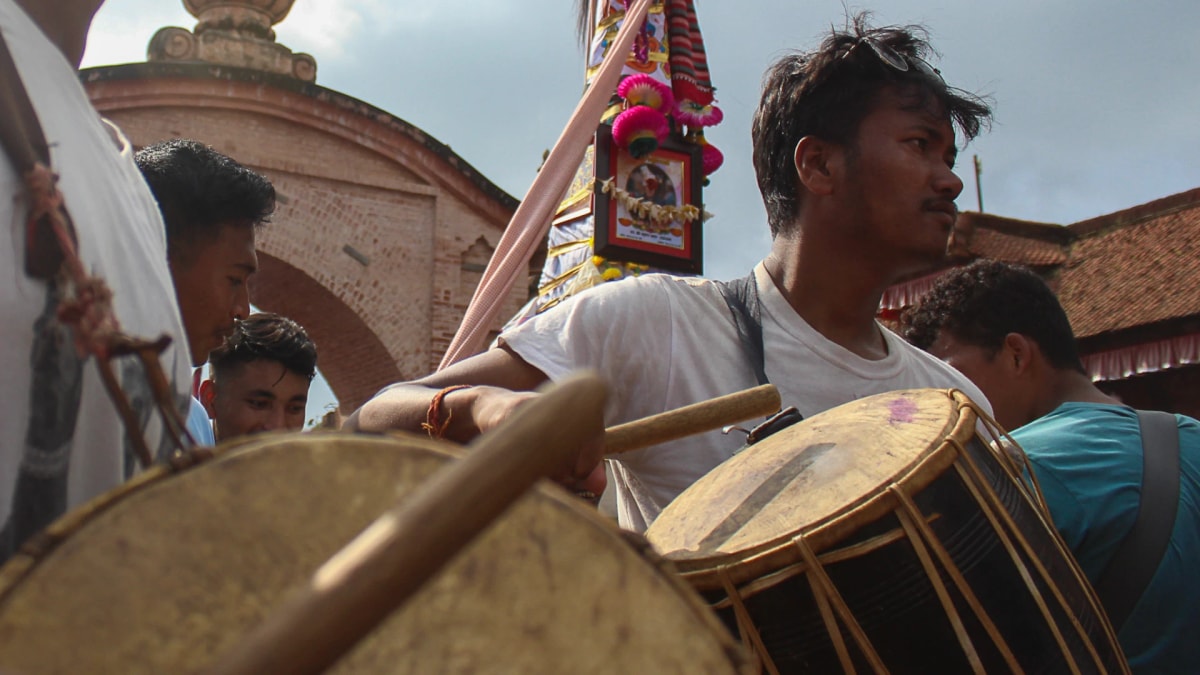
The Rhythm of the Streets: Ghintang Ghisi
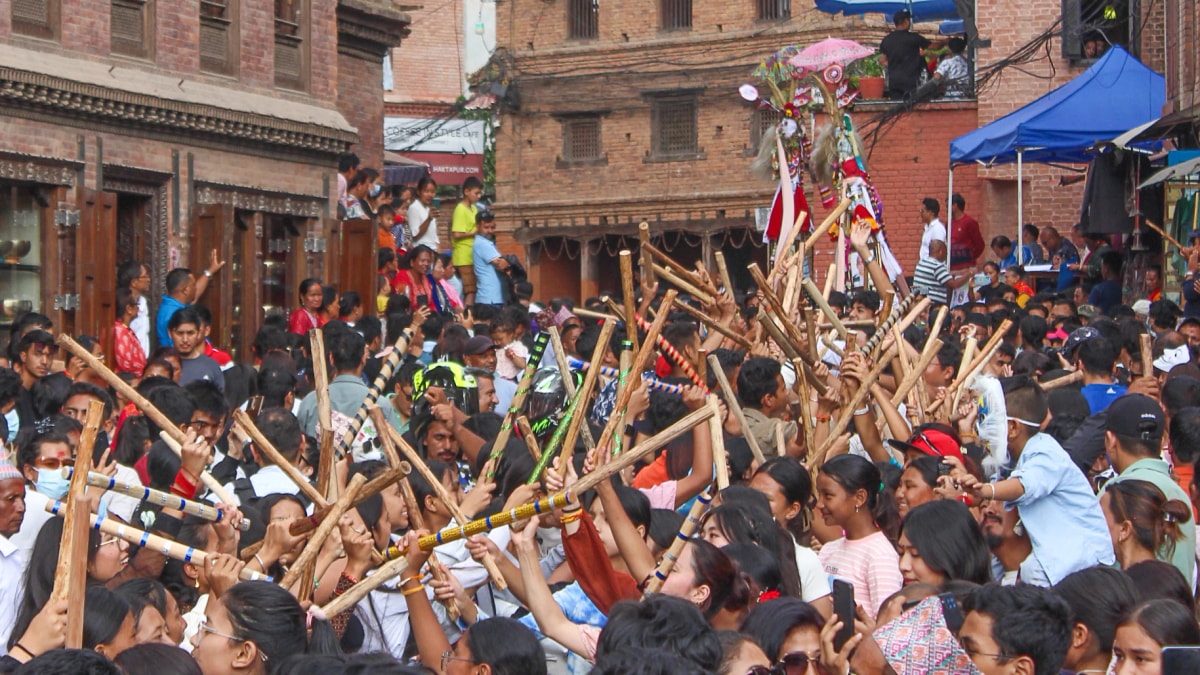
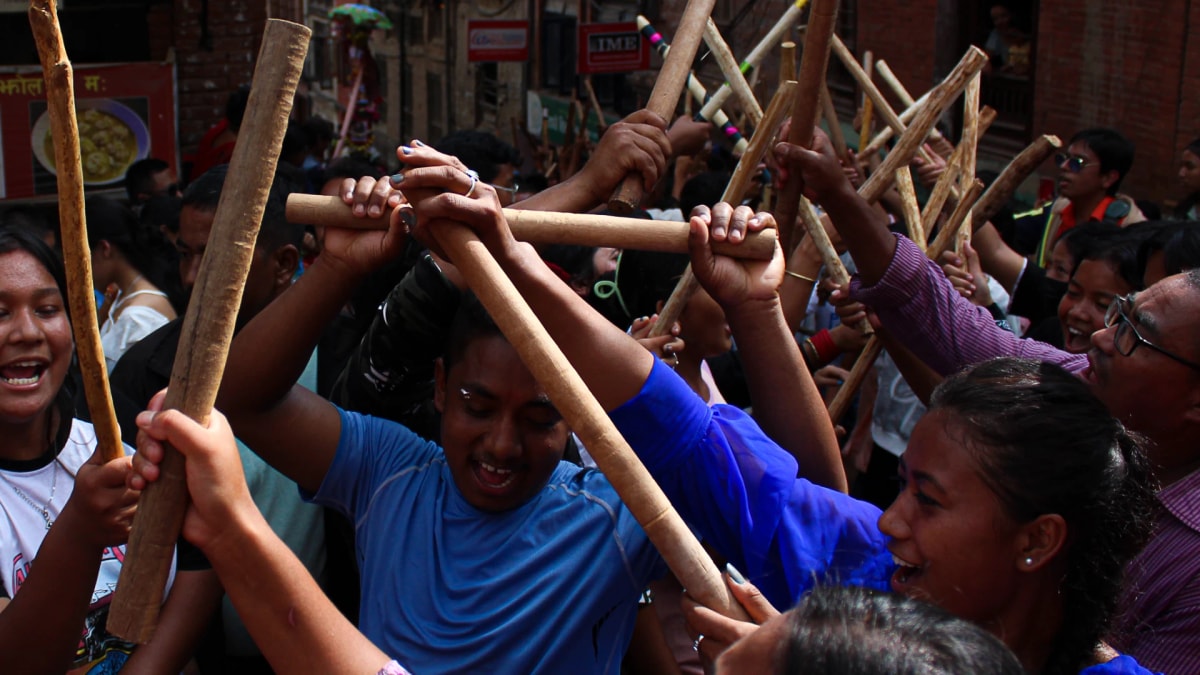
As the chariots align, the air begins to crackle with the intense, rhythmic thwack of the Ghintang Ghisi - the traditional Newari stick dance unique to Bhaktapur’s Gai Jatra.
Lines of local youth, often painted and adorned in vibrant fabrics, move in hypnotic synchronization. They strike their short wooden batons together in a complex, escalating rhythm. The beat becomes so solid and relentless that it literally reverberates through the terracotta brickwork of the city. It is a physical release of energy - a collective heartbeat that sweeps up mourners and spectators alike into a trance of celebration.
The Art of Theatrical Mockery
Historically, it was a skit mocking the obscene wealth and hypocrisy of high society that finally provoked a smile from the grieving Malla Queen. She looked at the immense crowd laughing together and realized she was not mourning alone.
Today, this tradition of biting social satire remains fiercely intact. As the afternoon progresses, street corners turn into impromptu amphitheaters. Troupes of actors perform exaggerated skits (khyala) that ruthlessly mock modern politicians, societal norms, and recent scandals. No figure of authority is safe from the punchlines. It is a brilliant sociological release valve, allowing the working class to vent their daily frustrations through sanctioned, therapeutic comedy.
Beyond the Procession: An Eight-Day Spectacle of Street Theater
While the breathtaking Taha-Macha procession on the first day commands the most attention, Gai Jatra (or Sa Paru) is actually the second-largest festival in Bhaktapur. It does not end when the sun goes down. The celebrations continue for seven nights and eight days, stretching from the day after Janai Purnima until the eve of Krishna Janmashtami.
During this week-long window, the designated circumambulation route - the Pradakshina Patha and the various neighborhood squares of Bhaktapur transform into open-air theaters for traditional Newari mask dances (Pyakhan).
If you wander the squares in the evening, look out for these major observations:
-
Kawana Pyakhan (The Skeleton Dance): Often performed in Bhaktapur Durbar Square, this involves local children painting themselves or dressing up as Kawana (skeletons). Two "skeletons" dance from opposite corners, facing each other. Though the character is meant to be fearsome, the performance is designed to be wildly entertaining for the crowds.
-
Bhalu Pyakhan (The Bear Dance): Head toward the Nasamana Tole neighborhood to witness this traditional storytelling act. The main attraction is a dancer in a highly characterized bear costume, acting out local folklore to the beat of traditional drums.
-
Khichha Pyakhan (The Dog Dance): In a beautiful nod to the animal kingdom, two participants dress in elaborate dog costumes to perform the Khichha Pyakhan. This specific dance is dedicated to showcasing the enduring loyalty and bond between dogs and human beings.
-
Tantric and Protector Dances: In the days following the main procession, the neighboring municipalities of Madhyapur Thimi and Bode host intense, spiritually charged dances. The Bhairava Dance (performed by the Shrestha community with ancient tantric rituals) is believed to rid the town of demons and bad luck, while the Nil Barahi and Lakhey (demon) mask dances are performed to celebrate peace and prosperity.
Why Gai Jatra Is Unlike Any Other Festival in the World
Gai Jatra offers those who visit something far rarer than a brilliant cultural spectacle; it provides a profound, psychological mirror. It stands as a vibrant, undeniable reminder that while loss is a universal certainty, how we carry it is a choice. In Bhaktapur, they choose to carry it together - dragging grief out of the shadows, dressing it in red and black, and dancing with it until it learns to smile again.
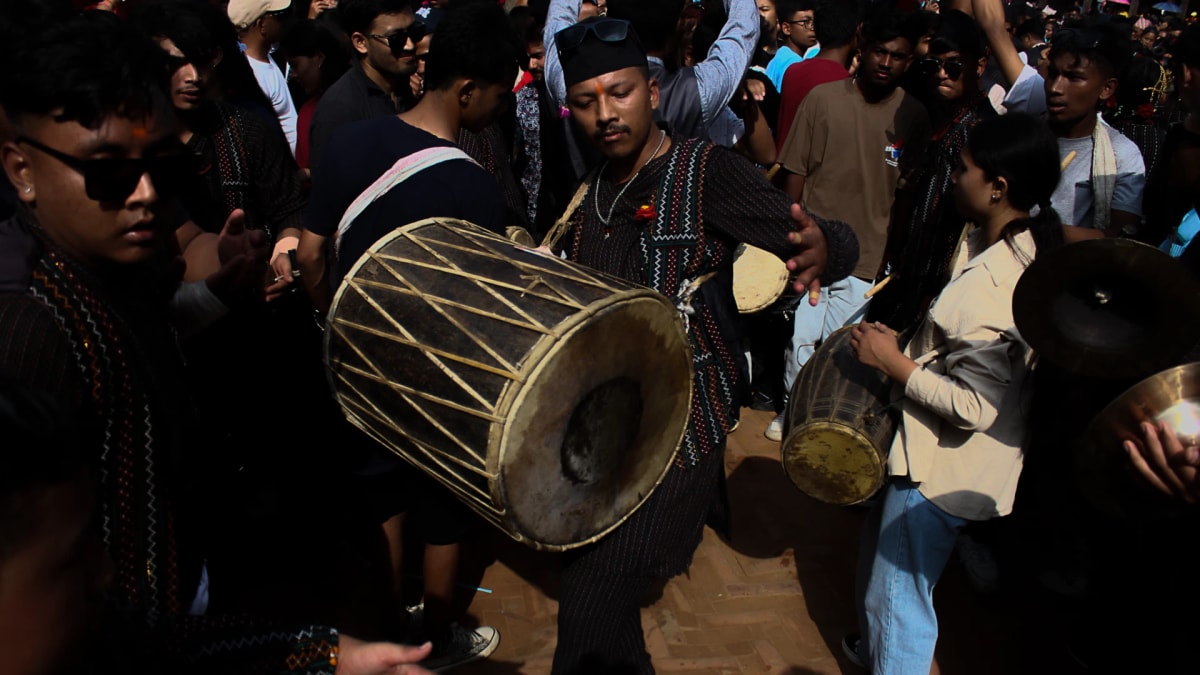
For the traveler, accustomed to hushed memorial services and the quiet isolation of private mourning, standing in the sun-drenched squares of Bhaktapur during Gai Jatra is nothing short of a paradigm shift. The festival shatters the familiar instinct to hide our sorrow behind closed doors. Here, in the heart of the Kathmandu Valley, you are witnessing a radical, centuries-old masterclass in emotional resilience.
If you find yourself navigating this terracotta maze in late August, do not simply pass through as a spectator hunting for the perfect photograph. Put the camera away for a moment. Allow the hypnotic thwack of the Ghintang Ghisi to reverberate in your own chest. Watch the faces of the locals as they transition from quiet reverence in the morning to raucous, tear-streaked laughter by the afternoon.