Pashupatinath: The Intersection of Life, Death & Hope of Ultimate Release
Step inside Pashupatinath - from the golden deer myth to the cremation fires on the Bagmati. Discover why Nepal's holiest temple holds the ultimate key to living, dying, and untying the soul.
Sworup Shrestha
Author
Sworup Shrestha writes for Hidden Hymn — long-form stories from the world's quietest corners.
August 12, 2026 · 16 min read
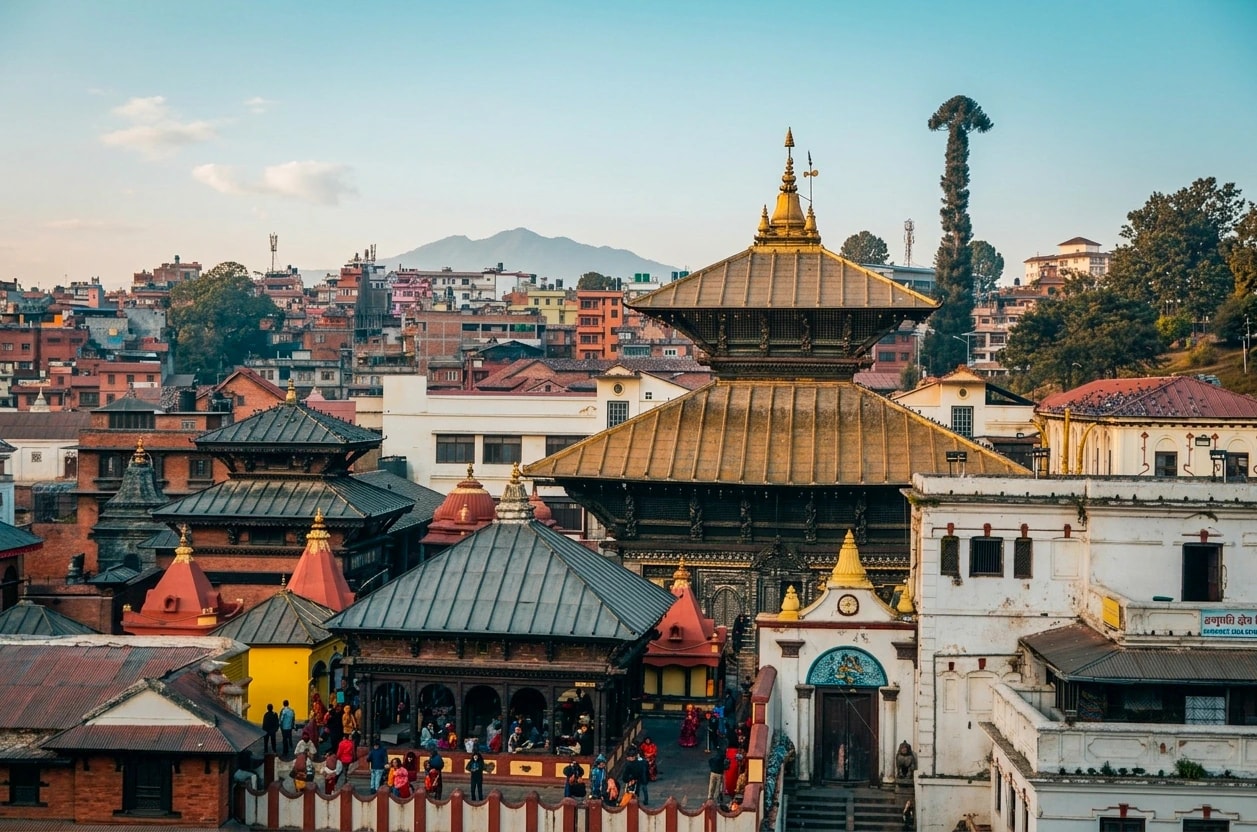
To stand at Pashupatinath is to stand at the intersection of life, death, and the hope of ultimate release. Before taking in the architecture or the rituals, one must understand the philosophy that breathes life into this sacred ground.
Here is the deeper meaning behind the rituals, the myths, and the smoke rising from the riverbanks.
What the People Here Believe
In the Hindu understanding, this life is not your first one. You have lived before - many times, in many bodies and unless something changes, you will live again. Death is not an ending; it is merely a turning of the wheel.
Think about what a single life contains: wanting things, getting some of them, losing them, and dreading that loss before it even arrives. You grow old, you grow frightened, and then you start over from a cradle with no memory of the past. Now, put that on an endless loop with no final page. What keeps a soul in this loop is attachment - the pull toward things, toward people, toward being you in particular. The old image for it is a tethered animal: a goat tied to a post can walk in circles all day and never leave the circle. It isn't caged. It is simply attached to something, and the attachment does the rest.
Freedom means being untied. The word for it is nirvana or moksha. It is not heaven; there are no clouds, no grand rewards, no improved versions of the same life. It is a pure release. The circle ends. And Pashupati - the form of Shiva worshipped here - is the god who unties the knot.
His name at this temple is Pashupati, which translates as Lord of All Living Beings. That phrase is precise rather than poetic. All living beings - including animals. Because in this view you may well have been one, and may be one again, and the god who releases souls does not much care what shape they turned up in.
What Pashupatinath Actually Means
Every guidebook translates the name the same way, and the translation is not wrong, only shallow - Pashupati, a form of Shiva. Pashu means animal. Pati means lord. Hence the standard gloss, reproduced in hundreds of tour brochures: Shiva as protector of the animals & the postcards of the deer.
But ask a priest, or read the Shaiva texts, and a second floor opens beneath the first.
In the Shaiva theology of the Pashupata tradition - the oldest known sect of Shaivism, existence resolves into three permanent categories:
-
Pati: The Lord.
-
Pashu: The individual soul.
-
Pasha: The fetter, the tether, the rope.
The soul is called pashu not because it is lowly, but because it is tied. The word for a tethered animal and the word for a human consciousness bound to its own appetites, its accumulated karma, and its stubborn conviction that it is separate from everything else - these are the same word, and they are the same word on purpose. The animal is named after the rope around its neck. Which makes Pashupati not a keeper of livestock but something considerably more demanding: the one who unties.
The temple's own older name for itself, Lord of All Living Beings, is therefore not sentiment about wildlife. It is a claim of jurisdiction. Nothing that breathes falls outside the knot; nothing that breathes falls beyond the untying. Pilgrims arrive here in the ordinary daily way, asking for blessings and for obstacles to be cleared. But the older logic sitting underneath that transaction is the one that explains the whole site - why the ashes enter the river fifty metres from the sanctum, why ascetics have sat in this particular forest since long before the temple had walls, why a complex of some five hundred shrines is arranged around a single proposition about bondage and release.
Myths & Legends
There is a specific story about how Shiva came to reside in the Kathmandu Valley. It is short, slightly humorous, and it perfectly explains the spiritual geography of the entire site.
The legend begins with Shiva, weary from his heavy cosmic duties, descending into the Kathmandu Valley with his wife, Parvati. As they walked along the banks of the Bagmati River, they stopped to rest. On the eastern bank stood a lush, tranquil woodland known as the Sleshmantak forest (later known as Mrigasthali, the forest of deer).
Looking at the herds of deer moving peacefully through the trees, Shiva did something nobody expected. He did not merely bless the forest, nor did he claim it as a conqueror. He transformed himself into golden deer, walked into the trees, and joined the herd. And then, Shiva refused to come out.
The universe cannot function for long without its supreme consciousness. Realizing that Shiva’s absence was causing a disruption to the cosmic order, the other gods descended to the earth to search for him. When they finally located him grazing as a deer in the Bagmati river basin, they pleaded with him to return to his duties. Shiva refused, desiring only the quiet detachment of the forest.
A divine struggle ensued as the gods attempted to force him back. During this metaphysical tussle, the gods grabbed the golden deer by its horns. Under immense pressure, one of the deer's antlers broke off and plummeted into the earth. Where that broken antler landed, a stone linga rose up from the soil on its own. No human hands carved it. No priest consecrated it. It was a Jyotirlinga, a self-manifested pillar of divine light turning into solid stone.
Only after this event did Shiva resume his true cosmic form and bestow upon himself a new title: Pashupatinath, the Lord of All Living Beings. That very stone, born from the shattered antler of a god in disguise, is believed to be the same sacred idol that sits behind the temple's silver doors today.
The Chaturmukha Linga: The Map of the Cosmos
Most visitors know there is a sacred stone inside the main temple, but few understand its cosmic architecture. Unlike most traditional, formless Shiva lingas, the one in Pashupatinath’s inner sanctum is a Mukhalinga - a lingam with faces.
It features four visible faces carved into the stone, each pointing to a cardinal direction, and a fifth, invisible face pointing upward. Together, they represent the entirety of existence:
The Face | Direction | Element | Spiritual Meaning |
Sadyojata (Mahadeva) | West | Earth | Creation, joy, and the nurturing aspect of life. |
Vamadeva (Uma / Tamreshvara) | North | Water | Preservation, compassion, and profound healing. |
Aghora (Bhairava) | South | Fire | Consciousness, discipline, and the divine spark within. |
Tatpurusha (Maheshvara) | East | Air / Wind | Dissolution, fierce transformation, and the destruction of fear. |
Ishana (Sadashiva) | Zenith (upward) | Ether / Space | The ultimate unmanifested truth; pure, formless liberation. |
The Essence: The linga is not just a statue, it is a physical representation of omnipresence. To stand before it is to be looked at from every direction, and to understand that the divine governs everything from the dirt beneath our feet to the formless space above our heads.
Cremation on the Bagmati: The Philosophy of the Ghats
Walk down toward the river bank and look properly at the thing every visitor photographs and few truly understand. Here, on a series of stone platforms known as ghats, bodies are continuously burning.
The process is deeply intimate yet completely public. The dead are brought here within hours. The body is washed in the river, dressed in fresh cloth, covered with marigolds. It is carried on a bamboo stretcher and laid on a stack of wood. The eldest son usually lights the fire at the mouth. It takes around three hours. The ashes are swept into the Bagmati.
None of this is concealed. It happens in the open, in daylight, in the middle of a capital city, in front of anyone standing on the far bank. Beneath the ritual lies a complete philosophy of death:
-
The Body is Only a Garment: The atman (eternal self) never dies. At death, a person simply sheds a worn body as one sheds worn clothing, while karma carries the soul forward.
-
Fire is Liberation: Cremation physically frees the soul. The fire returns the physical vessel to the natural elements, releasing the self to move on. Many believe cremation at Pashupatinath’s Arya Ghat leads directly to moksha.
-
The River Purifies: The Bagmati River, revered as Nepal’s own Ganges - eventually flows into the Ganges itself. Its sacred waters are believed to carry and cleanse the soul on its onward journey.
Because of this, the ghats are hopeful, not morbid. Pashupatinath is one of the rare places on earth where life and death share the same ground in peaceful reverence. Death here is not understood as an end, but as a release.
It is why elderly Nepalese will sometimes travel here to spend their final weeks. They do not come out of sadness, but out of positioning. If there is one place in the universe where the rope is most likely to come off, they know it is here.
The Sanctuary of the Outcast: Finding God in the Ashes
Walk through the courtyards and forest paths of Pashupatinath, and you will inevitably encounter them: the Sadhus and Aghoris. These wandering ascetics, often wrapped in nothing more than a loincloth, sit with matted hair (jata) piled high on their heads, their skin smeared in pale, ghostly ash. They have renounced families, possessions, and worldly identities to live entirely on the margins of human society.
To the uninitiated visitor's eye, they can appear startling, eccentric, or even frightening. But to dismiss them as mere spectacle is to miss the radical spiritual truth they embody. Their very presence challenges the most fundamental ways we are taught to understand holiness.
The Illusion of Purity
In most mainstream religious traditions - both East and West, the divine is associated with absolute purity. God is found in pristine altars, polished marble, clean clothing, bathed bodies, and sanitized environments. We are taught that to approach the divine, we must first scrub away the dirt of the world.
The ascetic Shaiva tradition practiced here teaches the exact opposite. They operate on the philosophy of non-duality (the belief that absolutely everything in the universe is a manifestation of the one divine consciousness). If God is truly omnipresent, they argue, then separating the world into "pure" and "impure" is not only a human illusion - it is an insult to the divine. If God is in the blooming lotus, God must also be in the rotting wood.
The Symbolism of the Ash (Bhasma)
The pale powder that coats the skin of these ascetics is not ordinary dust. It is bhasma, and in the case of the more extreme sects like the Aghoris, it is often taken directly from the cremation pyres burning just down the hill at the Arya Ghat.
Smearing oneself with the ashes of the dead is a profoundly confronting act, but it carries a beautiful, dual logic:
-
The Ultimate Equalizer: When a king and a beggar burn on the ghats, their ash looks exactly the same. Ash cannot be corrupted, it cannot rot, and it cannot be broken down any further. It is the final, indestructible truth of the physical body. By wearing it, the Sadhu wears the truth of human impermanence on his skin.
-
Death of the Ego: To cover oneself in the remnants of death is to accept mortality so completely that the fear of it vanishes. The ascetic dies to worldly life shedding his ego, his past, and his social status, so that he can be entirely reborn into spiritual consciousness.
Embracing the Taboo
The Aghoris, the most extreme of Shiva's devotees, take this philosophy of non-duality to its absolute limit. They deliberately seek out what society deems "unclean," "taboo," or "terrifying." They meditate in graveyards at midnight, drink from human skulls, and embrace the grotesque.
They do not do this because they are drawn to evil, but to prove a terrifyingly difficult spiritual point: fear and disgust are constructs of the ego. As long as you are disgusted by something, you are still bound by earthly judgments. As long as you fear death, you are still tethered to the physical body. By staring directly into the darkest, most repulsive corners of human existence and finding Shiva there, they break the final tethers (pasha) of the mind.
The Essence: Pashupatinath is the ultimate sanctuary for this raw, unfiltered form of devotion. It stands as a testament to the belief that you do not need to escape the darkness to find the light. If God is truly everywhere, then God is in the ashes just as much as in the gold.
What Pashupatinath Teaches the Modern World
For a visitor arriving from a different part of the world, Pashupatinath can feel like a profound shock to the system. It is a place that actively dismantles many of the core assumptions that govern modern, industrialized societies.
The rituals and theology of this temple offer a quiet but radical counter-narrative to a world obsessed with accumulation, youth, and individual permanence. Here are the profound life teachings this ancient site offers to the modern world:
1. Death is a Transition, Not a Failure
In much of the modern world, death has been sanitized and exiled. It happens behind the closed doors of hospitals, softened by velvet curtains in funeral parlors, and is often treated as a medical failure or a tragic anomaly.
At Pashupatinath, death is brought out into the open air and the midday sun. Children fly kites on the opposite bank while bodies burn on the ghats. Monkeys play, vendors sell tea, and life continues to pulse vigorously just feet away from the funeral pyres.
The Teaching: Death is not an error in the system; it is part of the fabric of daily life. By hiding death away, modern society breeds a paralyzing fear of it. Pashupatinath teaches that when we look directly at mortality and accept it as a natural, inevitable shedding of an old garment, we are freed to live with a much deeper, more grounded peace.
2. Freedom is Not Accumulation; It is Untying
Modern culture frequently equates freedom with more - more choices, more wealth, more experiences, more control over one's environment. The idea is to build a life so comfortable and secure that one is insulated from suffering.
The Shaiva concept of pasha (the tether) suggests the exact opposite. Accumulation is precisely what binds us. The more we attach ourselves to our identities, our possessions, and our desires, the shorter our rope becomes. We are like the goat tethered to the post, mistaking the size of our pasture for true liberty.
The Teaching: True freedom does not come from lengthening the rope so you can wander a little further; it comes from cutting the rope entirely. The path to peace is not found in getting everything you want, but in loosening your grip on wanting itself.
3. The Myth of the Unbroken Legacy
A driving force in thought is the desire for a legacy - to build monuments, write books, amass fortunes, or carve a name into stone so that one will never be forgotten. There is an exhausting cultural demand to make a permanent mark on an impermanent world.
At the Arya Ghat, a human life with all its triumphs, anxieties, titles, and wealth is reduced to ash in three hours. That ash is not preserved in an urn to sit on a mantelpiece; it is immediately swept into the flowing waters of the Bagmati River to be carried away and dissolved.
The Teaching: Impermanence is not something to be defeated; it is something to be embraced. Clinging to the illusion of permanence only causes anxiety and suffering. There is profound relief in accepting that we are temporary visitors. We are not meant to last forever in this form, and letting go of the desperate need to be remembered allows us to be fully present in the life we are living right now.
4. The Illusion of Absolute Separation
A cornerstone of modern Western philosophy is hyper - individualism, the belief that you are a completely separate, self-made entity, cut off from the rest of the natural world.
The name Pashupati - Lord of All Living Beings, reminds us that humans are not sitting at the top of a pyramid, distinct and disconnected from the rest of creation. We are part of the exact same continuous loop as the deer in the forest, the monkeys on the temple steps, and the stray dogs sleeping in the shade of the shrines.
The Teaching: You are not an isolated ego fighting against the universe. You are deeply and inextricably woven into the fabric of all living things. When we stop viewing ourselves as separate conquerors of the natural world and start seeing ourselves as fellow travelers bound by the same cosmic rules, compassion naturally replaces competition.