
Bhaktapur Durbar Square: History, Location & Travel Guide 2026
Bhaktapur Durbar Square guide 2026 - entry fee, opening hours, history, Nyatapola, Bisket Jatra dates, and how to reach it from Kathmandu.
Hidden Hymn
Author
Hidden Hymn writes for Hidden Hymn — long-form stories from the world's quietest corners.
September 5, 2026 · 21 min read
About Bhaktapur Durbar Square
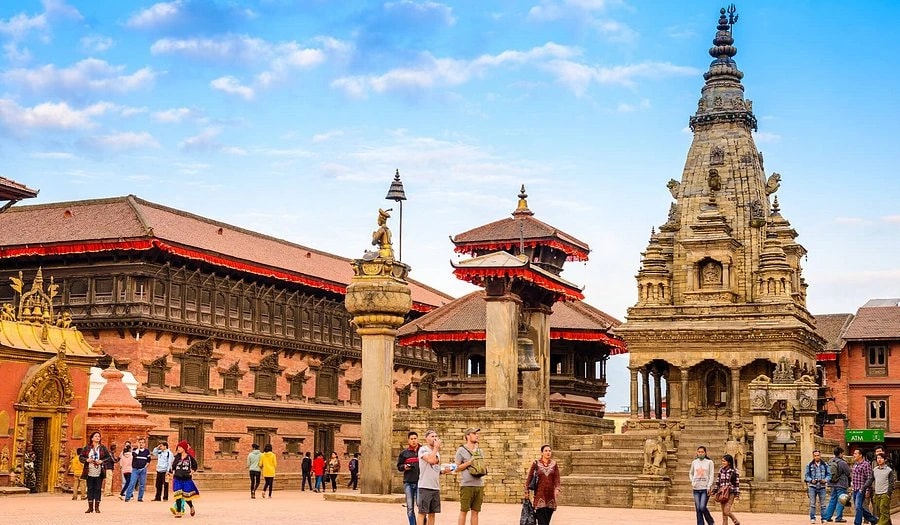
Bhaktapur Durbar Square is the old royal court of Khwopa - the seat of the Malla kings who ruled the entire Kathmandu Valley from here before it divided, and who then ruled Bhaktapur as an independent kingdom until 1769. It sits at the centre of a walled medieval town roughly 13 km east of Kathmandu, at around 1,400 m, and it is the one durbar square in the Valley you can still walk through without a motorbike at your heels. The historic core is closed to traffic. That single fact changes everything about how the place feels.
Its significance is threefold. Architecturally, Bhaktapur holds the Valley's most ambitious structures - the tallest temple in Nepal, the most celebrated gilded gate in South Asia, a palace whose window screen is a national emblem. Socially, it remains a Newar farming and craft town first and a heritage site second: potters still turn clay in the open at Talako, and the ticket revenue you pay funds the municipality that repairs the temples. And politically, Bhaktapur is the one place in Nepal that rebuilt its own monuments after 2015 with its own money, on its own terms, having turned down a foreign grant worth more than ten million dollars.
Also known as Bhadgaon in Nepali and Khwopa to the Newars who have always lived here, Bhaktapur was inscribed as part of the Kathmandu Valley UNESCO World Heritage Site in 1979. The square is bigger and emptier than Patan's - a legacy of the 1934 earthquake, which took buildings that were never replaced. That emptiness is not absence. It is space to see what survived.
Give it a full day. The ticket covers four squares, and the city only opens up on the second lap.
History of Bhaktapur Durbar Square
The capital of the whole Valley
Bhaktapur's founding is traditionally credited to King Ananda Dev in the 12th century, on a site already settled and already prosperous - it sat directly on the old trade route between India and Tibet, and the tolls and traffic of that road paid for a great deal of what you now photograph. For roughly three centuries, from the 12th to the 15th, Bhaktapur was not one capital among three. It was the capital of the Kathmandu Valley, and Kathmandu and Patan were secondary towns.
That ended with King Yaksha Malla. On his death in 1482, the kingdom was divided among his heirs, and the Valley split into the three rival city-states: Bhaktapur, Kathmandu and Patan - whose competitive temple-building produced almost everything a visitor now comes to see. Rivalry, not piety alone, built the Kathmandu Valley.
The golden age of Bhupatindra Malla
The square you walk today is overwhelmingly the work of two kings. Jitamitra Malla and, above all, his son Bhupatindra Malla (reigned 1696–1722), whose name is attached to almost every masterpiece here: the 55-Window Palace, the Nyatapola, the great gallery of carved screens. He is the figure kneeling on the stone column facing the Golden Gate, hands folded, still watching the palace he built.
The gilding of the Golden Gate in 1754 belongs to his successor Ranjit Malla, the last king of Bhaktapur - an offering to the goddess Taleju, and the final flourish of an independent kingdom that had perhaps fifteen years left.
Conquest, and two earthquakes
Prithvi Narayan Shah of Gorkha took Bhaktapur in 1769, the last of the three capitals to fall, completing the unification of Nepal. Ranjit Malla went into exile. The court dissolved; the city stayed.
Then came the earthquakes, and this is where Bhaktapur's story diverges sharply from Patan's. The 1934 Nepal–Bihar earthquake did not merely damage this square - it redrew it. The Fasidega, Hari Shankar, Siddhi Lakshmi, Chyasilin Mandap and Bhairavnath temples all came down, along with structures whose names are now uncertain. Some were rebuilt in their original form. Others never returned, and the wide, open plaza that visitors often describe as serene is in fact the outline of what was lost.
The 2015 Gorkha earthquake hit hard again - over 300 people died in Bhaktapur, more than 30,000 houses were damaged, and 116 monuments across the city were significantly harmed. But the square itself lost only one temple outright, the stone Vatsala Durga. Its reconstruction, completed in 2021, closed the chapter: the last temple in Bhaktapur Durbar Square to come back.
Major Attractions of Bhaktapur Durbar Square - A Self-Guided Walking Tour
The ticket covers the whole walled city, and the four squares sit along a single spine running roughly west to east. Everything below is a few minutes from the last, and the sequence is deliberate - it moves from royal display to working craft, which is the correct direction for understanding this town.
1. The Lion Gate and the western approach
Enter from the western side, where most visitors arrive. The Lion Gate, flanked by two stone lions, opens the palace frontage. Local lore holds that the king had the sculptor's hands cut off afterwards so the work could never be repeated - a story told about several Newar masterpieces, and worth hearing for what it says about how this city values its craftsmen, whether or not it happened.
2. The 55-Window Palace and the Golden Gate
The Pachpanna Jhyale Durbar, the Palace of Fifty-Five Windows - is Bhupatindra Malla's signature: a long brick façade broken by a continuous screen of carved wooden windows, dark and intricate, the finest surviving woodwork of the Malla period. It is one of the most reproduced images in Nepal.
Its entrance is the Golden Gate (Sun Dhoka), gilded by Ranjit Malla in 1754 and generally rated the most refined piece of repoussé metalwork in the country. The tympanum shows Taleju Bhawani above a multi-armed Garuda, framed by nagas, nymphs and monsters. Stand close. The gate is small, and the detail is the point.
Behind it lies the Taleju Chowk and the Taleju Bhawani shrine - the royal tutelary goddess. Non-Hindus cannot enter the inner courtyards. Accept the boundary without negotiating it; it is the most sacred space in the city.
3. The National Art Museum
The western wing of the palace houses the National Art Museum, guarded by two stone lions with Hanuman and Narasimha beside them. Inside: thangkas, palm-leaf manuscripts, stone and metal sculpture, and painted chronicles spanning centuries of Hindu and Buddhist iconography. It runs on a separate ticket from the city entry fee and that ticket also admits you to two more museums further east, which is the argument for buying it early rather than late.
4. Vatsala Durga, the Taleju Bell and King Bhupatindra's column
In front of the palace stand three things worth reading together. The column of King Bhupatindra Malla, kneeling in gilded bronze, facing the gate he commissioned. The Taleju Bell, hung in 1737 by Ranjit Malla, still rang at daily worship - known locally as the barking-dog bell, for the effect it is said to have on the neighbourhood's dogs. And the stone Vatsala Durga Temple, a sandstone shikhara built in 1672, destroyed in 2015 and rebuilt by 2021 through municipal funds and public donation.
Look at the Vatsala carefully. It is the newest old thing in the square, and every stone in it was placed within the last five years by craftsmen using methods four centuries old.
5. Chyasilin Mandap
The octagonal pavilion east of the palace is the most instructive object in Bhaktapur, and almost nobody stops at it. The original fell in 1934. It was reconstructed in 1990 as a Nepali–German project, faithful in every visible respect but with a hidden steel core carrying the load.
In 2015, the Chyasilin Mandap stood. Its unretrofitted neighbours, the Vatsala Durga and the adjacent rest-house, did not.
That is the entire argument about heritage engineering in Nepal, rendered in a single square: whether a monument should be a museum of technique or a building that survives. Bhaktapur has been arguing about it ever since.
6. Pashupatinath Temple and Naga Pokhari
The Pashupatinath (Yaksheshwar) Temple at the square's western end is the oldest structure here, a 15th-century copy of the Kathmandu original, and notable for the erotic carvings on its roof struts, which are usually read as tantric protection rather than decoration. To the north, the royal bathing tank Naga Pokhari is ringed by a stone serpent, its water spouts a cobra's head. It was where the royal household bathed, and it is still filled.
7. Taumadhi Square and the Nyatapola
Walk two minutes southeast and the scale changes completely.
The Nyatapola Temple, commissioned by Bhupatindra Malla and completed in July 1702 after roughly six months of work, is the tallest temple in Nepal - five tiers rising above thirty metres from a stepped plinth. Its stairway is guarded by five ascending pairs of figures: the wrestlers Jayamel and Phattu at the base, then elephants, lions, griffins and goddesses, each pair traditionally said to be ten times stronger than the one below.
It survived 1934. It survived 2015 with barely a crack. It is dedicated to Siddhi Lakshmi, a fierce tantric goddess, and nobody enters - not tourists, not residents. You climb the steps, you sit, you look out over the square. That is the whole experience, and it is enough.
Facing it across the square is the Bhairavnath Temple, a three-tiered pagoda holding the Bhairav mask that rides the great chariot at Bisket Jatra. Squat where the Nyatapola is tall, it is the town's ritual engine.
8. Dattatreya Square, the Peacock Window and Pottery Square
Continue east along the old main street. Dattatreya Square is the oldest part of Bhaktapur, anchored by the Dattatreya Temple, dating to 1427 under Yaksha Malla and said to have been built from the timber of a single tree.
Beside it, the Pujari Math - a priestly residence rebuilt in 1763, restored by German conservators in 1979 as a wedding gift to King Birendra - now holds the Woodcarving Museum. Down a narrow lane on its southern side is the Peacock Window, a 15th-century lattice generally called the finest carved window in Nepal. It is small, it is in an alley, and it is the thing most day-trippers skip.
The Brass and Bronze Museum sits opposite. Both are covered by your National Art Museum ticket.
Pottery Square (Talako), south of Taumadhi, is not a monument at all. It is a workplace - wheels turning, rows of unfired pots drying in the sun, kilns smoking under straw. Watch a potter for ten minutes without buying anything. You will learn more about Bhaktapur there than in the palace.
What Most Visitors Miss
Most people arrive by tour bus around eleven, photograph the Nyatapola, eat lunch on a rooftop, and leave by three. They see the monument and miss the town.
The reward for staying is the second layer. Buy the ticket and stay overnight - the entry pass can be extended free of charge for up to seven days with your passport, which makes an overnight cheaper per day than a rushed visit. At dawn, the square belongs to residents carrying brass plates of offerings, and the light on the 55-Window Palace is the best of the day. After dark, the day-trippers are gone and the town is simply a town.
Walk the lanes between the four squares rather than the direct route. This is where the city actually lives - courtyards, communal water spouts, drying grain, a shrine every thirty metres.
Sit at the Chyasilin Mandap and think about steel. Look at what came down in 1934 and never came back, and understand that the openness of this square is a scar, not a design.
Eat Juju Dhau - "king curd," the buffalo-milk yoghurt set in clay pots that Bhaktapur is famous for across Nepal. Buy it from a dairy in the lanes, not from a menu.
And watch the restoration crews, still working through the municipality's list of monuments. Bhaktapur is one of the few places on earth where medieval building crafts are practised as a functioning trade rather than a demonstration.
Entry Fees, Tickets & Opening Hours
Bhaktapur Durbar Square entry fee 2026:
Bhaktapur charges differently from Kathmandu and Patan, and this trips people up. The fee is not for the square - it is for the entire walled historic city, covering Durbar Square, Taumadhi Square, Dattatreya Square and Pottery Square, with checkpoints on all main approach roads. It is also the highest heritage fee in the Valley, and the municipality is unapologetic about that: the revenue funds the reconstruction you have come to look at.
Visitor Category | Entry Fee | Notes |
|---|---|---|
Foreign nationals (non-SAARC) | USD 15 / ~NPR 2,000 | Covers all four squares; valid for the day |
SAARC nationals | ~NPR 500 | Passport required as proof |
Chinese nationals | ~NPR 500 | Treated on the SAARC rate |
Nepali citizens | Free | |
Children under 10 | Free | Accompanied by an adult |
National Art Museum + Woodcarving + Brass & Bronze | ~NPR 150 (foreigners) | Separate ticket, covers all three |
The extension nobody tells you about: ask at the ticket counter and show your passport, and the ticket can be extended to a maximum of seven days at no extra cost. If you are staying longer than that, apply for a visitor pass at the Tourist Information Centre in Durbar Square with passport photos, a passport copy and your original ticket. If you plan to stay even one night in Bhaktapur, ask for the extension when you buy - not afterwards.
Opening hours:
Typical Hours | Notes | |
The historic city | Effectively open all day | Ticket checkpoints staffed roughly 7am–7pm |
National Art Museum | ~10:00am–5:00pm | Closed one day a week and on public holidays - reports vary between Tuesday and Saturday; verify locally |
Temples & courtyards | Roughly daytime hours | Taleju courtyards closed to non-Hindus |
Practical ticket tips
-
Carry cash in Nepali rupees. Card readers at heritage counters are unreliable.
-
Keep the ticket on you. Wardens check it inside the walled city, not only at the gates.
-
Groups of 11–20 are commonly granted one free leader entry - confirm at the counter.
-
Fees change without much notice. Confirm at the gate rather than trusting any blog, including this one.
Visitor Rules & Guidelines
Bhaktapur is not a heritage park with a town attached. It is a working Newar city of farmers, potters and priests that happens to contain a UNESCO site, and you are paying to walk through its streets. The rules below are less regulation than etiquette - the terms on which a neighbourhood lets a stranger in.
Guideline | What it means on the ground | Why it matters |
Dress modestly | Cover shoulders and knees, particularly at temples and shrines. There is no enforced code, but residents notice the effort. | These are active places of worship, not a backdrop. |
Remove your shoes | Take them off before entering any temple or shrine. Leather items are restricted at some shrines | Bare feet on temple ground is the oldest mark of respect in Nepal. |
Respect closed sanctums | The Nyatapola's interior is closed to everyone, including residents. The Taleju courtyards are closed to non-Hindus. | A boundary that is not about you is not a boundary to negotiate. |
Ask before photographing a person | Always ask a resident, priest or potter before raising a camera and never photograph a ritual in progress. Accept refusal gracefully. | The people here are narrators, not subjects. |
Photograph the stone, not the sacred | Photography is welcome across the open squares. It is restricted inside several temples and in parts of the museums. Watch the signage. | Flash damages pigment and interrupts devotion. |
Do not touch or climb | No climbing on plinths or guardian statues, no handling of offerings, and respect restoration hoardings. | Much of what you are looking at was rebuilt by hand within the last decade. |
Walk clockwise | Circle shrines and temples clockwise (pradakshina), as devotees do. | A small gesture that signals you know where you are. |
Give potters room | Pottery Square is a workplace. Do not step on drying pots, and do not stage photographs among them. | Their livelihood is the attraction |
No drones without permission | Drone flights and commercial filming require prior clearance from Bhaktapur Municipality. | Heritage airspace and ceremony both need protecting. |
[→ Full guide: Nepal Temple Etiquette for Travelers]
Best Time to Visit Bhaktapur Durbar Square
Best time of day:
Bhaktapur rewards the two ends of the day more sharply than any other square in the Valley, because most of its visitors are day-trippers on a fixed loop from Kathmandu.
7–9am is the finest window. Low light rakes across the 55-Window Palace, residents are making their morning offerings, and the tour coaches have not arrived.
4–7pm is the second: the brick warms to deep red, the squares fill with an easy end-of-day rhythm, and the town becomes residential again.
Staying overnight collapses this problem entirely. It is the single best decision a traveller makes in Bhaktapur.
Best season:
October and November are the finest months - post-monsoon skies, comfortable temperatures, and Nepal's peak season for good reason.
March and April are a close second, warm and clear, and April carries Bisket Jatra.
The monsoon (June–September) brings dramatic cloud and green terraces but heavy afternoon rain and slick brick underfoot.
Winter (December–February) is cool and quiet, with the crispest mornings of the year and the fewest visitors - Bhaktapur sits high enough to be genuinely cold at dawn.
Bhaktapur's Festival Calendar
Bhaktapur has the most intense festival calendar of the three cities, and one significant advantage for planners: its signature festival follows the solar calendar, so the dates barely move.
Bisket Jatra - the New Year festival
Bisket Jatra (Biska Jatra) is a nine-day, eight-night festival marking the Nepali New Year, and it is unlike anything else in the country. A towering wooden chariot carrying Bhairav is hauled through the narrow stone lanes, and the city divides - upper town pulling one way, lower town the other - in a tug-of-war whose outcome is read as an omen for the year ahead. At Khalna Tole, a ceremonial pole roughly twenty-five metres tall is raised and then brought crashing down, marking the turn of the year. Neighbouring Thimi answers with Sindoor Jatra, a vermilion-throwing procession, and Bode with its tongue-piercing ceremony.
Because Bisket is tied to the solar new year rather than the lunar calendar, it lands in mid-April every year - the festival runs roughly from 10 April, with Nepali New Year on 13–14 April. For 2027, plan around that window and confirm the exact schedule locally a few weeks out.
If you can time one visit to Nepal around one festival, this is a strong candidate. Expect road closures across the old city, packed lanes, and genuine crush near the chariot. Go early for position, and stay on the edges if crowds concern you.
The rest of the year
Gai Jatra (August) is celebrated with particular force in Bhaktapur, mixing public mourning for the year's dead with costume, stick dance and licensed satire. Dashain and Tihar (October–November) bring the masked Navadurga dancers out through the town - a tantric dance cycle performed by a hereditary troupe that runs from autumn through to Bisket. Indra Jatra, Sithi Nakha and Nepal Sambat each mark the calendar.
Most of these follow the lunar calendar, so dates shift year to year. Confirm before committing travel.
Bhaktapur vs Kathmandu & Patan Durbar Square
All three durbar squares are UNESCO-listed, and travelers with limited time reasonably ask which to prioritise. The honest answer: they are not substitutes for one another.
Bhaktapur Durbar Square | Patan Durbar Square | Kathmandu Durbar Square | |
City | Bhaktapur (Khwopa) | Lalitpur (Patan) | Central Kathmandu |
Best for | Scale, car-free medieval town, festivals | Fine art, Newari craft, calm | Central location, grandeur |
Crowds | Moderate | Moderate | Moderate–heavy |
From Thamel | ~60–90 min | ~20–40 min | ~10–15 min (walkable) |
Foreign entry (approx.) | ~NPR 2,000 (whole city) | ~NPR 1,000 (museum incl.) | ~NPR 1,000 (museum incl.) |
Signature sight | Nyatapola · Golden Gate · 55-Window Palace | Krishna Mandir · Patan Museum | Kumari Ghar · Hanuman Dhoka |
Signature festival | Bisket Jatra | Rato Machhindranath Jatra | Indra Jatra |
Time needed | Full day (ideally overnight) | Half day to full day | 2–3 hours |
Tip: Kathmandu and Patan pair well in one busy day. Bhaktapur deserves its own - the ticket price alone makes a rushed visit poor value, and the town is the point, not the square. Fees change often; confirm current rates before you go.
[→ Full guide: Patan Durbar Square: History, Location & Travel Guide 2026]
How to Get to Bhaktapur Durbar Square from Kathmandu
Bhaktapur sits about 13 km east of central Kathmandu along the Araniko Highway. The distance is short; the traffic is not. Reckon on 30–45 minutes by taxi outside peak hours, and up to ninety minutes in the morning and evening crush. Travelling before 9am or after 4pm is worth the effort in both directions.
Taxi is the simplest option - agree the fare before setting off, or use a ride-hailing app (Pathao and InDrive are widely used) for a fixed, trackable price. Expect roughly NPR 1,000–1,500 one way, more if you ask the driver to wait.
Local and micro buses run from Ratna Park and Bagbazar toward Bhaktapur, dropping at the bus park near Kamalbinayak or at Sallaghari. Cheapest by a wide margin, and a short walk from the gates.
Note: Vehicles do not enter the historic core. Wherever you are dropped, you walk the last stretch - which is the correct way to arrive anyway.
Bhaktapur also pairs naturally with Changu Narayan Temple, a short drive or a well-marked hour's walk to the north, and the two are frequently combined in a single day.
Where to Stay Near Bhaktapur Durbar Square
Staying inside the walled city is the strongest argument this guide makes. It converts a NPR 2,000 day ticket into a multi-day pass, and it gives you the town at dawn and after dark, when it stops performing.
The lanes around Durbar Square, Taumadhi and Dattatreya hold a good spread of heritage guesthouses in restored Newari buildings, small hotels and a few boutique properties, many with rooftop terraces looking directly onto the Nyatapola. Rooms are simpler than Thamel's at comparable prices - you are paying for a position, and the position is unmatched.
For travelers combining Bhaktapur with hill views, Nagarkot is around forty minutes further east and commonly done as an overnight extension.
Challenges & Preservation: The City That Rebuilt Itself
Bhaktapur's preservation story is the most contested in Nepal, and the most instructive. It is worth telling honestly, including the criticism.
A city already rebuilt once
Modern Bhaktapur was shaped by the Bhaktapur Development Project (1974–1986), a Nepali–German programme that began with a single restored math on Dattatreya Square and grew into an integrated urban renewal effort - monuments restored, but also water supply, sewerage and housing in a town where those things had barely existed. It drew international attention, local resistance, and eventually a shift from technical restoration toward community development. It is the reason Bhaktapur was already unusually well organised about heritage before 2015 - and part of the reason it later felt able to go it alone.
2015, and the decision that defined the city
The Gorkha earthquake killed over 300 people in Bhaktapur and damaged 116 monuments. What happened next set the city apart. Residents gathered and catalogued fallen fragments before official crews arrived - a duty toward the wealth of their ancestors, as one resident put it.
Then, in 2018, Bhaktapur Municipality declined more than US$10 million in reconstruction funding from the German Development Bank, over disagreements about how projects would be commissioned and executed. Where Kathmandu and Patan welcomed foreign funds and foreign expertise, Bhaktapur chose to rebuild with municipal revenue, local donations and its own trained workforce - writing its own guidelines for clay, wood and brick construction when the national reconstruction authority had none.
The results are hard to argue with. The mayor's office has reported reconstruction completed on more than a hundred of the city's damaged monuments. Residents could sponsor a temple and see the accounting. Vatsala Durga stands again. And unlike its neighbours, Bhaktapur has been largely scaffolding-free for years.
The criticism, which is also real
This is not a story without a counter-argument, and Hidden Hymn will not flatten it into one.
Conservation specialists have objected that several of Bhaktapur's methods sit uneasily with international heritage guidelines - decisions about materials, about how much reconstruction constitutes restoration, about rebuilding forms for which the documentary evidence is thin. The Lion Gate is a case in point: the municipality wanted to rebuild the pre-19th-century original rather than the later design, but so little is known about what stood there that the design has been difficult to settle. Independence has a cost, and part of that cost is proceeding without the archive.
There is also a philosophical split that the Chyasilin Mandap embodies. Fewer than one in ten of Bhaktapur's heritage sites is directly assigned to the national Department of Archaeology. That autonomy is precisely what made rapid reconstruction possible - and precisely what makes external oversight limited.
The slow threats
The earthquake was sudden. The rest is not. Agricultural land around Bhaktapur is steadily disappearing to concrete, and with it the farming economy that produced the festivals, the food and the calendar in the first place. Traffic and air pollution press against the walled core from every side. The wider Kathmandu Valley sat on UNESCO's List of World Heritage in Danger from 2003 to 2007, largely over exactly this kind of unsympathetic transformation.
A city that fought to rebuild its temples on its own terms is now facing a harder question than any earthquake posed: whether the community that gives those temples meaning can afford to stay.