
Patan (Lalitpur) Metal Craft: Nepal’s Living Tradition of Statue-Making
In Patan, art is not just decoration — it is devotion. Down the narrow brick lanes of this Kathmandu Valley, a soft tapping never quite stops: artisans crafting metal into gods, as their families.

Sarvagya Shakya
Author
Sarvagya Shakya writes for Hidden Hymn — long-form stories from the world's quietest corners.
July 14, 2026 · 11 min read
Patan (Lalitpur), the City of Art
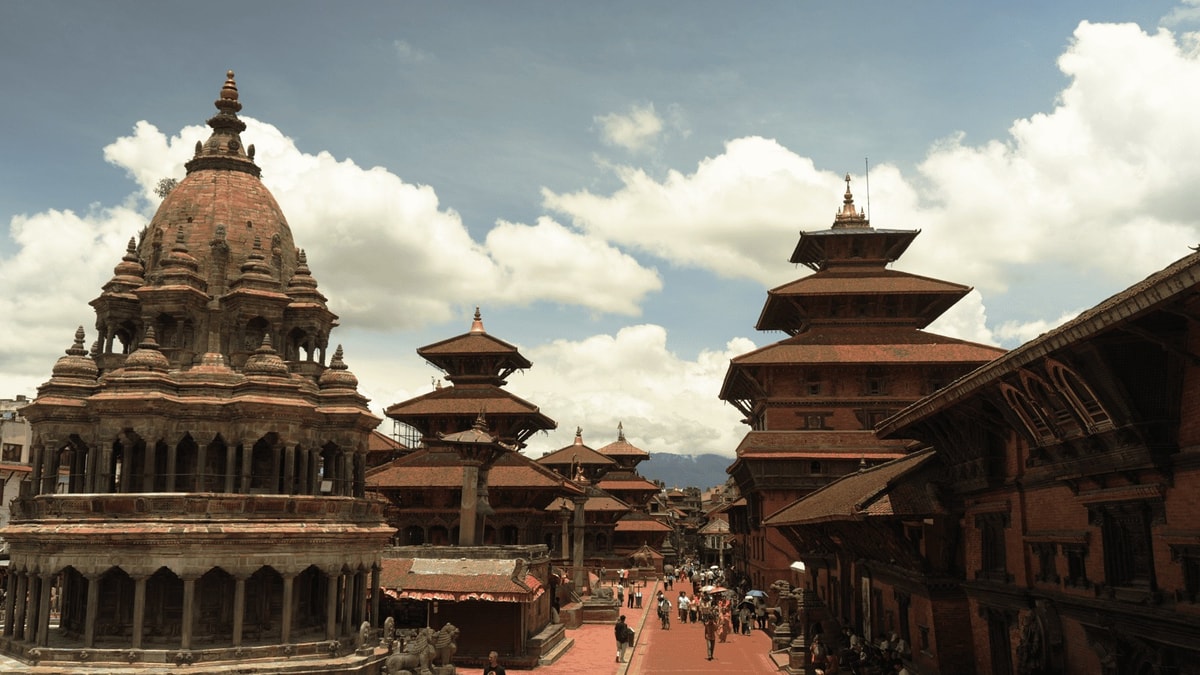
Patan lies in the heart of Nepal’s Kathmandu Valley, famous for its art and its artisans. It's name tells you as much: “Lalitpur” breaks clearly into two words - “lalit”, meaning “art” and “pur”, meaning “city” hence, “The City of Art” . Renowned for its exquisite Newar architecture, its pagoda-style temples are adorned with finely worked metal and wooden monuments that lend the place a charm of its own.
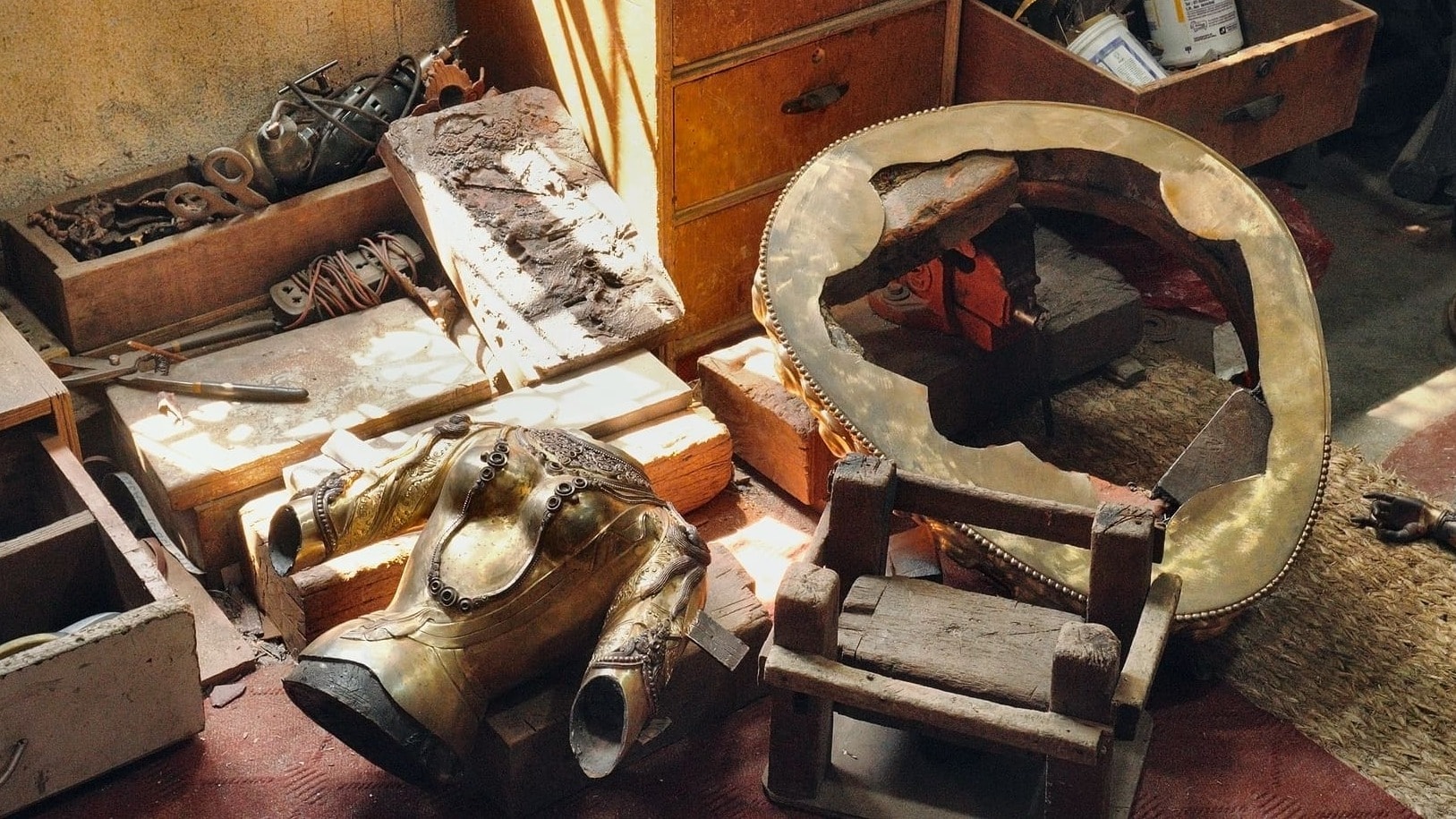
Wander the alleys and you will hear something before you see it - a soft, steady tapping in almost every lane. That is the sound of Patan’s artisans, beating metal with astonishing precision into intricate patterns. A centuries-old process, still kept alive by a small number of makers, the knowledge handed quietly from one generation to the next.
Evolution of Metal Craftmanship: From Stone to Gold
The Pre-Medieval Era
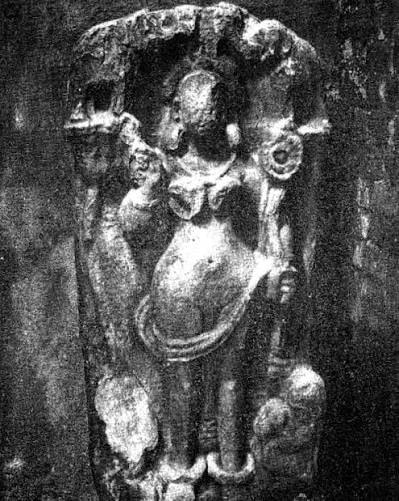
Metal art flourished in Nepal in the 17th century AD, though no record pins down exactly when it began. Early works from the Licchavi era (400–750 CE) show that stone was the predominant building material and bronze the common alloy. The Gajalaxmi statue of Chyasal, dated to the 2nd century AD, and the Ashoka caitya of Oku Bahal are among its prominent surviving artifacts.
The Transition Period
Later pieces turned to copper and to precious metals such as gold and silver. Nepali metalworkers used copper, bronze and other metals for casting and gilding, for jewelry, for minting coins, and for setting crystal, coral and gems. By the 10th century, metalwork is believed to have overtaken stone in both quantity and demand.
The Indian Subcontinent Influence
Art in the higher hills and mountains was shaped by several civilizations that grew up on the plains of the Indian subcontinent; the Pala dynasty (750–1150) held particular sway over regions such as Kathmandu. The human figure appears to have passed through a transition between 880 and 1200 - according to Pratapaditya Pal, author of The Arts of Nepal - with 10th and 11th century pieces showing slender forms and long, well-shaped limbs and fingers.
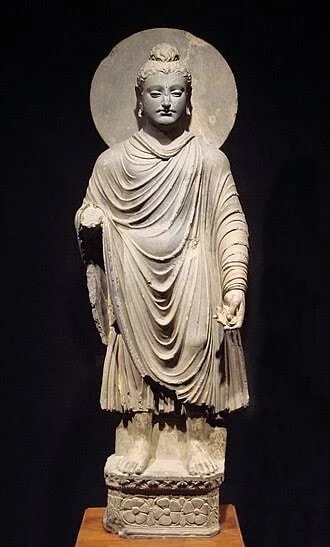
These stand in sharp contrast to the fuller, more curvaceous Licchavi sculptures, with their broad hips and full bodies. The rounder forms are thought to have arrived from the Mathura kingdom; before that influence took hold, and after it wore off, Kathmandu’s artists favored slimmer figures.
The Golden Era: Rivalry Through Art
As the valley moved into the medieval era - often remembered as the golden age of its art and architecture - it settled into a political standstill. In 1482, Yaksha Malla divided the Kathmandu Valley kingdom among his three sons, creating the cities of Patan (Lalitpur), Kantipur (Kathmandu) and Bhadgaon (Bhaktapur), which soon fell to competing with one another.
Art became the weapon of choice. The three kingdoms raised ever-grander palaces and temples, and commissioned every fine metal and wooden work, each trying to outshine the others. Local legend tells how the artisans of Patan traveled to Bhaktapur to build its famous Golden Gate, set before the royal palace - today part of the UNESCO World Heritage site of Bhaktapur Durbar Square. The gate was hailed as the pinnacle of craftsmanship; but when the king of Patan learned of it, the artisans were refused permission to return home, and were sheltered instead by the king of Bhaktapur. That royal rivalry sharpened the valley’s art and architecture, leaving behind three magnificent palaces - each raised to top the last - that still woo the traveler to this day.
The Craftsman Who Astonished China: Arniko
Arniko (1244–1306), a craftsman born in the Kathmandu Valley, is remembered as the most distinguished artist of medieval Nepal - the man whose work left the Chinese court astonished.
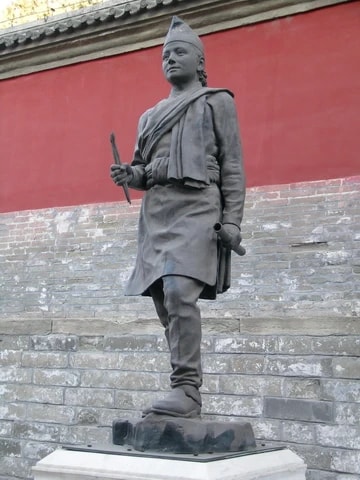
A prodigy from the City of Art
By the account of the late scholar Satya Mohan Joshi, Arniko was born around 1244 in Patan, the City of Art - though his birthplace is still debated. Local stories remember a wonderkid who outpaced his family’s craft from childhood, probing with questions that stunned his teachers and bewildered his elders. One tale recalls a family visit to a Buddhist holy place when the boy was just three - gazing up at the pagoda, its tiered eaves and golden finial, he asked his parents the names of the people who had built it. It was only a matter of time before he would be chosen for the great projects that would carry his name into immortality.
The Journey to North
In 1260, the Mongol leader Kublai Khan asked his spiritual guru, Phagpa, to build a golden stupa in Tibet. When the patriarch of the Shakya sect of Tibetan Buddhism requested hundred artists from Nepal’s king, Jaya Bhimadeva Malla, the sixteen-year-old Arniko - already famous as a child prodigy, volunteered to lead them. He raised stupas in Tibet, Beijing and Wutaishan, and proved himself just as gifted at casting statues of the Buddha, at painting, at embroidering images on silk, at engraving and portraiture. In 1278, he built the White Pagoda in Beijing. When it was finished, the emperor held a great ceremony to consecrate it and as he arrived, a beam of heavenly light is said to have struck the pagoda and set it glowing. Astonished, the emperor believed Arniko possessed divine power.
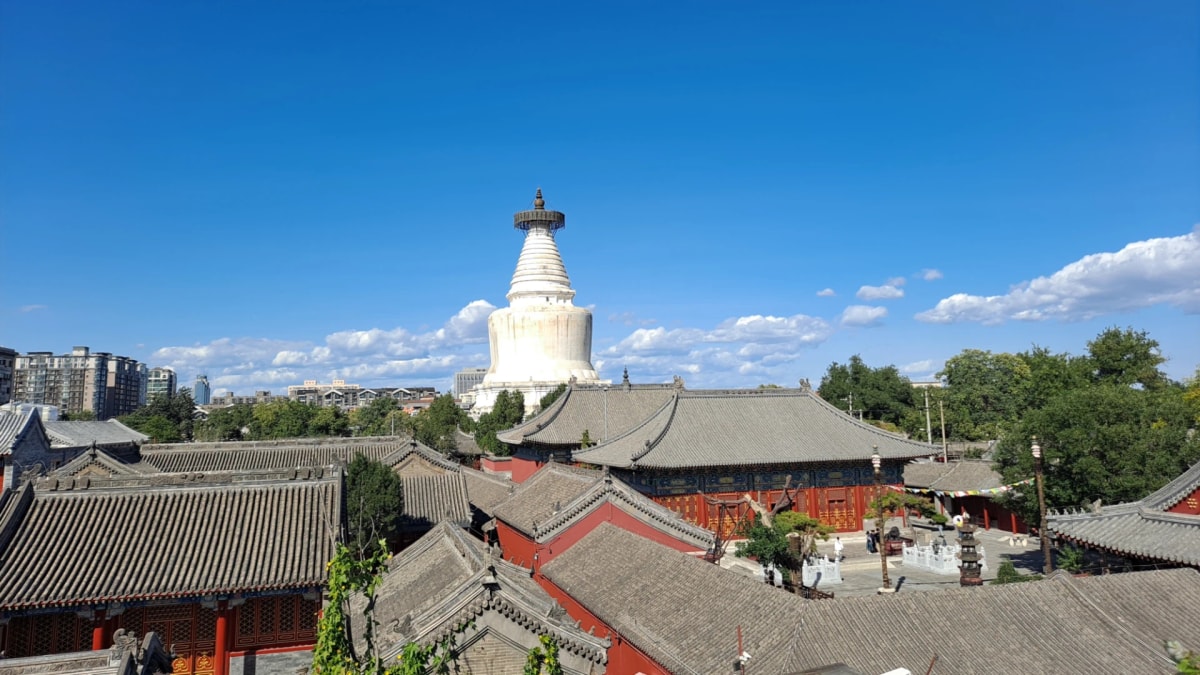
The Legacy
The emperor made him a powerful minister of the court, granting him the title “Liang Guo Gong” (duke) and, after his death, the title “Ming Hui” - “the bright wisdom”. Arniko founded an arts workshop at the Imperial Palace, with some two hundred apprentices from Nepal, China, Tibet and Mongolia, and wrote a book on the measurements and proportions for making statues of the Buddha. His work still stands: the White Stupa (Bai Ta) in Beijing; the stupa raised in 1302 at Mount Wutaishan in Shanxi Province, one of China’s most sacred Buddhist mountains; and his Taoist commissions, for which he created 191 statues of Taoist saints and painted portraits of the Yuan emperor and empress. The legacy of this Nepalese artist laid the foundation of an eastern architectural style still revered and practiced across East Asia.
How Is A Metal Statue Made?
The finished statue can look as though the deity itself has graced the room - but creating one is immensely complex from start to finish.
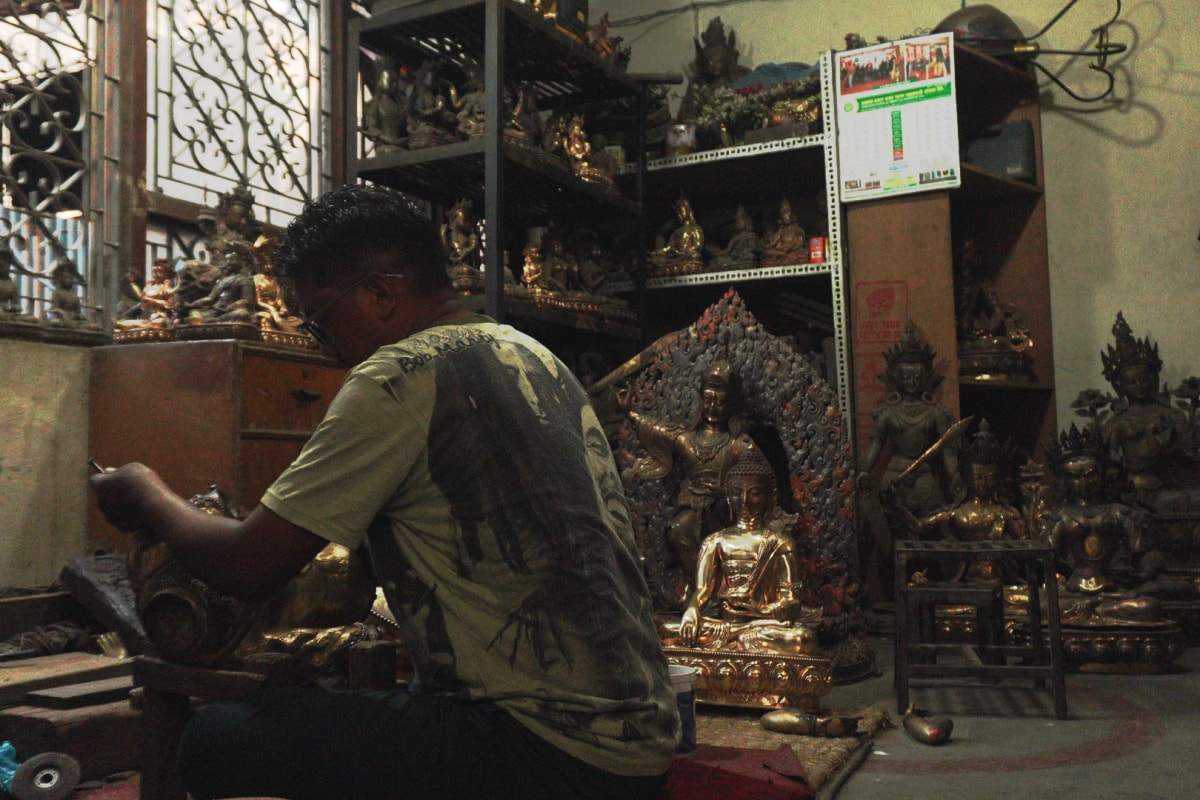
The Wax Statue (Ma Jya):
The first step is called “Ma jya,” a Newar term for creating the wax model of the deity. Artisans use honeycomb as the source of wax, mixed with various chemicals. The wax is dried into a thick brick, then reheated and modeled using a tool called a “Dash,” giving it its final wax form. As Devraj, a wax artisan of 48 years, explains:
“The wax statue determines the final output - if the wax is modeled properly, the final statue comes out well refined.”
— Devraj, wax artisan, Patan
The Clay Mould:
The finished wax statue is then coated with clay made from cow dung and black soil. First, a layer of cow dung is applied and left to dry for a few days - the timing depends heavily on the weather. Once the details are crisp, a second layer, a mixture of clay and hay, is added and dried in the sun for a few weeks.
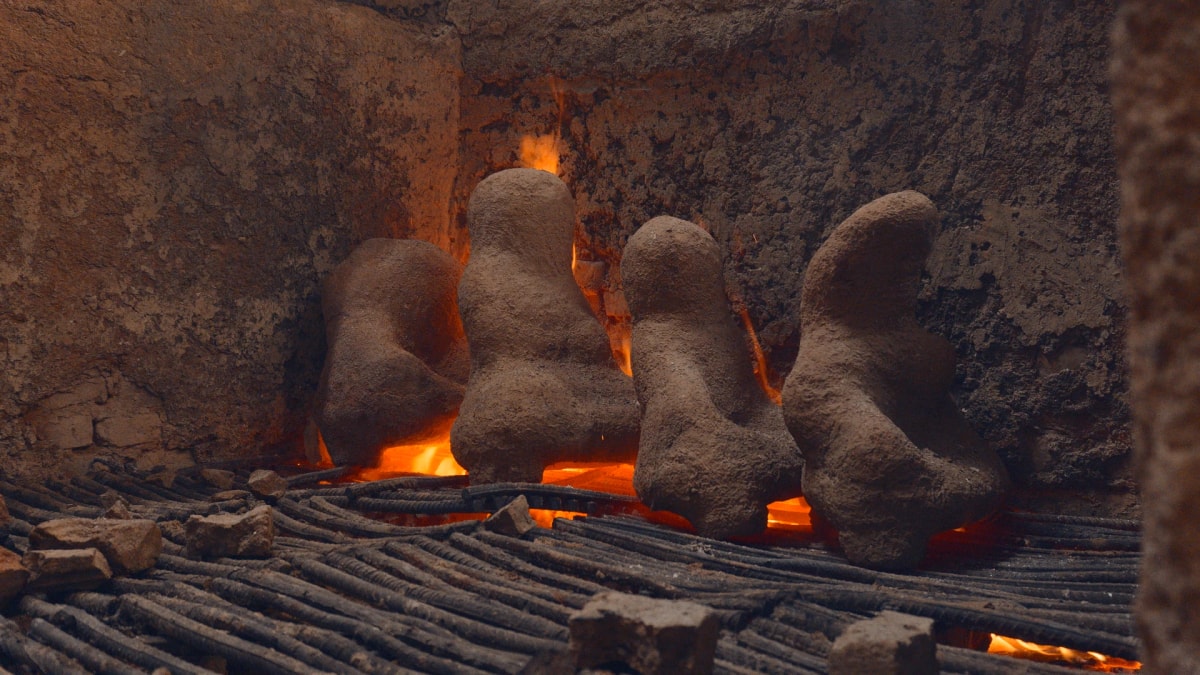
The Furnace:
It is one of the most intense stages; copper, zinc and other metals are melted in a high-temperature furnace. The molten alloy is poured into an opening in the clay-covered statue, then left to cool and quenched. The clay is carefully broken away, revealing the first glimpse of the deity.
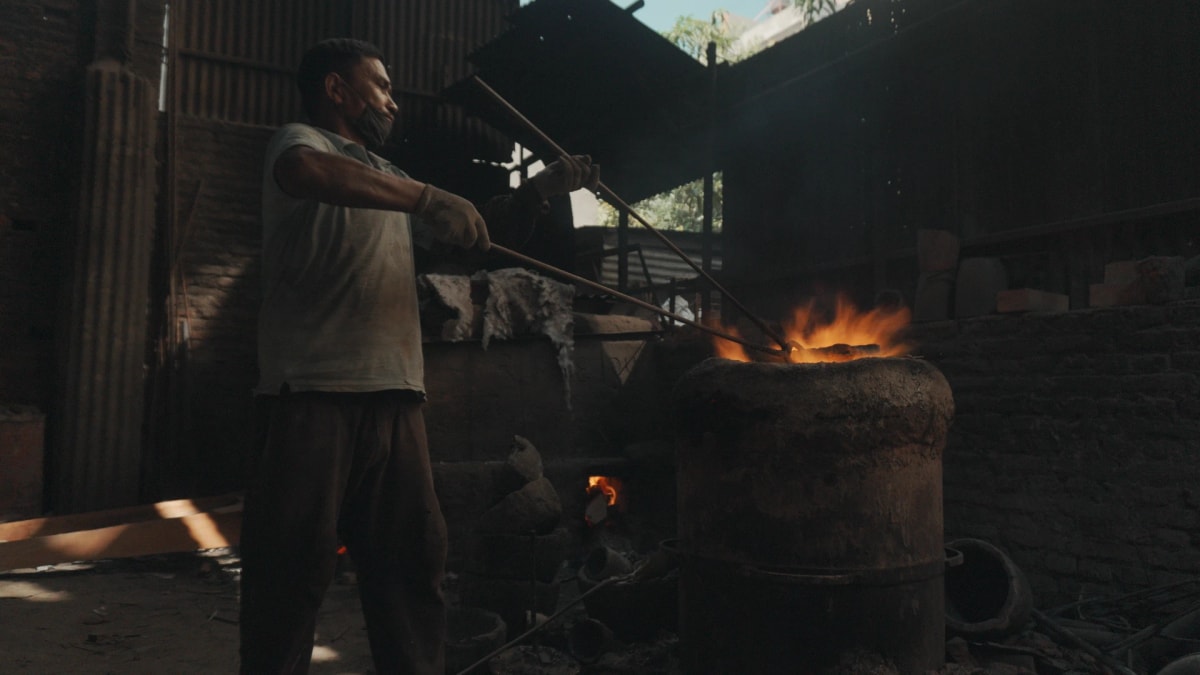
The Finishing:
The metal statue now moves to finishing. The artisans cleanse the deity - scraping away debris, checking for flaws and correcting them, then carve the intricate patterns that give it its final, refined look.
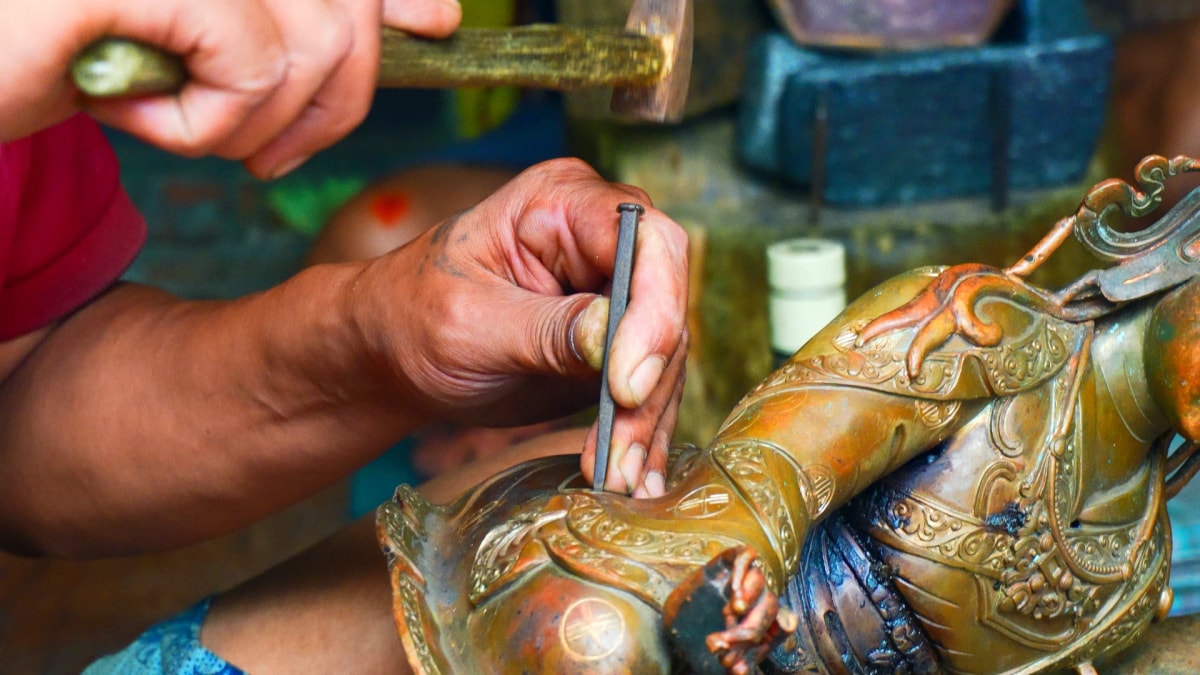
Devotee’s Wish:
The final step depends on the devotee. Some prefer the deep, oxidized copper colour; others ask for the deity to be finished entirely in gold. At their request, the body is gilded and the face painted with pure powdered gold, and gems are set across the figure - giving the deity its final, mystical look. The process may sound simple, but from start to finish a single metal statue takes around two months and almost eight artisans to complete.
A Living Craft, Passed Down Through Generations
Today the tradition is moderately active, kept alive by a small circle of Patan’s artisans. It is a practice handed down through generations - something Sabin Raj Shakya, a Patan local, brings vividly to life. His family has worked in art for four generations; the line began, he says, with his great-grandfather, Dhanraj Shakya. Before him came a line of excellent craftsmen - Dhancipa, Kulakuma, Siddhiraj and Bodhiraj - known for their work in Patan.
Like his forefathers, Sabin began at sixteen, taught by his grandfather and father. Recalling his introduction to the craft, he says:
“I wanted to create a masterpiece. I may not have mastered the skill myself - but I truly help my team, and lead them to create one.”
— Sabin Raj Shakya, 4th generation Patan craftsman
The difficulty, he explains, is immense. A maker with the 32 guna - the thirty-two characteristics of a perfect work, might once have completed a masterpiece from start to finish alone. Today it takes eight or nine artisans, each working at different stage, to finish a single statue. It is that shared dedication, that makes everything happen. As for the generation after him, he holds out quiet hope:
“My son is sixteen. He helps his mother - herself an exceptional artist, paint the golden faces of the statues and give them their final touch. I have never forced him, but I hope he will continue the family legacy.”
— Sabin Raj Shakya
Sabin is far from alone. Across the city, artisans still work from small, one-room workshops, carving “butta” - the intricate patterns pressed into polished metal. Just outside the courtyard of Nagbahal, regarded as the birthplace of Arniko - Bhuwan Sinchuni has practiced the craft for some eleven years, shaping statues of the Buddha, of Tara and of Tibetan teachers, work he says has reached nearly every nation in East Asia.
“This craft has been a special experience - to create what devotees worship and respect. It is more than a source of livelihood. When travelers who don’t know this tradition come to see my work and talk with me, I feel proud.”
— Bhuwan Sinchuni, metal artisan, Nagbahal
And in Mahabuddha, we met Pushparaj Shakya, a traditional craftsman who runs a souvenir shop and has given four decades to the art.
“I have been active in this art for forty years and have seen the industry’s highs and lows - yet each day I sit down with the same dedication to create. Collectors and devotees from Germany, the UK, Japan, Taiwan, China and many more have come and bought my work.”
— Pushparaj Shakya, craftsman, Mahabuddha
A Fading Craft? The Fight To Keep It Alive
To most travelers, it can look like a booming industry. For artisans like Sabin, sustainability is the harder question. Demand has not recovered since the COVID-19 pandemic; the work is among the finest in the world, yet weak branding and marketing have held it back. The output is the best there is, but the story around it never traveled as far. The high cost of raw materials, and of production overall, has pushed many makers to leave the trade altogether, quietly thinning the flow of new work. Still, the artisans practiced on, determined that the skill be passed down and kept alive.
Nepali craft is found all over the world - from the British Museum to the Metropolitan Museum of Art in America. This is not a souvenir you simply take home. It is a story you carry: a lineage of artisans who worked to bring this art into the form it holds today, among the most prestigious anywhere.