
Bagdwar, Shivapuri Hike: Source of the Bagmati River
Sworup Shrestha
Author
Sworup Shrestha writes for Hidden Hymn — long-form stories from the world's quietest corners.
July 21, 2026 · 9 min read
If you have stood at the Pashupatinath Temple and watched the pale smoke lift from the cremation platforms (ghats), you have watched it move beside the Bagmati river. If you have crossed any bridge in the heart of Kathmandu, you have passed over it: the patient, hardworking artery that has carried the life of the valley for generations.
Yet, a river is not defined only by its flow. Somewhere far above the city’s traffic, smog, and concrete, the Bagmati begins as something luminous - cold, clear, and sacred. This source is Bagdwar, the "Tiger’s Gate." Hidden in the shaded folds of the Shivapuri hills, Bagdwar is not just a geographic origin; it is the spiritual and cultural anchor of the entire Kathmandu Valley.
To understand the valley, one must walk backward against the current, treating Bagdwar as both the destination and the ultimate center point of Kathmandu Valley civilization.
What is Bagdwar? Nepal's Most Sacred River Source Explained
Bagdwar is located at approximately 2,600 meters above sea level in the Shivapuri Nagarjuna National Park - just below the summit of Shivapuri Peak. Bagdwar translates literally to "Tiger's Gate." It is the precise geographic and spiritual birthplace of the Bagmati river: the sacred artery that has organized an entire civilization for over two millennia.
At this high elevation, the river does not begin as a roaring torrent. Instead, three thin streams slip quietly from the hillside, gathered through a beautifully weathered stone spout carved into the shape of a tiger’s open mouth. The water collects in a small, shaded pool under a heavy forest canopy that filters the sunlight into a soft, emerald glow.
Bagdwar Hike at a Glance: Practical Information for Travelers
Detail | Information |
|---|---|
Location | Shivapuri Nagarjuna National Park, Kathmandu, Nepal |
Altitude | ~2,600 m (8,825 ft) above sea level |
Hike Duration | 3–4 hrs (Budhanilkantha route) / 5–6 hrs (Sundarijal route) |
Difficulty | Easy to Moderate |
Best Season | October–November / February–April |
National Park Entry Fee | NPR 1,000 for foreign visitors, NPR 600 for SAARC nationals, and NPR 100 for Nepali citizens |
Key Landmarks | Budhanilkantha Temple, Nagi Gompa Nunnery, Bagdwar Spring, Shivapuri Peak, Bishnudwar |
What Makes Bagdwar Different from Any Other Hike Near Kathmandu
To truly appreciate Bagdwar, one must look past the water and into the layers of faith, myth, and history that converge at this single stone spout.
The Archaeology of Faith: A Living Syncretism at the Source
Step closer to the spring, and you will realize this hidden glade is far from empty. Half-grown into the living rock and damp moss is a timeless congregation of deities. This is the precise geography of Nepalese spirituality made visible - where nature ends and devotion begins. Here, Hinduism and Buddhism layer together without friction, the way the valley below has always woven its faiths.
As you explore the site, you will find:
-
Shiva Lingas and Yoni Bases: Deeply revered Hindu symbols of creation, weathered by centuries of mountain water.
-
The Coiled Nagas: Ancient serpent deities carved into stone, tasked with guarding the valley's water sources.
-
Statues of the Buddha: Seated in serene meditation alongside Hindu gods without a hint of structural or theological contradiction.
-
Ascetic Hermit Caves: Tiny, moss-lined chambers cut straight into the hillside where sadhus (holy men) have sought isolation and enlightenment for generations.
The Buddhist Myths of the Bagmati’s Origin
In the Tibetan Buddhist tradition, the Bagmati River did not form through geology. According to ancient texts, the river was born when the vāk - the sacred utterance of the Buddha Kakusandha struck the cliffside, releasing the pure water trapped within the rock.
It is a profound concept to carry on the trail: that the only difference between rock and river is a single spoken sentence. For Nepal travel and Hindu pilgrimage sites in Nepal, few origin myths carry this kind of weight. The Bagmati is not just a water source. According to this cosmology, it is a divine declaration - a word that has been flowing, uninterrupted, ever since.
The Cradle of Kathmandu Valley Civilization
Whatever your spiritual leanings, the historical reality of this place is staggering. This fragile thread of water, no wider at Bagdwar than a single stride, is the literal lifeblood and source of Kathmandu civilization.
Everything that defines the Kathmandu Valley below:
-
The ancient Licchavi and Malla kingdoms,
-
The towering cremation ghats of Pashupatinath,
-
The seven UNESCO World Heritage sites,
-
The three million lives animating the city today - organized itself entirely around this water.
The ancient kings downstream understood the Bagmati not as a mere resource, but as a spiritual reason for being. Stand at the Tiger's Gate long enough, watching the clear water spill from the stone tiger's jaw, and the weight of history settles in. You aren't just standing at a river source; you are standing at the absolute beginning of everything the valley is.
How to Hike to Bagdwar: Two Routes from Kathmandu
To reach the source, you must choose your gateway. The two primary routes offer entirely different physical and spiritual textures, making them a staple among the best day hikes in Kathmandu valley.
-
The Spiritual Ascent (Budhanilkantha / Pani Muhan): This is the most popular Shivapuri Peak hike route. It begins near the sacred temple of Budhanilkantha, where a colossal 5th-century statue of Lord Vishnu reclines on a bed of serpents. Entering through the Pani Muhan gate, this trail is notorious for its relentless, beautifully laid stone staircases. It passes directly through Nagi Gompa and offers a direct, albeit steep, 3-to-4-hour climb straight to Bagdwar.
-
The Watershed Wander (Sundarijal): For a longer, more rugged adventure, starting at Sundarijal takes you past roaring waterfalls and the massive water pipes that feed the city below. This route winds through the hillside village of Mulkharka and Okhreni, offering a gentler, more rural look at the park before plunging into the deep woods toward Bagdwar. It takes roughly 5 to 6 hours to ascend this way, making it a great option for seasoned trekkers seeking solitude.
Nagi Gompa Nunnery: The Essential Stop on the Climb to Bagdwar
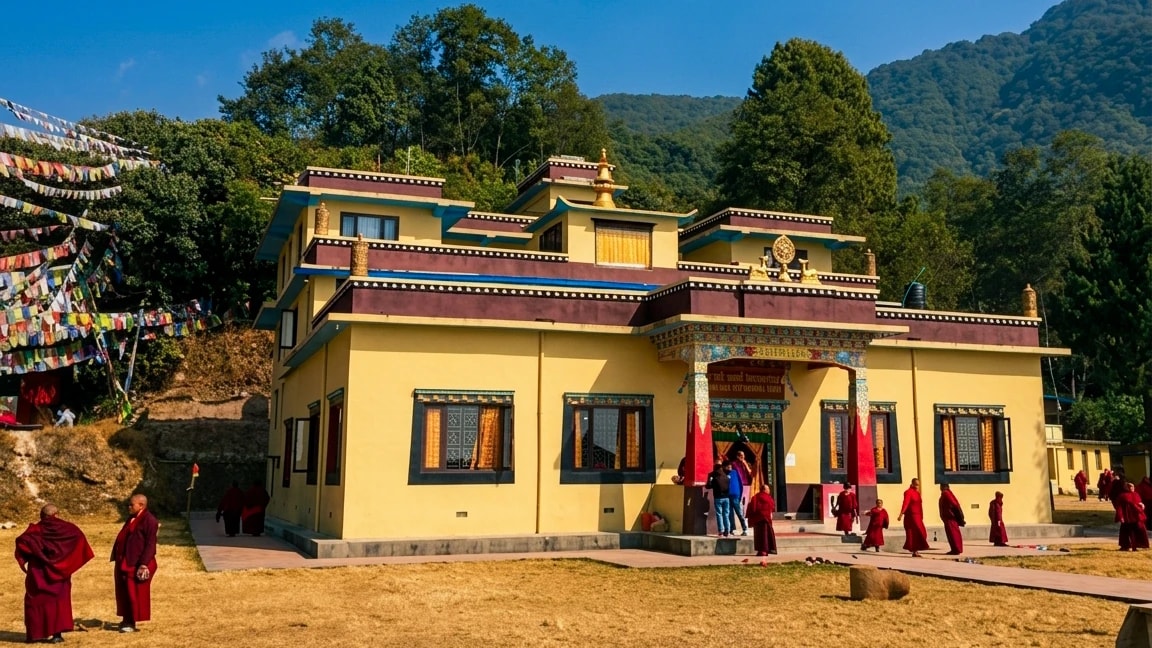
The forest opens partway up onto Nagi Gompa, a Buddhist nunnery clinging to the hillside with the valley laid out hazily below.
It is built for the thing the trail has been teaching: stillness. The nuns here arrange their days around silence and attention in a way the city has forgotten. To pause is to be reminded that the people who know this hill best do not see it as scenery. For them it is not a view. It is a discipline, a home, a practice kept daily whether or not anyone is watching.
This is the part of the climb the guidebooks miss. They will tell you the summit gives a panorama of the Himalaya on a clear day - Langtang, Ganesh Himal, the white teeth of the range. And it does. But the mountain's gift is not just the view outward. It is the small, shaded, easily missed place below the peak.
Mulkharka and Okhreni: The Villages the Bagdwar Trail Belongs To
The trail to Bagdwar does not just belong to trekkers or hikers. It also belongs to the people who have been walking it their entire lives - before the national park had a gate, before the permit system existed, before anyone thought to put it on a map.
Two villages, Mulkharka and Okhreni, sit on the Sundarijal flank of the ridge. They are Tamang-majority settlements, built into terraces that climb the hillside in slow, patient steps. From the trail you see them first as a change in the forest: cleared squares of millet, maize, and potato cut into the slope; corrugated roofs catching the light below; smoke rising thinly in the late afternoon from kitchens you cannot quite see.
Dhan Bahadur Tamang grew up in Mulkharka, the hillside village on the Sundarijal route, where his family farmed the terraced slopes that drain into the same watershed the city below depends on. He calls himself a neighbor of the forest.
"People come here and look at nature," he says. "But nature is looking back at them. This resource knows every person who has lived in this valley. It has carried all of them."
For the communities of Mulkharka and Okhreni, Bagdwar is not just a destination. It is the explanation for everything - why their ancestors settled here, why the terraces face the way they do, why the forest above their fields has always been treated as something that cannot be owned.
Why Bagdwar Is Unlike Any Other Sacred Site in the Kathmandu Valley
Bagdwar offers those who reach it something far rarer than a physical reward for a hard hike. It provides a spatial and historical recalibration that few sites in Nepal can match.
Most travelers arrive in Kathmandu and move through its heritage from the outside - photographing temples, crossing squares, watching ceremonies. Bagdwar inverts this entirely. Here, you arrive at the hidden origin of all of it: the place where the sacred geography of the valley begins, not ends.
Standing at the Tiger's Gate - watching cold, clear water pour from a stone mouth into the same river that will eventually carry cremation ash at Pashupatinath - the entire Kathmandu Valley reorganizes itself in your understanding. The UNESCO sites, the ritual bathing ghats, the palace squares: they are all downstream consequences of this small, quiet pool in the Shivapuri forest.